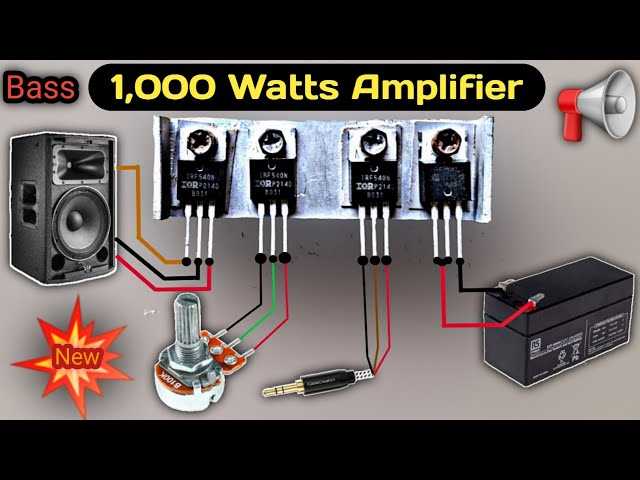
Use a robust MOSFET pair rated for at least 120V and 20A to ensure stable operation under continuous high-current loads. Employ a low-impedance heat sink with forced airflow to prevent thermal runaway and maintain signal fidelity.
Optimize the pre-stage network with a complementary transistor push-pull arrangement to maximize linearity. Adding small-value resistors in series with the input can suppress parasitic oscillations without degrading frequency response.
Choose a power supply with low ripple and a capacitor bank totaling at least 20,000µF to sustain transient peaks. Include fast diodes in parallel to reduce voltage spikes during high-output bursts.
Layout considerations: Keep high-current traces short and wide, separate from the signal path. Ground loops can be avoided by creating a star-ground topology, minimizing hum and preserving dynamic range.
Output protection: Implement both DC offset sensing and overcurrent detection circuits. Relay-based muting during power-on prevents speaker damage and ensures safe operation at maximum output levels.
High-Power Audio Module Layout
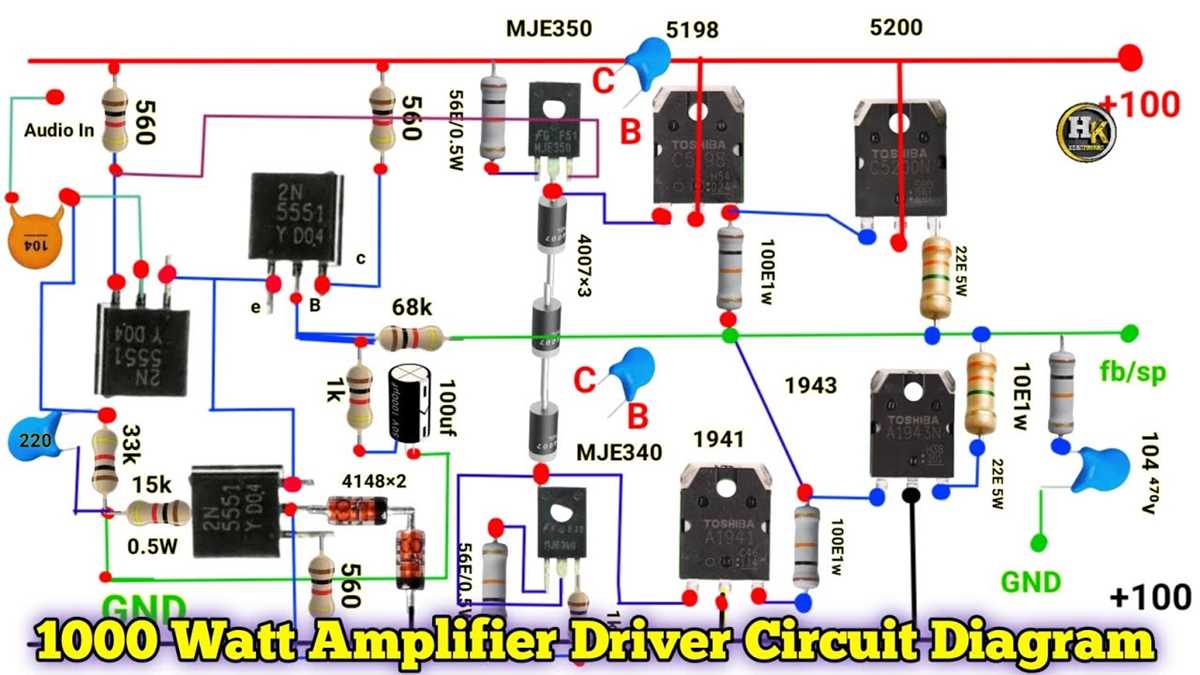
Use MOSFET transistors rated for at least 150V and 50A each to handle the energy peaks. Place large electrolytic capacitors, 22,000µF or higher, close to the output stage to stabilize voltage swings. For thermal stability, attach each power transistor to a heatsink with a thermal resistance below 0.5°C/W and include a temperature sensor to prevent thermal runaway.
For the pre-amplification section, implement a complementary pair of high-speed BJTs with a gain of around 40dB. Keep signal traces under 15 cm and separate from high-current pathways to avoid inductive interference. Use polypropylene capacitors for coupling to maintain clarity in the mid and high frequencies without introducing phase shifts.
Power Supply Layout
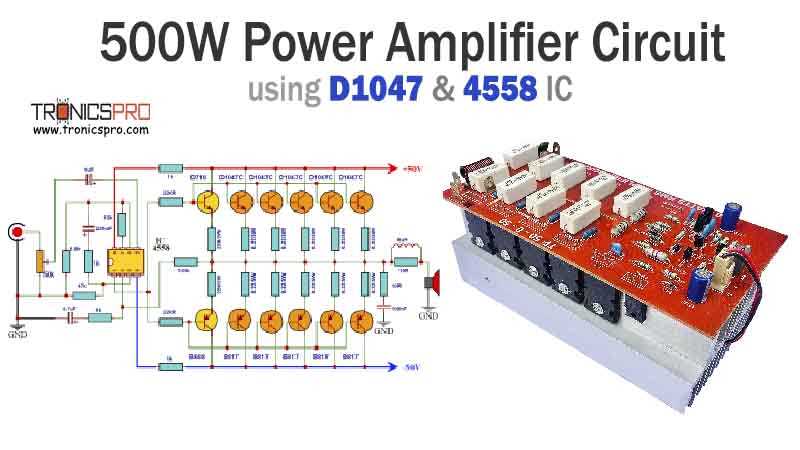
Integrate a dual-rail supply of ±70V with a toroidal transformer rated for 2 kVA. Include fast diodes with low reverse recovery time for rectification and 0.1Ω resistors in series with the filter caps to reduce inrush current. Arrange heavy gauge copper tracks for output paths to handle up to 50A continuous without significant voltage drop, and add snubber networks across the output to suppress high-frequency oscillations.
Selecting Components for a 1000W Power Stage
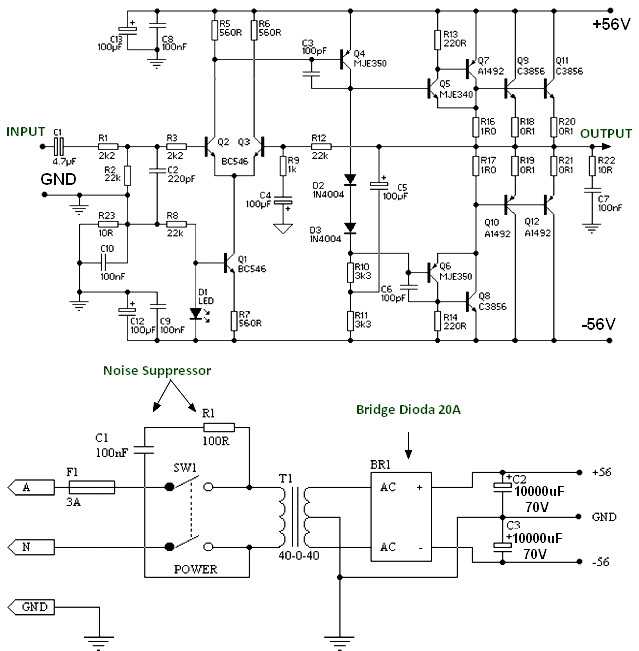
Use high-current MOSFETs with a drain-source voltage rating of at least 200V and continuous current of 50A per device. Complement these with low-RDS(on) types like IRFP460 or STW60NM50 for minimal heat generation and improved linearity under heavy loads.
Choose toroidal transformers capable of delivering 90–100A RMS on the secondary winding. Steel-core designs reduce leakage inductance, and multi-tap configurations allow fine-tuning of voltage rails between ±70V to ±80V without saturating under full load.
High-speed diodes are mandatory for the rectification stage. Select devices with reverse recovery times under 50ns and forward current ratings matching at least 120% of the peak transformer output to prevent voltage spikes and maintain signal integrity.
- Electrolytic capacitors: 4700µF–10000µF, 100V rating minimum, low ESR types for ripple suppression.
- Film capacitors: 2.2µF–4.7µF in parallel with electrolytics to improve high-frequency response.
- Thermal management: Aluminum heat sinks with 0.8–1.0°C/W rating per transistor; forced airflow recommended above 1000W RMS output.
Use precision resistors for the bias network: 0.5% tolerance metal film types rated 5W or more. Mismatched resistances can lead to crossover distortion and uneven power distribution among devices, reducing efficiency and reliability.
For interconnections, employ bus bars or heavy-gauge copper wiring to minimize voltage drop and inductive effects. Avoid thin PCB traces on high-current paths; combine with star grounding to reduce hum and oscillations under peak output.