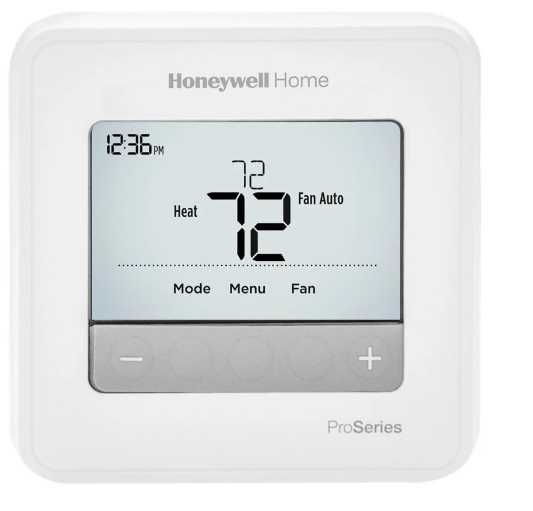
Identify all terminals on the unit and match them with the corresponding colored wires from your HVAC system. Label each conductor before making connections to prevent errors and simplify testing.
Attach power wires first, ensuring correct polarity and secure screw or push-in connections. Verify that the low-voltage supply matches the control unit specifications to avoid damage.
Connect heating and cooling signal wires according to the system type. Double-check each link for tight contact and insulation to maintain safe operation and prevent short circuits.
After completing connections, use a multimeter to confirm voltage and continuity. Test the system by activating heating and cooling modes to verify that each function responds accurately.
Connection Setup for a Honeywell Climate Controller
Attach the red lead to the R terminal for 24V power, the white wire to W for heating activation, and the yellow to Y if controlling a cooling stage. Blue or common wires should connect to C to complete the circuit. If a fan relay is present, green must link to G. Double-check each conductor’s label before energizing the unit to avoid short circuits or system faults.
For multi-stage systems, separate terminals exist for auxiliary and second-stage heating and cooling–W2 and Y2. Some models require jumpering R and Rc if the HVAC uses a single transformer. Always verify the voltage at each contact using a multimeter, and secure all screws tightly to maintain stable connections under vibration or airflow. A clear layout of each terminal connection significantly reduces troubleshooting time during operation or seasonal service.
Identifying Terminals and Wire Colors
Connect the red conductor to the R terminal to supply 24V AC. This is the main power line and should never share a connector with another voltage source. Confirm the voltage using a multimeter before proceeding.
White wires link to the W terminal, activating the heating stage. For systems with multiple stages, W2 or W3 terminals manage auxiliary heat, allowing sequential operation without overloading the primary furnace relay.
The yellow lead must attach to the Y terminal to control the compressor or cooling mechanism. If a second-stage cooling unit exists, Y2 handles that stage separately, preventing simultaneous activation of multiple compressors.
Green wires engage the fan through the G terminal. This connection bypasses heating or cooling stages, enabling independent blower operation for ventilation or air circulation without altering temperature settings.
Blue or black cables serve as the common line to the C terminal, completing the low-voltage circuit. Absence of a C wire may require a power-stealing controller or auxiliary transformer to maintain proper operation.
Some models include an Rc terminal when heating and cooling systems use separate transformers. Jumpering Rc to R is necessary only if a single transformer handles both functions, otherwise separate leads prevent backfeeding.
Label each conductor with tape and notation before disconnecting old connections. This practice avoids misidentification during installation and minimizes the risk of short circuits or blown fuses when activating the system.
Inspect each terminal’s screw and slot for corrosion or looseness. Secure attachments maintain reliable contact under vibration, temperature changes, and airflow, ensuring consistent system response and reducing maintenance calls.