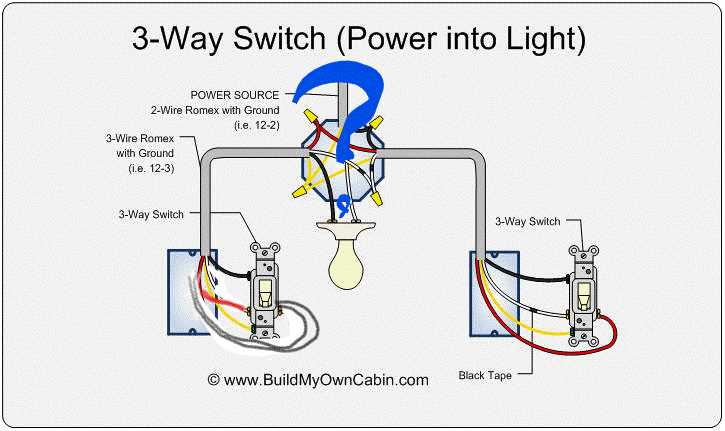
Connect two wall control units using traveler conductors so one lamp can be operated from two different locations. This setup is common in hallways, staircases, and large rooms where entry points exist at opposite sides. One control receives the incoming line voltage, while the second sends power to the lamp fixture.
Each control unit has three terminals plus a grounding screw. The dark screw marks the common terminal. Two brass screws connect traveler conductors that pass between the two wall boxes. When either control changes position, the internal contact redirects the electrical path and toggles the lamp between on and off states.
Typical cable arrangement uses 14/3 or 12/3 electrical cable depending on branch circuit rating. The black conductor usually carries the line feed or load connection. Red and white conductors act as traveler lines between both control units. Neutral conductors from the supply and the lamp fixture remain tied together inside the junction box.
Verify each conductor before installation using a voltage tester or multimeter. The incoming feed normally measures about 120 volts relative to neutral in North American residential systems. Proper identification of the line, traveler pair, and load conductor prevents wiring errors and ensures the lamp responds correctly from both control points.
3 Way Light Switch Circuit Diagram with Traveler Wire and Common Terminal Guide
Attach the incoming line conductor to the dark screw marked common on the first wall control, then connect the load conductor leading to the lamp fixture to the common terminal on the second control unit. Two traveler conductors run between the brass terminals on both devices, allowing the internal contacts to alternate the electrical path. Standard residential installations usually use 14/3 or 12/3 cable, where red and white serve as traveler lines and black carries either line feed or load depending on the box location.
Keep neutral conductors tied together inside the ceiling box and route grounding wires to the green screw on each device and metal box. With power applied, voltage across line and neutral should measure around 120 V in typical North American systems. Toggle either control lever and observe how the traveler pair redirects the current path; the lamp state changes because one control connects the common terminal to one traveler while the other unit completes or breaks the path to the load.
3 Way Light Switch Circuit Diagram with Traveler Wires and Common Terminal Connections
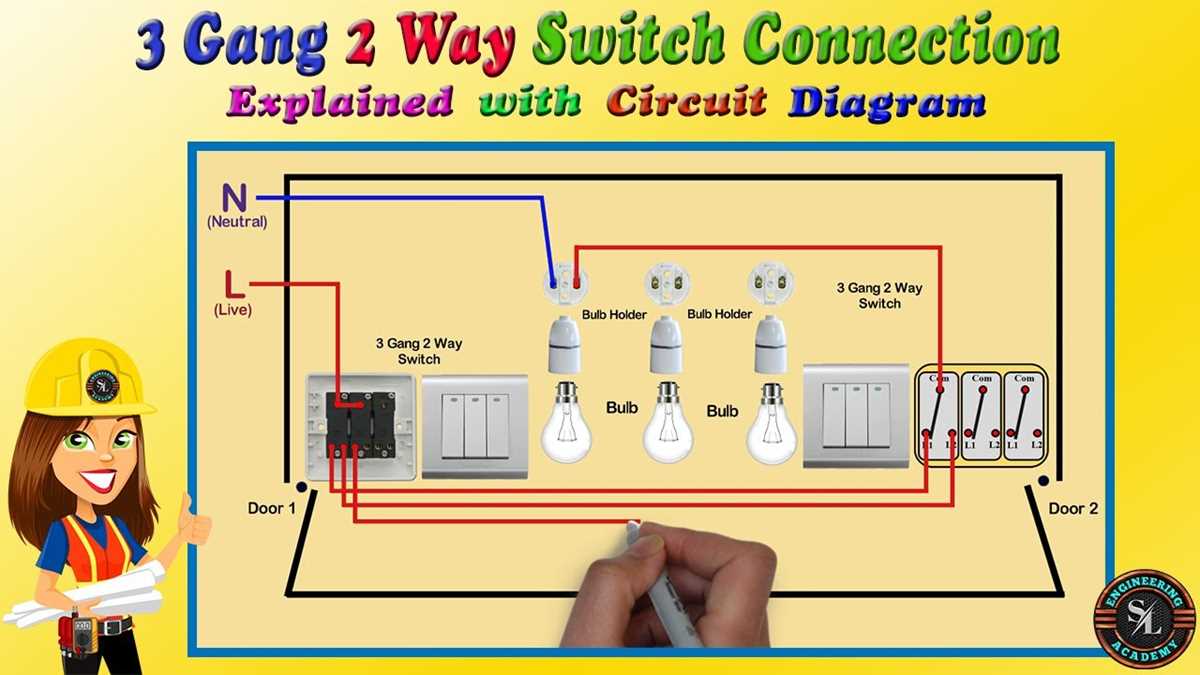
Connect the incoming phase conductor to the common terminal on the first wall control and attach the outgoing load conductor to the common screw on the second control unit. The pair of traveler conductors link the brass terminals between both devices. Use 14/3 or 12/3 cable in typical residential installations; black often carries the supply or load, while red and white serve as traveler lines. Ground conductors attach to green screws and metal boxes.
Traveler conductor routing between control units
Run the two traveler lines directly between both control boxes without splices whenever possible. Each brass terminal must connect to a separate traveler conductor so the internal contact mechanism can redirect the current path.
- Red conductor → brass terminal A on device one → brass terminal A on device two
- White conductor (re-identified with tape if used as hot) → brass terminal B on device one → brass terminal B on device two
- Ground wire → green screw on both devices and metal electrical boxes
- Neutral conductors remain tied together in the fixture box
Common terminal identification and load connection
Locate the darker screw on each device; that terminal carries either the supply conductor or the line feeding the lamp fixture. Connecting the wrong wire here causes the controls to behave unpredictably.
- Supply conductor enters the first box and attaches to the dark screw
- Two traveler lines connect to brass screws
- Second control receives the same traveler pair
- Outgoing conductor from the dark screw feeds the lamp holder
- Neutral from the panel connects directly to the lamp holder neutral lead
After wiring, restore power and test operation from both control locations. Voltage measured between phase and neutral in North American residential systems should read near 120 V. Toggling either lever redirects the path through one of the traveler lines, completing or interrupting the electrical path feeding the ceiling fixture.