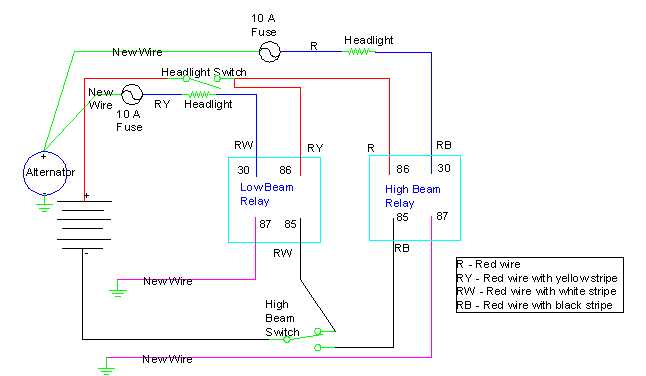
Connect the vehicle battery positive line to the main lighting control terminal through a 15–20A fuse and route the output contacts to low beam, high beam, and parking lamps. This arrangement prevents overheating of the dashboard control unit and protects the lighting harness during short circuits. Many passenger cars use 12V electrical systems with lamp loads between 55W and 65W per bulb.
The dashboard lighting selector usually contains several internal contacts that distribute current to different lamp groups. One position activates parking lights, another supplies current to the main front lamps, and an additional path connects to the high beam relay. Contact pins on the rear side of the control unit typically include battery input, parking lamp output, low beam feed, and instrument panel illumination feed.
Typical conductor colors help identify each connection. Many vehicles use red or orange for battery supply, brown or black as ground reference, green for parking lights, and blue or white for high beam feed. Following these color conventions simplifies tracing faults such as dim lamps, non-working beam selection, or intermittent illumination.
Current drawn by two 55W front lamps reaches about 9–10A at 12V. Because of this load, many systems route current through a relay module placed between the dashboard selector and the lamps. The control knob then carries only a small control current while the relay contacts handle the heavier load. This reduces wear on the internal contacts and extends service life of the lighting control unit.
Headlight Switch Wiring Diagram With Terminal Layout and Vehicle Light Connections
Connect the battery positive lead to the main lighting control unit input through a 15A–20A fuse, then route separate outputs to parking lamps, low beam lamps, and the high beam relay. This layout prevents excessive current through dashboard contacts and protects the harness during short faults. Standard automotive systems operate at 12–14.4V, while a pair of 55W front lamps draws roughly 9–10A during normal operation.
Typical Terminal Layout
Rear pins on the lighting control unit usually follow a consistent arrangement used by many manufacturers. Typical contacts include:
- BATT – constant battery supply from the fuse block
- PARK – output feeding front and rear parking lamps
- LOW – line connected to low beam relay or directly to lamp units
- HIGH – feed leading to the high beam relay or steering column selector
- ILL – dashboard illumination supply
- GND – chassis ground reference
Wire color identification simplifies tracing each connection in the lighting harness. Common patterns include red as battery supply, green or brown used by parking lamps, and blue or white used by high beam feed. Keep conductor length between the control unit and relay block as short as possible to reduce voltage drop; a drop larger than 0.5V may lower lamp brightness during nighttime driving.
Pin Layout of a Typical Headlight Switch and Function of Each Terminal
Identify the battery feed pin first and confirm voltage near 12–14.4V with a multimeter before connecting any lighting lines. This terminal usually carries constant supply from the fuse box through a 15A–20A fuse. It serves as the main source feeding all lighting positions on the dashboard lighting control unit.
The parking lamp terminal activates front marker lamps, rear tail lamps, and license plate illumination when the control knob moves to the first position. Current draw in this mode normally ranges between 3A and 5A, depending on the number of bulbs installed. A single wire typically branches into multiple lamp circuits through the vehicle harness.
Low Beam Output Terminal
The next contact supplies current to the low beam lighting path. In many vehicles this line feeds a relay coil rather than the lamps directly. Using a relay prevents high load through the dashboard control assembly. Two 55W bulbs draw around 9–10A, which exceeds the safe load of small dashboard contacts if connected directly.
High Beam Signal Terminal
This terminal sends voltage toward the steering column beam selector or directly to a relay module that activates high intensity forward lamps. The signal usually passes through a column lever mechanism that toggles between low and high illumination. A typical conductor color used here is blue or white, though manufacturers may vary.
An additional contact often feeds the instrument panel illumination line. This output powers small dashboard bulbs rated around 1–3W each. Some control assemblies include a rheostat that adjusts brightness by varying resistance in this line, allowing the driver to reduce glare during night driving.