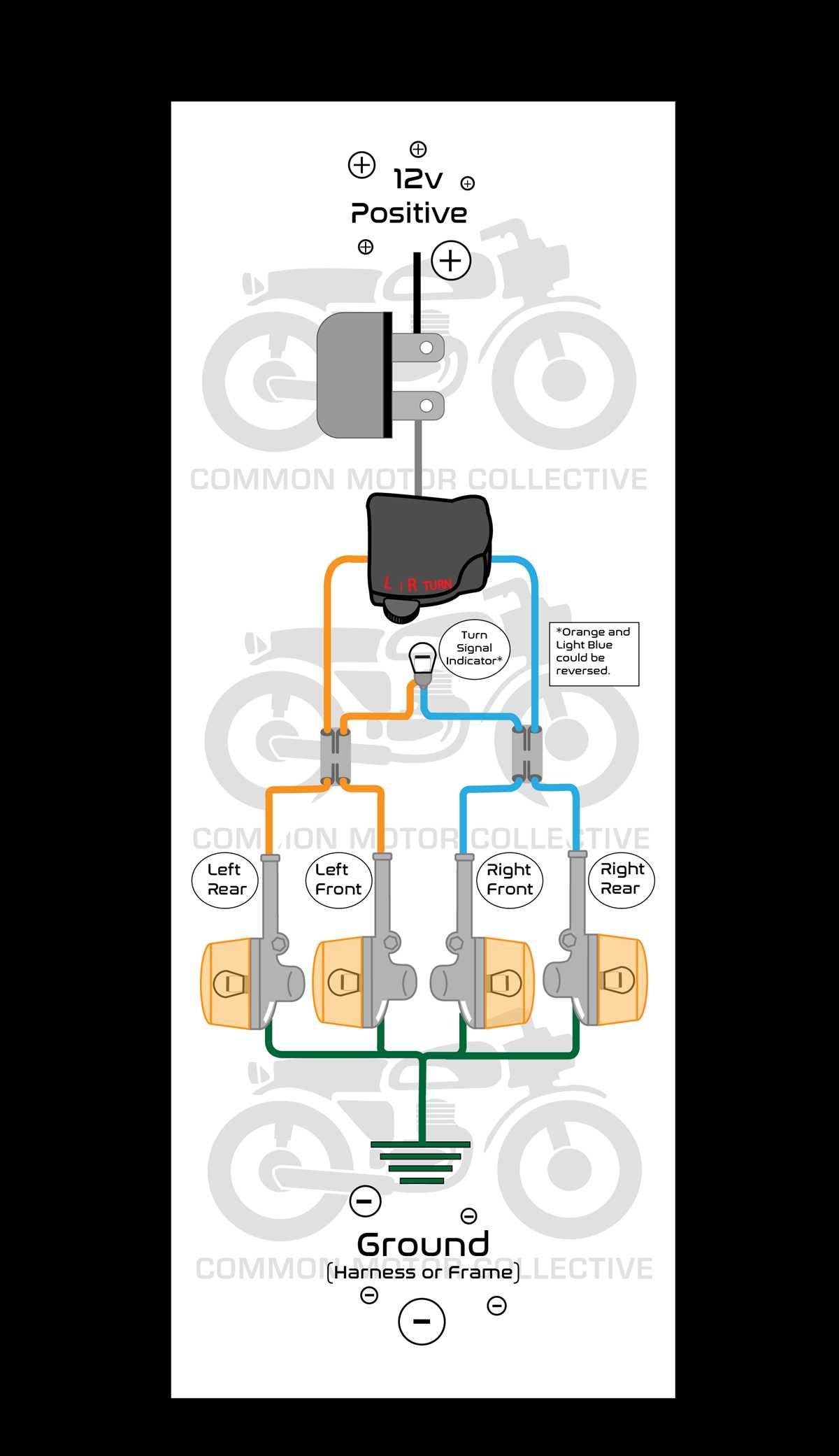
Verify polarity and voltage ratings before connecting any lamps or control units. Incorrect attachment of the positive and ground lines can result in blown fuses or short circuits. Use a multimeter to confirm continuity and ensure the relay operates at the specified 12V or 24V.
Label each conductor clearly to prevent cross-connection. Color-coded leads usually follow standard conventions: green for front lamps, yellow for rear lamps, and brown for ground. Matching the cable to the corresponding terminal reduces troubleshooting time and prevents erratic blinking.
Check resistance values on each path before final assembly. A faulty resistor or corroded connector can cause uneven illumination or failure of the warning system. Measure ohms between terminals and replace any component that exceeds recommended limits.
Secure all junctions with insulated terminals or heat-shrink tubing. Loose connections lead to intermittent operation and can generate sparks under vibration. Fasten each wire with proper clamps and avoid contact with hot engine parts to maintain longevity.
Test the complete circuit under operational conditions before reinstalling panels. Activate each directional lamp sequentially and observe current draw to confirm proper distribution. Document any deviations for immediate correction to prevent potential hazards on the road.
Turn Indicator Electrical Layout
Connect the flasher unit directly to the battery through a 15A fuse; this prevents overloads and ensures consistent blinking at 60–90 flashes per minute. Use 16-gauge copper wire for distances under 3 meters, switching to 14-gauge for longer runs to minimize voltage drop.
Branch circuits should split immediately after the fuse. Front lamps require a parallel connection with the amber bulbs rated at 21W each, while rear assemblies need dual filament bulbs rated at 21/5W for combined running and indicator functions. Avoid series connections to prevent uneven illumination.
Ground points must be clean and corrosion-free. Steel chassis points with paint removed or dedicated copper terminals reduce resistance under 0.05Ω, preventing flickering caused by high-resistance contacts. Apply dielectric grease on terminals to enhance longevity.
Include inline connectors with locking tabs at junctions; this allows easy disassembly without compromising continuity. Standard automotive spade connectors of size 6.3mm are preferred for bulbs, while 4.8mm terminals are suitable for flasher unit connections.
For vehicles with multifunction stalks, verify that the control module output matches the flasher input voltage, typically 12V nominal. Incorrect polarity can cause immediate bulb burnout or non-functional indicators, especially in LED conversions where current draw is significantly lower than halogen setups.
Test the full circuit after installation using a digital multimeter: check for voltage drop under load, continuity from the module to each lamp, and verify flashing rate under typical battery voltage (12.6–13.2V). Document the routing for future maintenance or upgrades, marking wire colors according to standard automotive codes: amber for left, green for right, and black for ground.
Identifying Wires and Connectors in Your Vehicle
Use a multimeter to check continuity before touching any connectors. Label each wire with masking tape and a fine-tip marker to prevent confusion later. Pay attention to wire gauge; thicker wires often carry higher current, while thinner wires handle signal-level tasks.
Colors are not universal. For example, a green wire might carry power in one model and ground in another. Cross-reference with the vehicle’s service manual rather than relying solely on visual cues.
Connector Types and Pins
- Blade connectors: flat metal tabs that slide into a socket, often used for lights and relays.
- Bullet connectors: cylindrical, easy to disconnect, usually insulated with colored sleeves.
- Multi-pin plugs: found on control modules, labeled with letters or numbers on the housing.
Inspect terminals for corrosion or bent pins before reconnecting. Use dielectric grease to prevent oxidation, especially on exposed terminals in the engine bay. Check the fit by gently tugging on the wire–resistance indicates a proper connection.
Tracing and Testing
- Disconnect the battery to avoid short circuits during testing.
- Follow each wire back to its source, noting any splices or junctions.
- Use a test light or continuity tester to confirm power flow and grounding points.
Keep a small notebook of observations. Recording pin numbers, wire colors, and connector locations reduces repeated errors. Even experienced mechanics rely on careful notes for complex electrical troubleshooting.