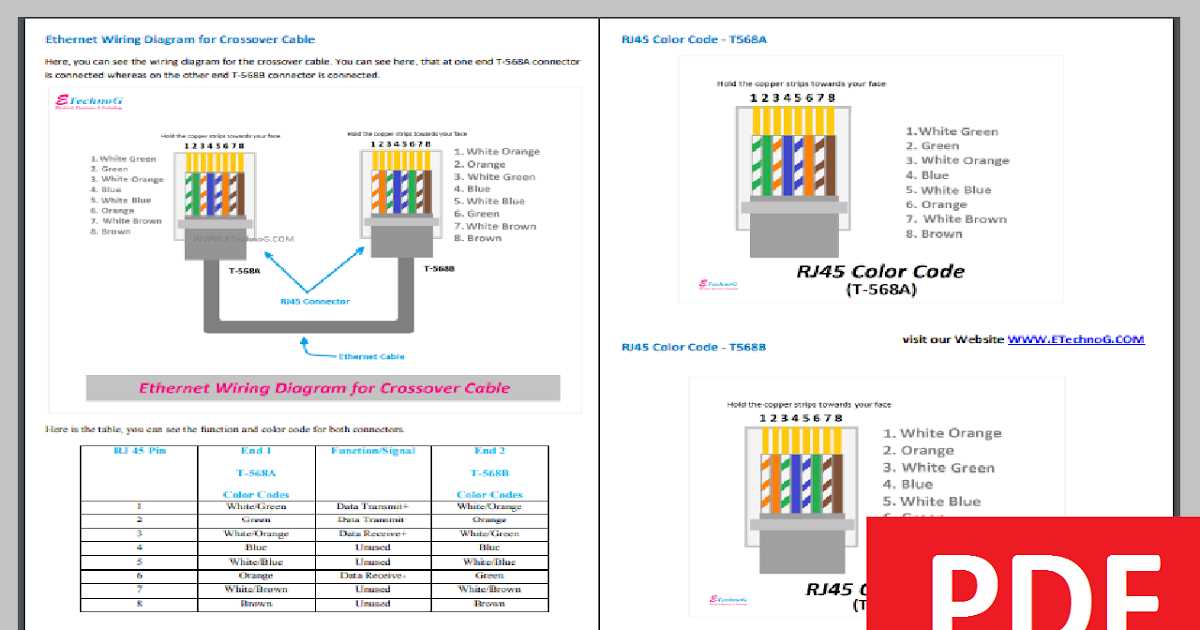
Use the T568B pin order for most home and office network cables unless the installation already follows the A layout. Both standards deliver identical data performance up to 100 MHz bandwidth, yet mixing them on opposite cable ends produces a crossover link rather than a straight network patch lead.
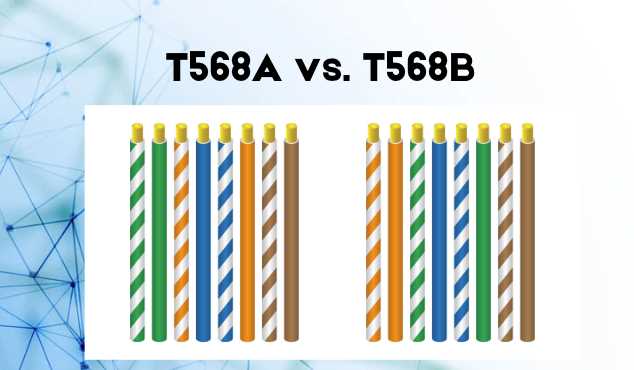
The RJ45 connector contains 8 metal contacts numbered from left to right when the clip faces downward. In the A arrangement the pair sequence begins with white-green, green, while the B arrangement begins with white-orange, orange. The remaining conductors keep the same order: white-blue, blue, white-brown, brown. Maintaining twisted pairs during termination helps preserve signal integrity and reduces crosstalk inside the copper cable.
Strip about 25 mm of outer jacket, untwist each pair no more than 12–13 mm, and align the conductors according to the chosen pin layout before inserting them into the modular plug. A crimping tool presses the gold contacts through insulation and secures the cable jacket. After termination, verify continuity with a network tester that checks all eight conductors and confirms correct pin mapping between both connectors.
Patch leads used between routers, switches, and computers normally require the same conductor order on both ends. A crossover connection appears only when one end follows A and the opposite end follows B, redirecting transmit and receive pairs for direct device-to-device communication without a switch.
Cat 5 Wiring Diagram A or B
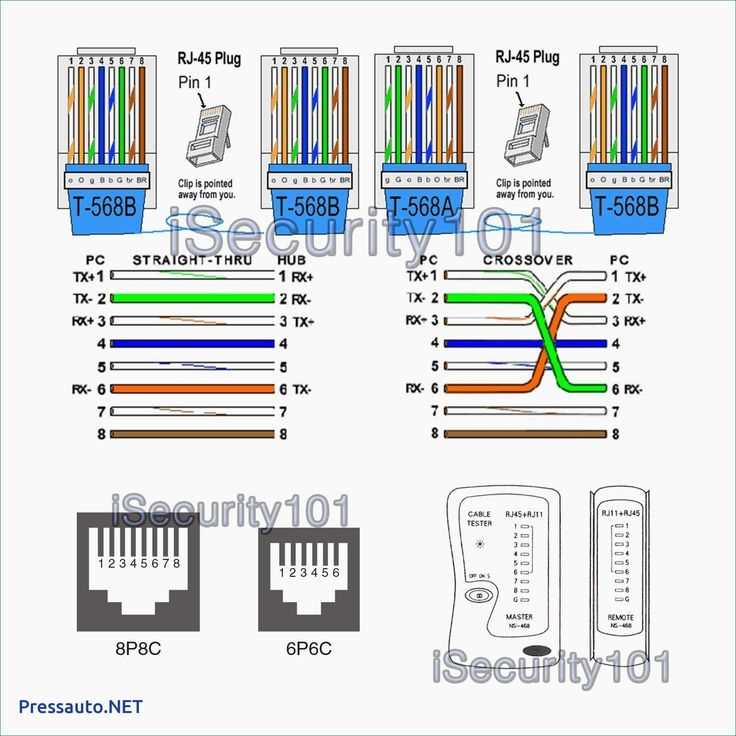
Select T568B conductor order for most Ethernet patch leads unless an existing installation follows the A layout across patch panels and wall outlets. Both arrangements carry identical electrical characteristics up to 100 MHz and support Fast Ethernet and Gigabit links through four twisted pairs inside the cable jacket. The difference lies only in the position of the green and orange pairs at the RJ45 connector. For layout A the sequence begins white-green, green, while layout B begins white-orange, orange, followed by white-blue, blue, white-brown, brown.
Align the eight conductors flat before inserting them into the modular plug so that each wire reaches the metal contact channel. Keep pair twists within 10–13 mm of the connector edge to limit crosstalk and signal loss. Both ends using the same conductor sequence produce a straight Ethernet patch cable, while one end A and the opposite end B forms a crossover lead used for direct device links without a switch.
T568A vs T568B Color Order for RJ45 Cat 5 Cable Pin Termination
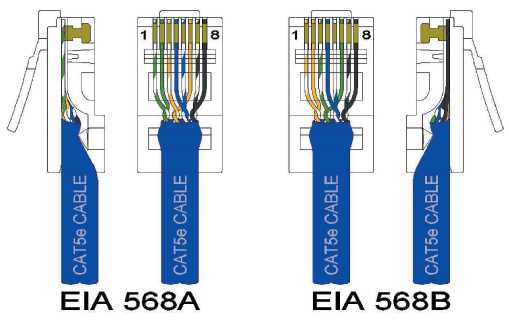
Choose one termination standard and keep the same conductor sequence on both ends of the Ethernet lead. T568A and T568B differ only in the placement of the orange and green twisted pairs, while electrical performance remains identical up to 100 MHz bandwidth. Pin numbering on an RJ45 plug runs from 1 to 8 with the retaining clip facing away.
- T568A order
- 1 – white/green
- 2 – green
- 3 – white/orange
- 4 – blue
- 5 – white/blue
- 6 – orange
- 7 – white/brown
- 8 – brown
- T568B order
- 1 – white/orange
- 2 – orange
- 3 – white/green
- 4 – blue
- 5 – white/blue
- 6 – green
- 7 – white/brown
- 8 – brown
Keep each twisted pair intact until roughly 10–12 mm from the connector entry to maintain pair balance and reduce crosstalk. Straight Ethernet leads use identical color order at both connectors, while one end A and the opposite end B creates a crossover lead that swaps transmit and receive pairs for direct device connection.