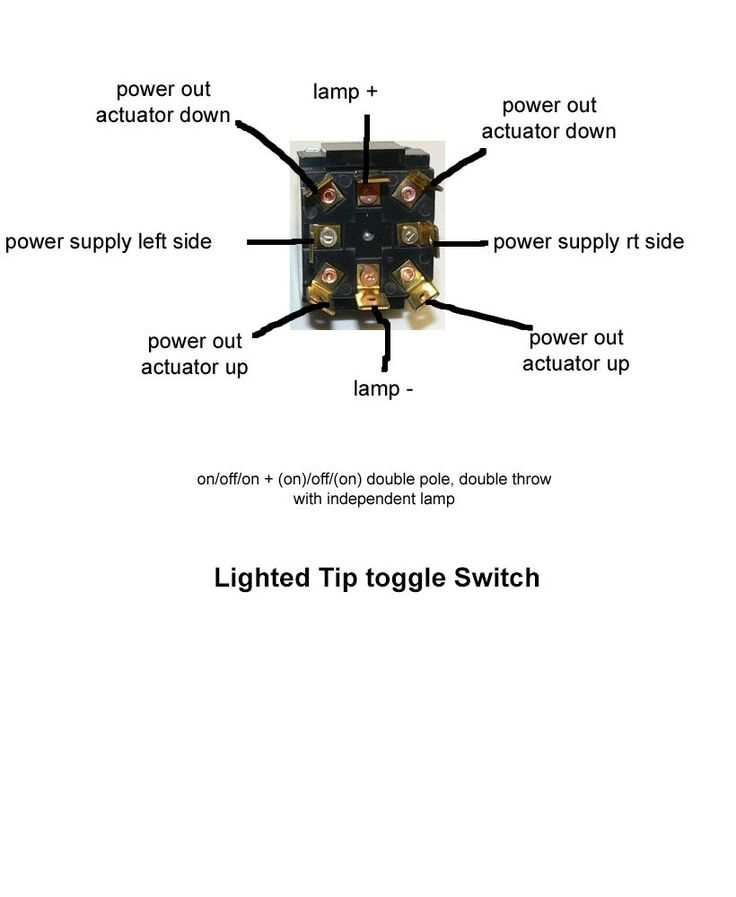
Connect the power line to the common terminal and route the load conductor through the output terminal of the panel toggle device. In most automotive and marine setups operating on 12V DC, the incoming positive lead from the battery attaches to the center contact, while the outgoing line toward the accessory connects to the adjacent output pin.
Panel-mounted toggle devices are widely used for lighting circuits, cooling fans, auxiliary sockets, and dashboard accessories. Typical models include SPST (single pole single throw) units with two terminals and SPDT (single pole double throw) versions with three terminals. The SPST version controls a single circuit path, while the SPDT type redirects current between two outputs.
Many illuminated panel controls include an internal LED or neon indicator. These versions usually require a third or fourth terminal dedicated to the indicator ground connection. In a 12-volt system, the indicator often draws less than 20 milliamps, allowing it to operate continuously while the load circuit carries several amps.
Correct terminal identification prevents contact overheating and intermittent operation. Common panel toggles used in vehicles are rated between 10A and 20A at 12V DC. Household versions designed for alternating current frequently support 15A at 120V. Always verify the rating stamped on the housing before connecting high-draw devices such as compressors or heating elements.
Short cable runs improve voltage stability in low-voltage systems. If the distance between the battery and the control device exceeds 10 feet, use thicker conductors such as 14 AWG or 12 AWG depending on load current. Thinner conductors increase resistance, which can reduce brightness in lighting circuits and create heat at the terminal contacts.
Rocker Switch Wiring Diagram With Terminal Layout and 12V 120V Connection Guide
Attach the incoming power lead to the common contact on the panel-mounted toggle control and connect the outgoing line to the load terminal. In a 12V DC system, the positive line from the battery typically goes to the center pin, while the accessory lead connects to the output contact. Ground returns directly to the battery negative or chassis. For versions with internal illumination, a separate ground terminal must be linked to chassis ground so the indicator light activates when the circuit closes.
For 120V AC circuits, route the hot conductor from the breaker panel through the panel control device while the neutral bypasses the control and connects directly to the load. Most household units support 15A at 120V, though some compact models handle only 10A. Terminal blades are usually arranged in two or three positions on the rear housing, stamped with markings such as COM, NO, or LOAD. Maintain tight crimp connectors and keep conductor insulation intact near the terminal blades to avoid arcing and overheating during repeated operation.
Pin identification and terminal layout on common rocker switches
Identify the common contact first by checking the marking stamped on the plastic housing or metal base. Most panel toggles include labels such as COM, NO (normally open), or NC (normally closed). The common contact receives the incoming power line, while the remaining terminals route current toward the controlled device.
Typical terminal layouts vary by internal contact design. The most widely used configurations include:
- Two-pin SPST – simple on off control with one input and one output
- Three-pin SPDT – one common contact and two selectable outputs
- Four-pin illuminated type – two power contacts plus two LED indicator contacts
- Five-pin automotive type – main power circuit plus internal indicator ground and supply
Examine the rear of the device to locate blade terminals arranged in rows. In many illuminated dashboard models the layout appears in the following pattern:
- Top terminal – incoming power line
- Center terminal – outgoing line toward the load
- Lower terminal – indicator ground connection
Terminal blades normally accept 0.250 inch quick-disconnect connectors. Use insulated crimp connectors rated for the circuit current. Automotive accessory circuits usually draw between 3 and 15 amps, while small LED lighting circuits often remain below 2 amps. Loose connectors increase resistance and generate heat near the terminal blades.
Confirm terminal function with a multimeter before connecting the circuit. Set the meter to continuity mode and press the actuator between ON and OFF positions. The meter should show continuity between common and output contacts only in the active position. This quick check prevents incorrect terminal placement and protects connected equipment from accidental short circuits.