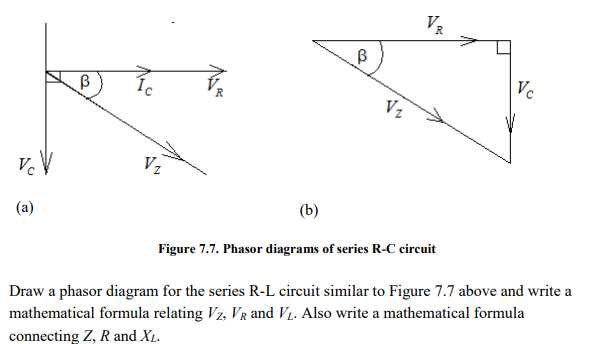
To analyze the behavior of an RC setup, use vector-based tools to represent voltage and current relationships. This approach simplifies the understanding of phase shifts and magnitudes in AC conditions.
Start by determining the voltage across the resistor and capacitor. In this type of setup, the voltage across the resistor and the current are in phase, while the voltage across the capacitor lags behind the current by 90 degrees. These relationships can be visually represented using vectors.
To create a clear representation, plot the current vector along the horizontal axis, as it is the reference point. Then, the voltage across the resistor is aligned with the current, while the capacitor voltage is depicted at a 90-degree angle from the current. This phase shift plays a crucial role in understanding how energy is stored and released within the system.
In a practical scenario, the total voltage is the sum of these components, resulting in a vector that is the hypotenuse of a right triangle. This provides insight into the overall impedance of the system, which is a combination of resistive and reactive components.
By utilizing this method, you can gain deeper insights into how the system responds at different frequencies. Adjusting frequency or resistance will alter the phase difference, which can be quickly visualized using this vector approach.
Ultimately, this technique is invaluable when designing, analyzing, or troubleshooting AC systems with reactive components. Understanding the phase differences and magnitude relationships enables better control and optimization of such setups.
RC Circuit Analysis Using Vector Representation
When analyzing an AC system with a resistor and capacitor, it’s helpful to use vector representation to understand the phase differences between the voltage and current. This method is particularly useful when working with alternating current and allows for a clearer view of the behavior of the system.
The voltage across the resistor and the capacitor are not in sync; there is a phase difference between them. The current vector is usually taken as the reference, positioned along the horizontal axis. The voltage across the resistor is in phase with the current, while the voltage across the capacitor lags by 90 degrees.
These phase shifts can be represented as vectors. The current is shown as a horizontal vector. The voltage across the resistor will align with the current vector, while the voltage across the capacitor is placed perpendicular to the current vector. This phase lag is a key characteristic in reactive components.
Vector Representation of Resistor and Capacitor Voltages
The vector corresponding to the resistor’s voltage is drawn in the same direction as the current vector. In contrast, the voltage vector for the capacitor is 90 degrees behind the current vector. This orthogonal relationship provides valuable insight into the interplay between resistive and reactive components in the system.
The total voltage across the system is the resultant of the two voltages. To find the total voltage, we use the Pythagorean theorem since the voltage components are at right angles to each other. This gives us the total voltage as the hypotenuse of the right triangle formed by the two voltage vectors.
Analyzing the Total Voltage and Impedance
This vector method is very effective in calculating the total voltage and impedance in an AC system. The impedance is the combination of both the resistive and reactive elements, which can be easily determined using the magnitude of the resultant vector.
As the frequency of the input AC signal changes, the phase relationship between the current and the voltage will shift. By adjusting the frequency, the magnitude and phase difference between the components can be altered, which can be directly observed in the vector representation. This method helps engineers and technicians quickly identify how changes in the circuit’s configuration affect overall performance.
How to Plot Voltage and Current Phasors in an RC System
To plot the voltage and current phasors in an RC system, start by setting the current vector as the reference point along the real axis. The current is generally considered in phase with itself, so its vector is drawn along the horizontal axis, pointing to the right.
Next, the voltage across the resistor is in phase with the current, so its vector is drawn in the same direction as the current. The voltage across the capacitor, however, lags the current by 90 degrees. To represent this, draw the capacitor voltage vector vertically, pointing downward (or upward, depending on the polarity) from the current vector.
The total voltage across the system is the vector sum of these two components. To find the total voltage magnitude, use the Pythagorean theorem, as the two voltage vectors are orthogonal. The resultant vector, forming the hypotenuse of the right triangle, represents the total voltage in the system.