Place a high-input-impedance buffer at the guitar input before the gain stage. A JFET or op-amp buffer with input impedance around 1 MΩ keeps the pickups from losing high frequencies and preserves the original tone. Without this stage, passive pickups interact with the next amplifier stage and reduce brightness.
The distortion character comes from an op-amp gain stage followed by diode clipping. A common configuration uses a dual op-amp such as the JRC4558 or TL072 with feedback resistors between 4.7 kΩ and 51 kΩ. Increasing the feedback ratio raises gain and pushes the signal into diode limiting earlier. Silicon diodes create sharper clipping around 0.7 V, while germanium types clip closer to 0.3 V and produce softer saturation.
Insert a passive tone network after the clipping stage to control brightness. A typical filter uses a 20 kΩ or 25 kΩ potentiometer with capacitors between 0.022 µF and 0.1 µF. Adjusting the control shifts high-frequency attenuation and lets the player match the sound to different amplifiers and speakers.
Power the device from a 9-volt supply and create a virtual midpoint using two equal resistors such as 10 kΩ with a filtering capacitor around 47 µF. This midpoint acts as the reference voltage for the op-amp stages and keeps the audio signal centered within the available headroom.
Overdrive Pedal Circuit Diagram With Op Amp Clipping Stage and Guitar Tone Control
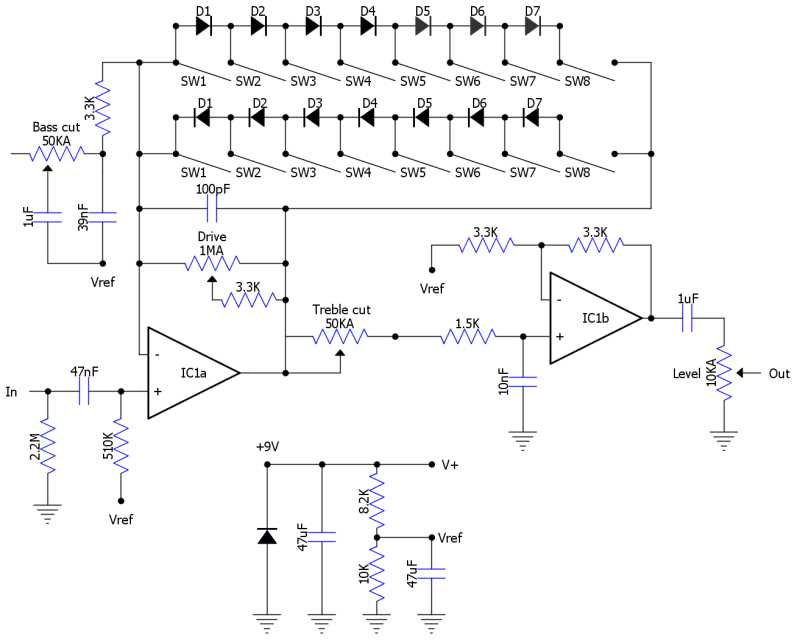
Use an operational amplifier gain block with feedback control between 4.7 kΩ and 100 kΩ to shape the amount of saturation. A common layout employs a dual amplifier such as TL072 or JRC4558 powered from a 9-volt supply. The gain potentiometer usually sits in the feedback path, letting the player adjust amplification from mild boost to heavy signal limiting.
Insert clipping diodes inside the feedback loop of the amplifier stage. Two silicon diodes connected in opposite directions limit the signal around ±0.7 V. This arrangement produces soft compression rather than harsh square-wave distortion because the amplifier reacts to the limiting components within the feedback path.
Op Amp Clipping Stage Layout
Place a coupling capacitor between the guitar input and the amplifier input pin. Values between 100 nF and 220 nF block DC while allowing full audio bandwidth. The non-inverting input normally connects to a bias reference around half the supply voltage, typically created with two 10 kΩ resistors and a filtering capacitor between 22 µF and 100 µF.
Modify clipping behavior by changing the diode type or quantity. Silicon parts provide tighter limiting, germanium devices clip earlier and sound smoother, while LED pairs raise the threshold above 1.6 V and allow stronger signal swing. Combining different diode types in asymmetrical arrangements generates harmonic imbalance that many guitarists prefer.
Insert a small capacitor across the feedback resistor, often between 47 pF and 220 pF. This component reduces high-frequency gain and prevents oscillation in the amplifier stage. Without it, the device may amplify radio interference or produce unstable high-frequency noise.
Guitar Tone Control Network
Route the signal through a passive tone filter after the clipping section. A common layout uses a 20 kΩ or 25 kΩ potentiometer combined with capacitors from 10 nF to 100 nF. Rotating the control adjusts how much high-frequency content reaches the output, allowing darker or brighter character.
Install a volume control at the final stage using a logarithmic potentiometer between 100 kΩ and 500 kΩ. This component sets the output level sent to the amplifier while maintaining signal integrity from the preceding gain section.
Add supply filtering near the amplifier chip using a 100 nF ceramic capacitor in parallel with a 47 µF electrolytic capacitor. These parts stabilize the power rail and suppress switching noise from adapters or batteries, keeping the audio signal clean during high gain operation.
Op Amp Gain Stage and Diode Clipping Layout in an Overdrive Pedal Circuit
Place the operational amplifier in a non-inverting gain configuration and control amplification through the feedback network. A typical arrangement uses a fixed resistor around 4.7 kΩ between the inverting input and ground, while a variable resistor between 50 kΩ and 500 kΩ sits in the feedback path. This structure allows the player to adjust amplification across a wide range while maintaining stable input impedance for guitar pickups.
Select an audio-friendly amplifier chip with low noise and moderate slew rate. Popular choices include:
- JRC4558 dual amplifier widely used in classic guitar devices
- TL072 with JFET inputs and low bias current
- NE5532 for strong output drive and low distortion
Bias the non-inverting input at half the supply voltage so the audio waveform can swing in both directions. A voltage divider made from two equal resistors, often 10 kΩ each, produces this midpoint reference. Add an electrolytic capacitor between 22 µF and 100 µF from the midpoint node to ground to stabilize the reference level.
Insert a coupling capacitor at the input stage to block DC from the guitar source. Typical values range from 100 nF to 470 nF. The capacitor works with the input impedance to form a high-pass filter that keeps low-frequency roll-off below the guitar range.
Arrange clipping components across the feedback path of the amplifier. Two diodes connected in opposite directions limit signal amplitude once the gain stage pushes the waveform beyond the diode threshold. The amplifier then compresses peaks smoothly instead of producing abrupt square edges.
Common diode choices change the character of the saturation:
- Silicon parts such as 1N4148 with forward voltage near 0.7 V
- Germanium types around 0.25–0.35 V for earlier limiting
- LED pairs near 1.6–2.0 V allowing larger signal swing
Add a small capacitor across the feedback resistor to control high-frequency amplification. Values between 47 pF and 220 pF limit gain at very high frequencies and reduce oscillation that may appear with long cable connections or high gain settings.
Route the amplifier output through another coupling capacitor, typically 1 µF to 4.7 µF, before sending the signal toward the tone network and level control. This stage removes DC offset created by the bias network and keeps the following audio stages centered around ground potential.