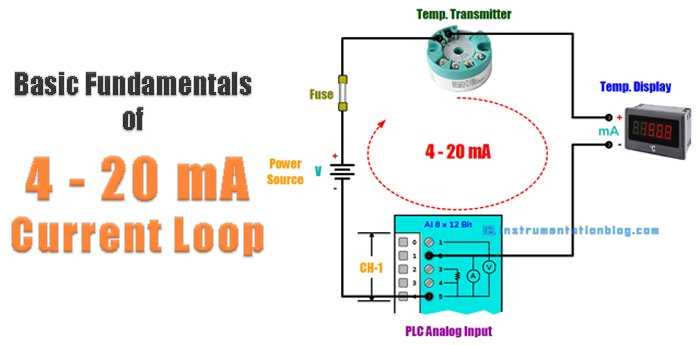
Use an op-amp controlled loop driver with a precision sense resistor if you need a stable 4 to 20 mA industrial signal link. A resistor with 0.1% tolerance and low temperature drift (25 ppm/°C or lower) keeps the output level predictable across temperature changes. Pair it with a rail-to-rail operational amplifier powered from 12–24 V so the control stage can regulate the output across the full loop range.
The typical configuration uses a voltage reference, amplifier stage, transistor pass element, and sensing resistor. The amplifier monitors the voltage across the sensing resistor and adjusts the transistor so the loop level matches the control voltage. For example, a 250 Ω sensing resistor produces 1 V at 4 mA and 5 V at 20 mA. These values simplify calibration and allow direct interaction with many analog measurement inputs.
Industrial transmitters rely on this method because a milliamp loop travels long distances with little signal loss. Cable runs exceeding 500 meters remain usable while maintaining measurement accuracy. The loop also tolerates electrical noise common in factories, motor drives, and relay switching environments.
A practical design also includes reverse polarity protection, transient suppression, and filtering. A TVS diode across the loop terminals protects against surge events, while an RC filter at the control input suppresses high-frequency noise that may disturb regulation. With correct component selection and stable reference voltage, the loop driver maintains precise signal levels required for pressure, temperature, and flow transmitters used in automation systems.
4-20mA Current Source Circuit Diagram with Working Principle and Component Selection
Select an operational amplifier paired with a precision sensing resistor if a stable industrial loop driver is required. The amplifier compares a control voltage with the voltage developed across the resistor and regulates a transistor or MOSFET pass element. This feedback keeps the loop signal proportional to the control input, allowing accurate transmission through long cables.
The operating principle relies on feedback regulation. A reference voltage applied to the amplifier input sets the target level across the sense resistor. If the measured voltage drops, the amplifier increases drive to the pass transistor. If the measured voltage rises, the drive decreases. This closed control loop maintains the programmed milliamp level through the external line and load.
Typical Functional Structure
A common layout contains four blocks: precision reference, amplifier stage, pass transistor, and measurement resistor. The resistor converts loop flow into voltage so the amplifier can monitor it. For example, a 250 Ω resistor produces 1 V at the lower signal level and 5 V at the upper level, which fits well within many analog control ranges.
Choose an operational amplifier with low offset voltage and stable drift characteristics. Offset below 100 µV prevents noticeable output deviation. Devices designed for instrumentation applications, such as rail-to-rail amplifiers operating from a single 12–24 V supply, maintain proper control even when the loop voltage drops under heavy load.
Component Selection Guidelines
The sensing resistor directly defines signal accuracy. Metal film types with 0.1% tolerance and temperature drift below 25 ppm/°C reduce measurement deviation in industrial environments. Power rating must exceed the expected dissipation; a 250 Ω resistor at 20 mA dissipates 0.1 W, so a 0.25 W or 0.5 W part provides margin.
The pass element must handle loop voltage and thermal load. A small signal NPN transistor works for moderate loads, while a logic-level MOSFET lowers power loss in higher voltage installations. Ensure the device supports at least 40–60 V drain or collector rating when used in industrial automation systems powered from 24 V supplies.
Add protective elements such as a transient suppression diode across the output terminals and a series resistor at the control input. These parts reduce damage risk during surge events and suppress electrical noise produced by motors, relay contacts, and long cable runs used in factory instrumentation networks.
Basic 4-20mA Current Source Circuit Diagram Using Op Amp and Transistor
Use a precision operational amplifier controlling an NPN transistor with a sensing resistor placed in the emitter path if a stable industrial signaling loop is required. The amplifier monitors voltage across this resistor and adjusts the transistor drive so the flow through the external line matches the control input. With a 250 Ω resistor, the amplifier regulates the emitter voltage between roughly 1 V and 5 V, corresponding to the typical industrial signaling range.
The amplifier output connects to the transistor base through a resistor between 1 kΩ and 4.7 kΩ, limiting base drive while maintaining stable regulation. The transistor collector connects to the positive supply, commonly 12 V or 24 V used in automation systems. The load and transmission line connect in series with the emitter resistor. Feedback from the emitter node returns to the inverting amplifier input, while the control voltage enters the non-inverting input. This arrangement forms a closed regulation loop where the amplifier continuously adjusts transistor conduction so the voltage across the sensing element tracks the control signal.
Select a transistor capable of handling the expected voltage drop and thermal dissipation. In a 24 V installation with a 500 Ω total load, power dissipation may approach 0.4 W at the upper signal limit, which requires a device rated above 1 W or mounted with small thermal relief. Pair the design with a low-offset amplifier and a metal-film resistor with 0.1% tolerance to keep signal deviation small across temperature shifts commonly present in industrial measurement equipment.