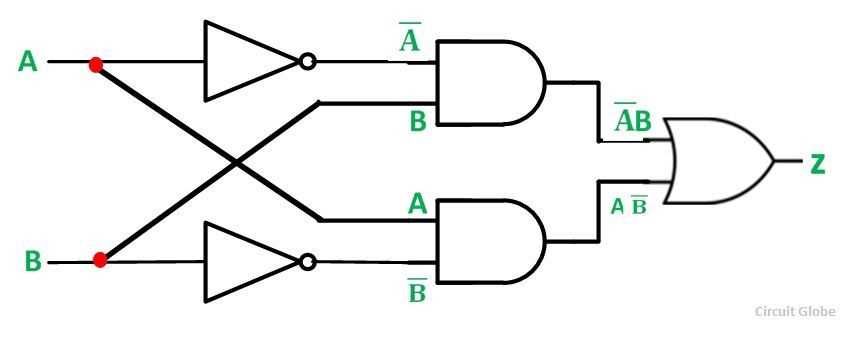
Use a two-input OR element built with diodes and a pull-down resistor when you need a simple hardware implementation that outputs a high signal whenever at least one input line carries voltage. A common arrangement connects each input through a diode to the output node, while a resistor links the node to ground. If any input rises above the threshold, current flows through its diode and the output becomes high.
This arrangement works reliably with low-voltage digital systems such as 5 V TTL-compatible designs. Select diodes with low forward voltage (for example 1N4148) to keep the output level close to the input level. The resistor typically ranges between 4.7 kΩ and 10 kΩ; lower values increase noise tolerance, while higher values reduce current draw.
For transistor-based implementations, two NPN transistors can feed a shared collector node through separate base resistors. Each base receives an input signal. When any base reaches roughly 0.7 V, the transistor conducts and pulls the collector line high through the supply resistor. This configuration allows integration with switching stages and improves signal isolation compared with a diode network.
In integrated digital systems, chips such as 74HC32 already contain four OR-type switching elements. Each unit accepts two inputs and produces a high output whenever one or both inputs carry a high level. Supply voltage commonly ranges from 2 V to 6 V, and propagation delay is typically under 10 ns in modern CMOS versions.
Carefully route input lines and keep trace lengths short to reduce noise pickup. Place a 0.1 µF bypass capacitor near the power pins of any integrated component, and confirm that input voltages stay within the permitted range of the chosen device family.
OR Boolean Operation Transistor Layout
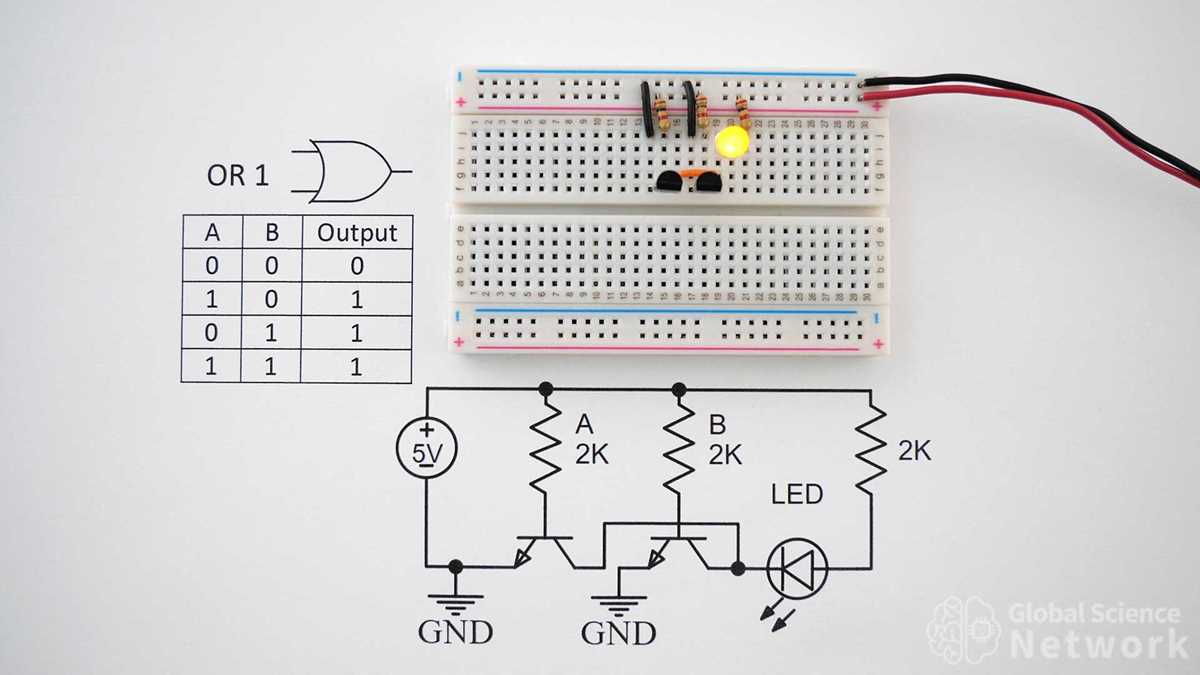
Use a two-input semiconductor arrangement where the output node connects to Vcc through parallel switching elements. If either input line carries a high level (for example 5 V in TTL-compatible systems or 3.3 V in modern microcontroller boards), the output immediately rises to the supply level. A practical build with discrete components uses two NPN transistors such as 2N3904, each base driven through a 4.7 kΩ resistor. The collectors join together and connect to a 1 kΩ pull-up resistor tied to the supply rail.
When drawing the schematic representation, place the two input lines on the left and route each through a base resistor toward its transistor. The emitters connect to ground. The combined collector node becomes the output. Label the voltage rails clearly: Vcc at the top and GND at the bottom. This arrangement reflects the Boolean rule: output becomes high if input A = 1, input B = 1, or both simultaneously equal 1.
For CMOS implementation, two p-channel MOSFETs arranged in parallel between the output node and the positive rail provide the same function. Complementary n-channel devices form the lower network. A common example uses 2N7002 for the n-channel side and BSS84 for the p-channel side in small experimental boards. With a 5 V supply, propagation delay typically stays below 20 ns in discrete builds when trace length remains under 5 cm.
Truth behavior can be verified with a simple table. If A=0 and B=0, the output remains 0 because no conduction path exists to the positive rail. When A=1 and B=0, the first switching element activates and the output jumps to the high level. When A=0 and B=1, the second element performs the same role. If both equal 1, parallel conduction occurs, reducing resistance and stabilizing the output near Vcc.
During layout preparation, keep the output trace short and add a 100 nF decoupling capacitor between supply and ground within 10 mm of the devices. This reduces voltage spikes that appear when input states change rapidly. Breadboard prototypes often show unstable output if the pull-up resistor exceeds 10 kΩ or if input wires exceed 20 cm.
Testing requires only a bench supply, two toggle switches for inputs, and a multimeter or LED indicator on the output node. With a 330 Ω series resistor and a standard red LED, illumination appears whenever at least one input line carries the high level, confirming correct Boolean OR behavior in the hardware arrangement.
How to Read an OR Boolean Symbol: Inputs and Output Representation
Identify the curved input side and the pointed exit side of the OR symbol on the schematic drawing. Two or more signal lines enter the concave edge, while a single line leaves the pointed edge. Each entering line represents a binary signal, commonly labeled A, B, or similar. If any incoming line carries a HIGH state (1), the outgoing line becomes HIGH; only a full set of LOW states (0,0 or more zeros) produces a LOW result.
Symbol Recognition
The OR symbol appears as a shape with a smooth concave left boundary and a tapered right edge. Input conductors connect to the curved boundary without crossing. Labels placed near those conductors specify signal names. In many engineering drawings the outgoing conductor is marked with Y, F, or OUT. Some schematics add a small bubble at the exit point; that bubble indicates inversion, converting the device into a NOR variant. Absence of that bubble means the output follows standard OR behavior.
Trace each incoming path carefully. If three lines connect to the curved side–A, B, and C–the resulting expression becomes Y = A + B + C, where the plus sign represents Boolean addition rather than arithmetic. Under this rule the output becomes 1 for combinations such as 1-0-0, 0-1-0, 0-0-1, or 1-1-0. Only the state 0-0-0 produces 0 at the exit conductor.
Input and Output Reading Method
Follow the wiring from left to right on most electronic schematics. Each entering line carries a binary level delivered from switches, sensors, or preceding components. The tapered exit line transports the resulting state toward another device symbol or a measurement point. Engineers often place small dots at junctions where wires connect; absence of the dot means lines merely cross without electrical contact.
Use signal tables while interpreting the drawing. For a two-input OR element, list four combinations: 00, 01, 10, 11. The resulting output sequence becomes 0, 1, 1, 1. This table helps verify whether the schematic connection matches the intended Boolean function and prevents wiring mistakes during board layout or troubleshooting.