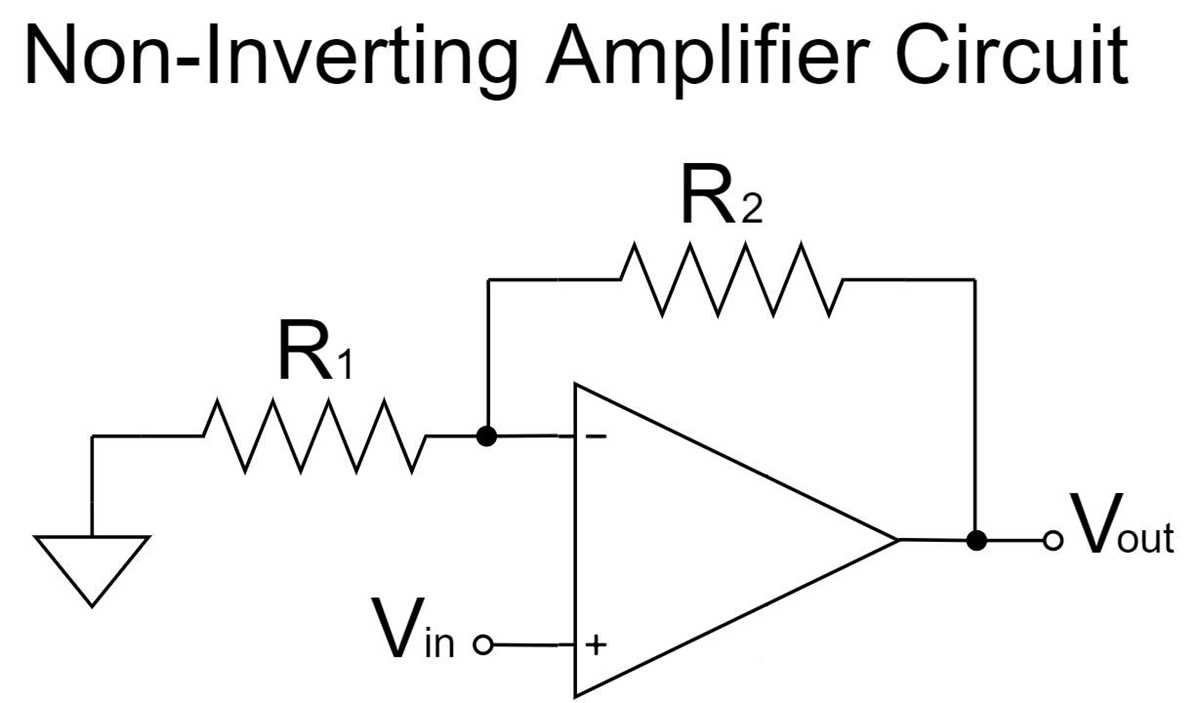
Connect the input signal to the positive terminal of the operational amplifier while routing the feedback network to the negative terminal. This configuration keeps the output waveform in the same phase as the input signal. A resistor pair connected between the output and ground determines voltage gain.
Use the gain relationship Av = 1 + (Rf / Rg). The resistor connected between output and negative terminal is usually labeled Rf, while the resistor connected between the negative terminal and ground is Rg. For example, if Rf equals 90kΩ and Rg equals 10kΩ, the voltage gain becomes 10.
Choose operational amplifier models that match supply voltage and bandwidth requirements. Common devices used in small signal amplification include LM358, TL071, TL072, and NE5532. These integrated components operate from supply rails between 5V and ±15V depending on the design.
Place a coupling capacitor at the signal input when the source contains DC offset. Values from 0.1µF to 10µF are common for low-frequency signals. Add a bypass capacitor near the supply pins of the integrated device, typically 0.1µF ceramic, to stabilize operation and reduce noise.
Non Inverting Op Amp Circuit Diagram with Gain Calculation and Feedback Resistor Layout
Connect the signal source to the positive input of the operational amplifier and place the feedback network between the output and the negative input. This arrangement keeps the output waveform in phase with the incoming signal while allowing precise voltage gain control through two resistors.
Calculate voltage gain using the relationship Av = 1 + (Rf / Rg). Rf connects the output to the negative input, while Rg connects the negative input to ground. Select resistor values based on the required amplification level and available supply voltage.
- Rf = resistor between output and negative input
- Rg = resistor between negative input and ground
- Voltage gain increases as Rf becomes larger
- Lower Rg values raise amplification factor
Example calculation using typical component values: if Rf equals 47kΩ and Rg equals 4.7kΩ, the gain becomes 11. This level suits microphone preamplifiers, sensor signal conditioning, and low-level analog sources that require moderate voltage increase before further processing.
- Input signal enters through coupling capacitor
- Positive input receives the source waveform
- Feedback network sets amplification ratio
- Integrated operational device increases voltage level
- Output feeds the next stage or load
How to Calculate Gain in a Non Inverting Op Amp Using Feedback Resistors
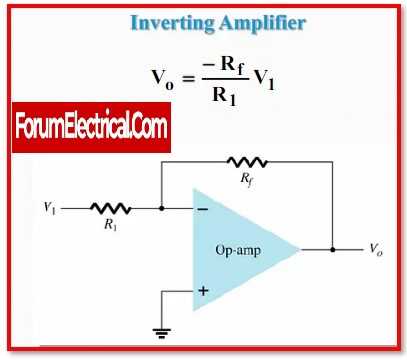
Use the formula Av = 1 + (Rf / Rg) to determine voltage amplification in a positive input operational amplifier stage. Rf represents the resistor connected between output and the negative input terminal, while Rg connects the negative input to ground. The ratio between these two resistors sets the multiplication factor applied to the incoming signal.
Practical gain calculation example
Select resistor values that produce the required amplification without pushing the device toward output saturation. If Rf equals 100kΩ and Rg equals 10kΩ, the gain becomes 11. A signal entering at 0.2 volts will appear at the output near 2.2 volts, assuming the supply rails allow this level.
Maintain resistor values within common ranges used in operational amplifier feedback networks. Values between 1kΩ and 220kΩ keep current levels stable while reducing noise pickup. Extremely high resistance may introduce instability, while very low resistance increases current draw from the output stage.
Gain adjustment through resistor ratio
Modify amplification by changing the feedback resistor while keeping the ground resistor fixed. Doubling the value of Rf doubles the contribution of the feedback path, increasing overall gain. Lowering Rg produces the same result, though excessively small values load the output stage of the integrated device.