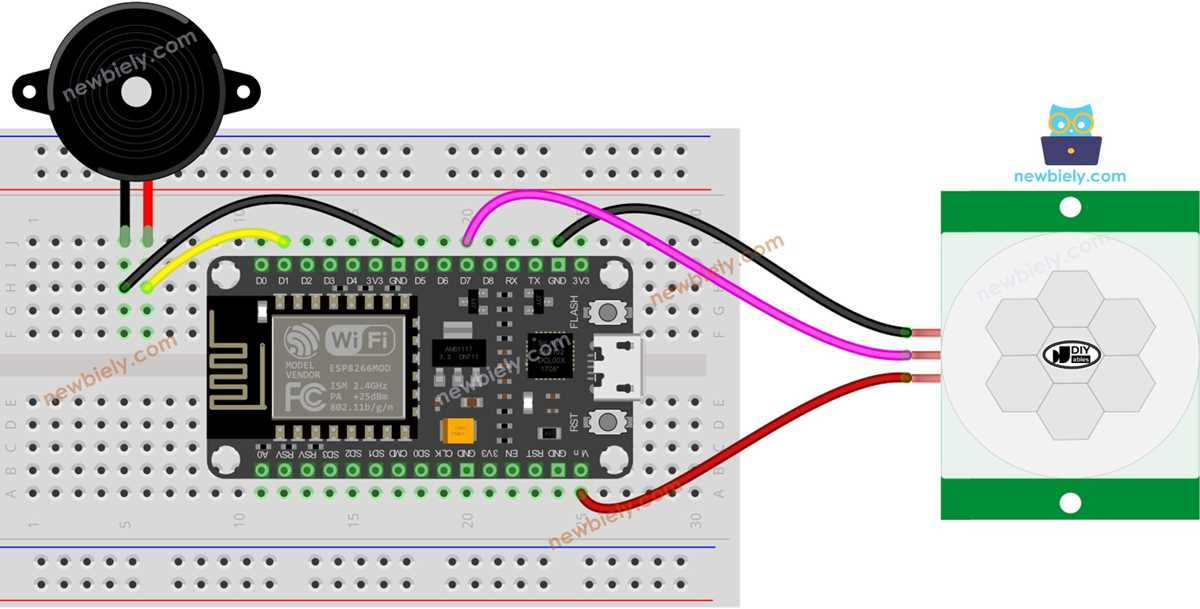
Connect the PIR detection module to a stable 5V or 12V DC supply depending on the board specification. Most compact PIR units operate at 5–20V DC and provide a digital output that changes from LOW to HIGH when body heat movement is detected within the sensing zone. Use a regulated power unit to avoid false triggers caused by voltage fluctuation.
The PIR module usually includes three terminals labeled VCC, OUT, and GND. Attach the positive supply to VCC and the negative lead to GND. The OUT pin carries the detection signal that can drive a transistor stage or logic input. Output voltage typically rises close to the supply level for several seconds after movement appears in front of the Fresnel lens.
Use a transistor stage such as 2N2222 or BC547 when switching higher loads like lamps or alarms. Connect the module output through a 1k–4.7k resistor to the transistor base. The transistor then controls a relay coil rated for the required load voltage. Add a flyback diode across the relay coil to protect the transistor from voltage spikes.
The sensing range normally reaches 5–7 meters with a detection angle close to 100–120 degrees depending on the lens design. Adjust two onboard potentiometers to change sensitivity and output hold time. One control adjusts the detection distance, while the other sets the output duration from roughly 3 seconds to 5 minutes.
Mount the PIR module about 2–2.5 meters above floor level for stable detection across a room or corridor. Avoid pointing the lens directly at heating vents, windows with strong sunlight, or air conditioners, since rapid temperature changes may trigger unwanted output pulses.
Motion Sensor Circuit Diagram with PIR Module Pinout and Relay Connection
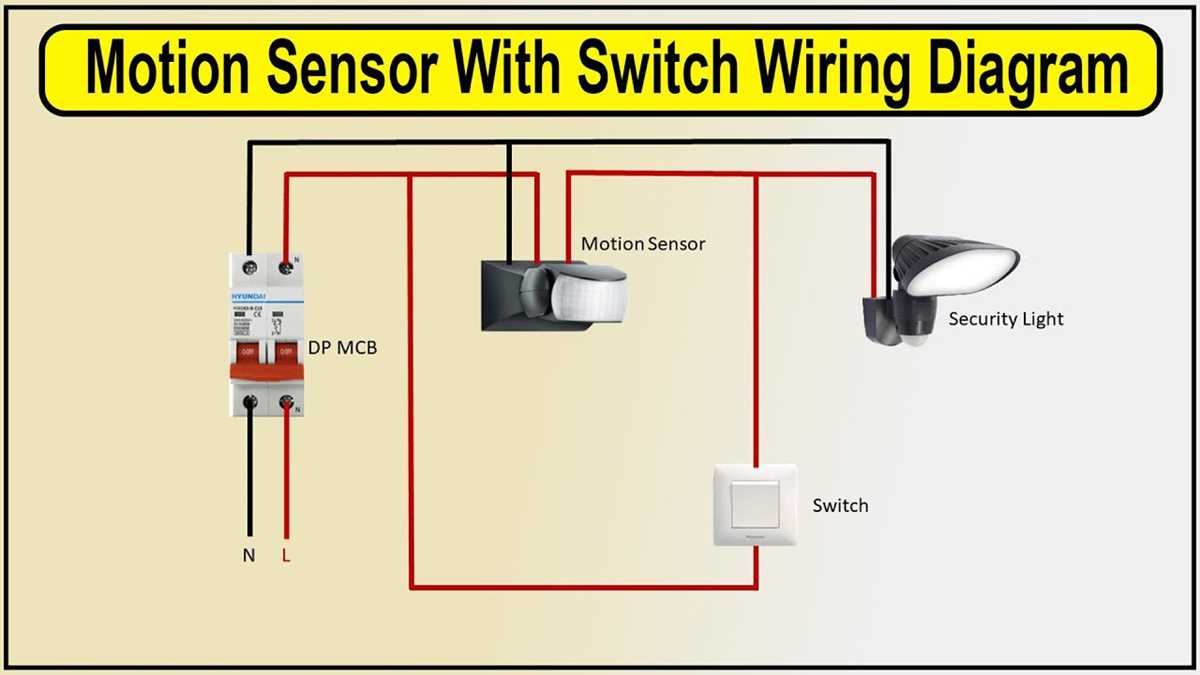
Connect the PIR detection module to a regulated DC supply between 5V and 12V depending on the board specification. Most modules include three terminals labeled VCC, OUT, and GND. Attach the positive supply lead to VCC and the negative line to GND. The OUT pin delivers a digital signal that rises close to the supply level when a warm body passes through the detection field.
PIR module pin layout and signal behavior
The module output remains LOW during idle conditions and switches HIGH once infrared changes appear across the sensing element. Typical signal duration ranges from 3 seconds to 300 seconds depending on the delay adjustment potentiometer. Standard connections include:
- VCC connected to regulated DC supply
- GND connected to common ground
- OUT connected to transistor base or microcontroller input
Use a transistor stage to control devices drawing more current than the module output can handle. A small NPN device such as BC547 or 2N2222 works well for driving relay coils rated between 5V and 12V. Connect the module output to the transistor base through a 1k–4.7k resistor to limit base current.
Relay driver connection layout
The transistor then controls the relay coil that switches lamps, alarms, or other loads. Typical connection order appears below:
- PIR module output connected to base resistor
- Base resistor connected to transistor base
- Emitter connected to ground
- Collector connected to one side of relay coil
- Other side of relay coil connected to DC supply
- Flyback diode installed across the relay coil terminals
The flyback diode prevents voltage spikes produced when the relay coil releases. Without this diode the transistor may fail after repeated switching cycles.
Install the PIR module roughly 2 to 2.5 meters above floor level and aim the Fresnel lens toward the monitored area. Typical detection coverage reaches 5–7 meters with a horizontal field close to 110 degrees. Avoid pointing the lens toward heating vents or windows receiving direct sunlight, since temperature shifts can cause false triggering.
PIR motion sensor pin connections and power supply layout
Connect the PIR module power pins to a stable DC source rated between 5V and 12V. Attach the positive line to the terminal labeled VCC and the negative line to GND. Use a regulated adapter or DC regulator module because unstable voltage can cause random output pulses or irregular triggering.
The module normally includes three main connection points. The VCC terminal feeds the internal amplifier and detection element, the GND terminal completes the power path, and the OUT pin delivers the detection signal. When a warm body moves through the infrared detection field, the output voltage rises close to the supply level for a preset time interval.
Typical PIR module pin arrangement
Many compact PIR boards follow a simple three-pin layout positioned along one edge of the board:
Pin 1 – VCC power input
Pin 2 – OUT signal output
Pin 3 – GND reference connection
Place a 100 µF electrolytic capacitor across the VCC and GND pins when the module shares a supply with relays or other switching loads. This capacitor stabilizes the supply line and reduces noise that can interfere with the internal amplifier stage.
Route the OUT pin to the control stage that drives the load. For small logic applications, connect it directly to a microcontroller input. For higher power loads such as lamps or alarms, route the signal through a transistor stage that controls a relay coil.
Power distribution layout for stable operation
Keep power conductors short and use copper leads sized around 22–20 AWG. Long thin conductors increase voltage drop and may cause unstable detection. Mount the module away from heat sources such as radiators, power supplies, or sunlight entering through windows, because strong temperature gradients can trigger unwanted output signals.