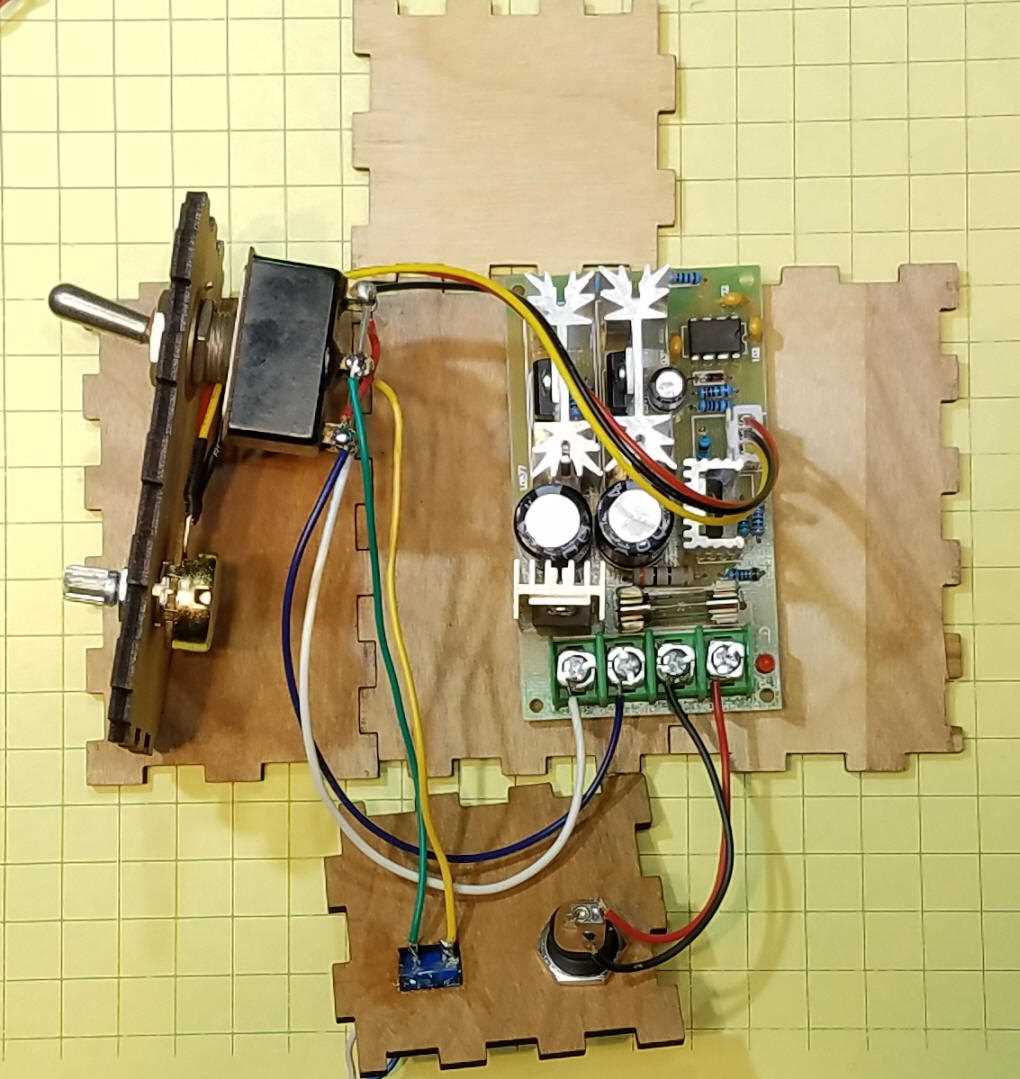
Use a 12–16 V DC track power supply with adjustable output so the locomotive speed can be varied smoothly. A small transformer rated around 1–2 A combined with a bridge rectifier and filter capacitor provides stable voltage for the rails. Without a regulated source, miniature train motors respond abruptly and low-speed movement becomes difficult.
Speed adjustment usually relies on a potentiometer connected to a transistor or voltage regulator stage. Rotating the knob changes the voltage delivered to the track, which directly affects motor rotation. For many small locomotives, stable motion begins around 3 V and reaches full speed near 12 V. A linear 5 kΩ or 10 kΩ potentiometer works well in this control stage.
Direction switching requires a polarity reversal between the two rail outputs. A double-pole double-throw toggle switch flips the polarity supplied to the rails, allowing the locomotive to move forward or backward. The switch must handle at least 2 A because startup current of small motors can exceed normal running current.
Protection components reduce damage from shorts on the track. Place a fast-acting fuse rated between 1 A and 2 A between the power supply and the rail output. Add a large electrolytic capacitor such as 2200 µF to stabilize voltage during sudden load changes caused by motor commutation or wheel contact interruptions.
Model Railway Controller Circuit Diagram With Track Voltage and Speed Regulation Layout
Use a 12–16 V DC supply with adjustable output connected to the track terminals through a variable control stage. Small locomotives typically operate between 3 V and 12 V, so the voltage adjustment unit must allow smooth transition across this range. A transformer rated around 15 V AC and 2 A combined with a bridge rectifier and smoothing capacitor provides stable power.
The basic power path usually includes several main components arranged in sequence.
- Step-down transformer converting mains voltage to low AC level
- Bridge rectifier converting AC to DC
- Filter capacitor between 1000 µF and 2200 µF
- Variable control stage using potentiometer and transistor or regulator
- Output terminals connected to the rails
Speed adjustment is handled through a potentiometer placed in the control stage. A linear 5 kΩ or 10 kΩ potentiometer connected to a transistor base or adjustable voltage regulator changes the amount of voltage reaching the rails. Increasing the knob position raises the rail voltage, which increases motor rotation speed inside the locomotive.
Direction switching requires polarity reversal across the rail outputs. A double pole double throw toggle switch performs this function by swapping the two output leads. When the switch position flips, polarity across the rails changes and the locomotive moves in the opposite direction.
- Power supply positive lead enters the regulation stage.
- Adjusted voltage exits the transistor or regulator output.
- Output passes through the polarity reversal switch.
- Two wires from the switch connect directly to the rails.
Protection components prevent damage during derailments or metal tools touching the rails. Install a fast-blow fuse rated between 1 A and 2 A in the supply line. Add a large electrolytic capacitor such as 2200 µF across the output terminals to smooth voltage drops caused by wheel contact interruptions.
Power Supply and Transformer Connections in Model Railway Controller Circuit
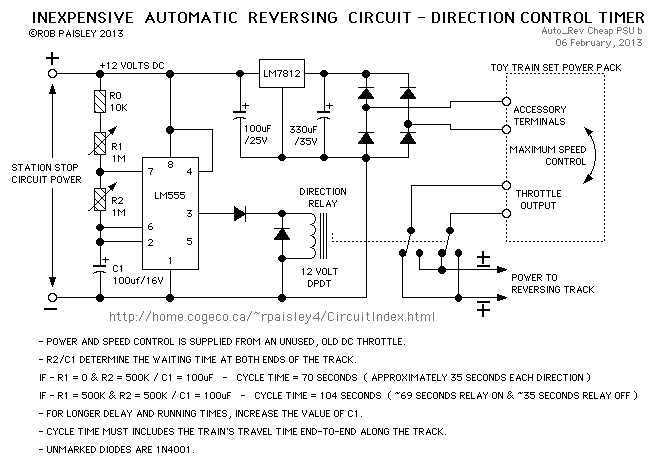
Select a step-down transformer delivering 12–16 V AC at 1.5–2 A so miniature locomotive motors receive stable track voltage. Mains input at 120 V or 230 V connects to the primary winding, while the secondary winding provides low-voltage output suitable for track operation and speed regulation hardware.
The transformer secondary output feeds a bridge rectifier that converts alternating current into direct current used by the train layout power stage. A full-wave rectifier built from four diodes rated at least 3 A handles current peaks during locomotive startup.
Place a smoothing capacitor directly after the rectifier output. Values between 1000 µF and 2200 µF at 25 V stabilize voltage delivered to the track system. Without this capacitor, voltage ripple causes uneven motor movement and visible speed fluctuations.
Transformer Output Path
The low-voltage secondary winding typically connects to the following components in sequence.
AC secondary → bridge rectifier → filter capacitor → adjustable voltage stage → track terminals
Use thick conductors between the transformer and rectifier. Current spikes during locomotive acceleration can exceed 1.5 A, especially with multiple engines drawing power simultaneously.
Protection and Thermal Safety
Install a fuse on the primary side rated slightly above the transformer operating current. For example, a 15 V 2 A secondary transformer usually uses a 250 mA to 500 mA fuse on the mains side depending on input voltage.
Mount the transformer on a ventilated metal plate or chassis panel. Continuous operation generates heat in the copper windings and laminated core, particularly when powering several locomotives or lighting accessories connected to the layout.
Ground the metal chassis if a metal enclosure is used. This reduces shock risk and protects electronic components connected to the power stage.