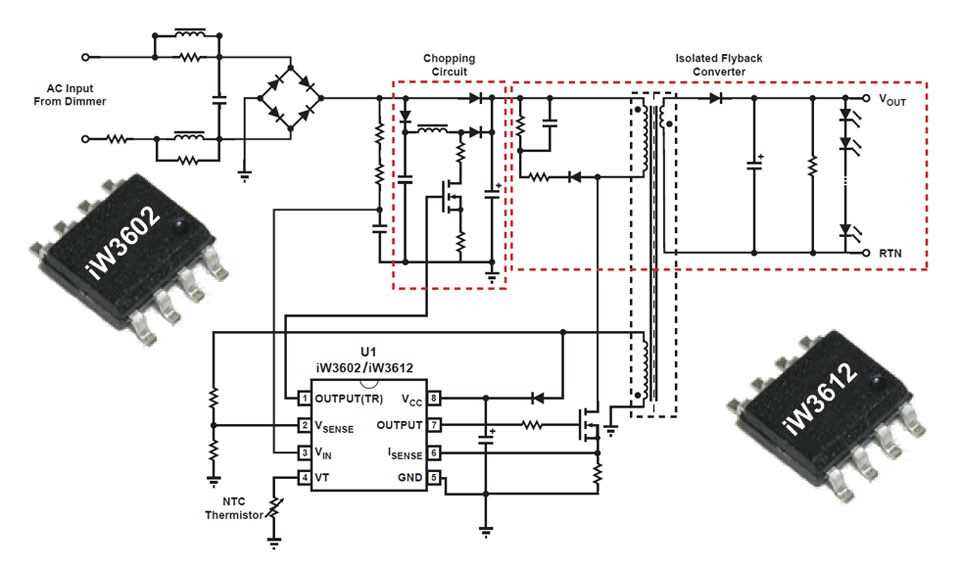
Select a constant-current control chip rated for at least 20–30% higher output current than the expected load and pair it with a low-ESR input capacitor of 4.7–10 µF. This configuration stabilizes power delivery to light-emitting diodes and prevents brightness fluctuation caused by ripple from the supply source. A Schottky rectifier with a forward drop below 0.4 V reduces heat dissipation and improves electrical stability in compact lighting modules.
The typical connection layout around a control IC contains four functional blocks: power input filtering, current regulation network, switching stage, and diode array output. Place the current-sense resistor close to the chip pins and keep its trace length below 10 mm. A resistance value between 0.1 Ω and 1 Ω sets the operating current according to the internal reference voltage of the chip, often around 95–250 mV. Lower resistance raises current through the diode string, while higher resistance reduces luminous intensity and heat.
Thermal behavior determines reliability of the entire lighting assembly. Mount the control IC on a copper area of at least 2–4 cm² on the PCB to dissipate heat generated during switching. When operating above 350 mA, include multiple vias beneath the chip pad connecting to a ground plane. This layout lowers junction temperature and prevents current drift that can shorten the lifespan of semiconductor light sources.
Switching frequency also influences component selection. Many current-regulation chips operate between 150 kHz and 1 MHz. Higher frequency allows smaller inductors, typically 4.7–22 µH, while lower frequency reduces switching loss and electromagnetic noise. Maintain short traces between the inductor, rectifier, and chip switching pin; excessive trace length increases parasitic inductance and voltage spikes.
For dimming control, connect the chip’s control pin to a PWM signal between 200 Hz and 20 kHz. This method preserves color temperature and avoids flicker visible to the human eye. Analog control through a reference pin also works for gradual brightness adjustment, though PWM delivers more stable current through the diode chain.
LED Driver IC Circuit Diagram: Practical Design and Connection Guide
Select a constant-current control chip rated for at least 20–30% higher output current than the diode string requirement; this margin reduces thermal stress and stabilizes brightness during supply fluctuations. For example, a 700 mA emitter chain should use a controller capable of 900 mA or more. Place the current-sense resistor close to the control IC pins to reduce parasitic resistance, and keep the power path short to limit voltage drop and heat concentration.
Basic Connection Layout
A typical lighting power stage contains several mandatory elements arranged around the regulating microchip:
- DC supply source (commonly 9–48 V depending on emitter chain length)
- Switching transistor or integrated MOSFET inside the control chip
- Inductor sized by ripple current target (usually 20–40% of nominal current)
- Fast recovery rectifier rated above supply voltage
- Current-sense resistor that sets output current
- Output capacitor that smooths ripple at the emitter terminals
Choose the inductor using the relation ΔI = (Vin − Vload) × D / (L × f). For a 24 V supply, 12 V emitter chain, 500 kHz switching frequency, and 30% ripple at 700 mA, the calculated inductance falls near 33–47 µH. Lower inductance increases ripple and heat, while excessive inductance enlarges component size and slows transient response.
Pin Connection Strategy
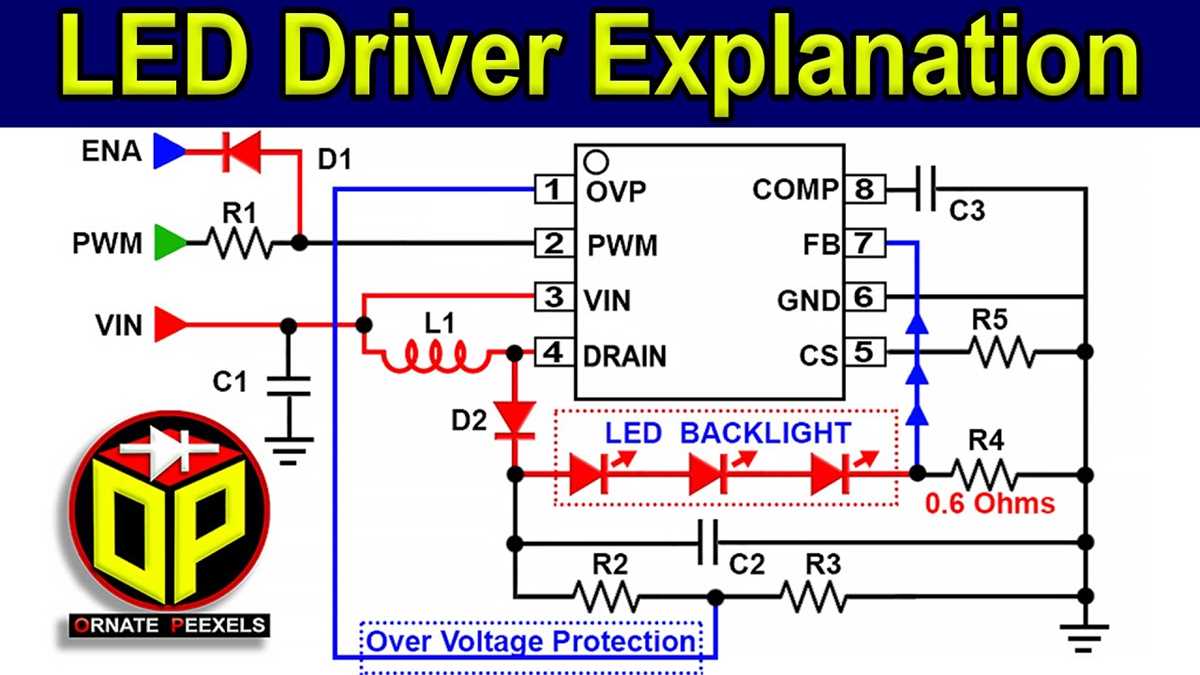
Most lighting controller chips expose similar pin groups:
- VIN – supply input; place a ceramic capacitor (1–4.7 µF) within a few millimeters.
- SW – switching node connected to the inductor.
- CS – current sense input tied across a low-ohmic resistor (0.1–0.5 Ω typical).
- GND – ground reference; connect with a wide copper area for heat spreading.
- DIM/PWM – brightness control input accepting either analog voltage or pulse modulation.
Thermal layout strongly affects reliability. Mount the regulating IC on a copper pad of at least 2–3 cm², add thermal vias to inner layers, and route high-current traces wider than 1 mm per ampere. Separate the switching node from feedback traces; electromagnetic interference from that node may cause brightness instability or flicker.
How to Read and Interpret a Typical LED Driver IC Circuit Diagram Pin by Pin
Identify the power entry pin first and trace its path through the schematic sheet before examining any control node. The supply input (often labeled VIN, VCC, or PVCC) usually connects to a decoupling capacitor placed within a few millimeters of the integrated chip in real layouts; capacitance commonly ranges from 0.1 µF to 4.7 µF depending on switching frequency and input ripple tolerance. Follow the ground return (GND or PGND) immediately after locating the supply node. A short return path and a dedicated ground plane indicate that the chip handles high current pulses, which strongly hints at a switching regulator architecture rather than a linear current source.
Power Switching and Energy Path Pins
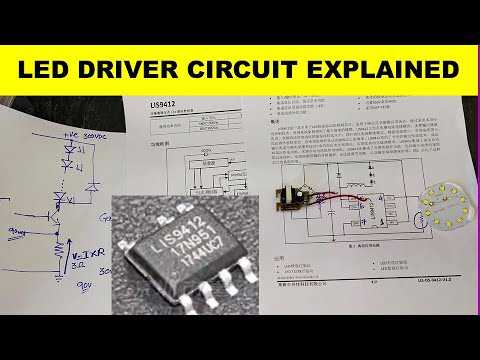
Locate the switching node pin, typically labeled SW, LX, or DRN. This terminal connects to an inductor and often to a Schottky diode or synchronous MOSFET stage. Track that node toward the coil symbol; inductance values between 4.7 µH and 47 µH appear frequently in constant-current lighting regulators operating between 200 kHz and 1 MHz. If the switching node feeds a diode leading to the load chain of light-emitting diodes, the topology is boost. If the inductor sits between VIN and the switch pin, the topology is buck. Such placement alone reveals how current flows without reading any documentation.
Feedback and Current Regulation Pins
Next inspect the feedback node (FB, ISET, or CS). This pin typically connects to a low-value resistor, often between 0.05 Ω and 0.5 Ω, placed in series with the diode string return path. Measure the voltage reference listed in the datasheet–values such as 95 mV, 200 mV, or 250 mV appear often. Divide that reference by the resistor value to estimate regulated current. For example, a 0.2 V reference across 0.1 Ω sets approximately 2 A through the load chain.
Locate control inputs such as EN, DIM, or PWM. These pins accept logic signals from microcontrollers or analog voltages from potentiometers. PWM dimming inputs normally tolerate frequencies from several hundred hertz to about 20 kHz. Analog dimming pins usually operate between 0.2 V and 1.2 V reference windows; outside that range the chip clamps current or shuts down output. Trace whether the pin connects through a resistor divider or directly to a logic source to determine which method of brightness control the designer intended.
Finish by examining compensation and reference nodes such as COMP, SS, or VREF. The compensation pin normally links to an RC network (for example 10 kΩ with 4.7 nF) tied to ground; this network stabilizes the current regulation loop. A soft-start pin marked SS may connect to a capacitor between 10 nF and 100 nF, which defines startup ramp duration and prevents inrush spikes through the diode chain. Reading these pins last clarifies how the regulator stabilizes output and protects components during power transitions.