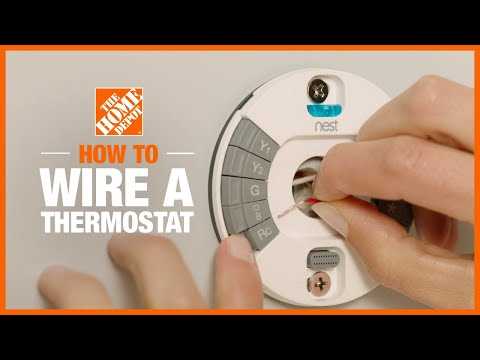
Turn off power at the breaker and verify the 24-volt control circuit before touching any conductors. A typical residential heat unit uses an 18 AWG low-voltage cable with five colored leads. The control base usually includes terminals marked R, W, Y, G, and C. Red supplies 24V from the transformer, white sends the heat call to the burner control board, yellow activates the compressor in combined HVAC setups, green triggers the air handler fan relay, and the common line closes the control circuit.
Correct terminal pairing prevents relay chatter and ignition faults. The red lead from the transformer connects to R; a short jumper may link R and Rc on single-transformer systems. The white conductor attaches to W, delivering the heating request signal. Systems with cooling capability route the yellow lead to Y. The indoor blower engages through the green lead on G. Modern digital controllers often require the C line for constant 24-volt supply.
Use solid copper conductors, strip insulation to about 6–7 mm, and tighten terminal screws firmly without crushing the wire. Label each lead during removal of the old controller base. Misplaced conductors can cause continuous fan operation, burner lockout, or a blank display panel.
Older installations sometimes contain only two leads: red and white. That arrangement supports heat-only operation where the regulator closes the circuit between those two terminals. Upgrading to a programmable control panel may require pulling a new five-conductor cable from the air handler control board so that the common line and fan relay can operate correctly.
Control Connections for a Gas Heating Unit and Wall Temperature Regulator
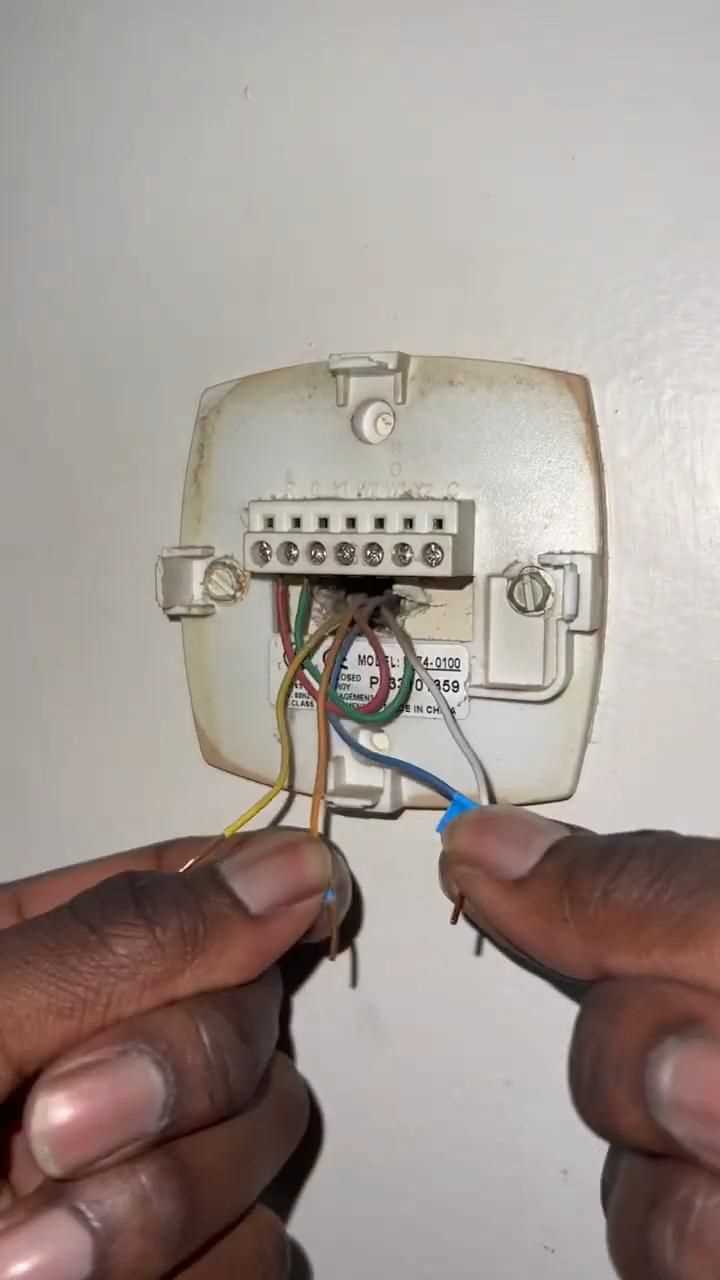
Connect the low-voltage conductors to the control board terminals using the standard color convention: red to the 24-V supply (R), white to the heat call terminal (W), yellow to the cooling call terminal (Y), green to the indoor fan terminal (G), and blue or black to the common return (C). Verify that the transformer inside the heater cabinet provides 24 V AC before attaching any conductor.
The terminal strip inside most forced-air heater cabinets follows a predictable layout, which simplifies identification of each control line. Use the printed letters on the board rather than relying only on insulation color. Typical assignments:
- R – 24-volt power from the internal transformer.
- W – heat demand signal that activates the burner sequence.
- Y – compressor request sent to the outdoor condenser.
- G – indoor blower relay control.
- C – common side of the 24-V circuit, often required for smart wall regulators.
- O/B – reversing valve signal used with heat pump installations.
If the cable from the wall control contains five conductors but only four are used, attach the spare to the C terminal at both ends; this allows installation of modern programmable controllers without reopening the wall.
Check connections methodically before energizing the system:
- Turn off the service switch near the heater cabinet.
- Remove the access panel and locate the control board terminal strip.
- Match each conductor from the wall cable with the labeled terminal.
- Tighten screw clamps firmly; loose contacts lead to intermittent heat calls.
- Restore power and raise the wall regulator setpoint to confirm burner ignition and blower startup.
Identifying Terminals R, W, Y, G, and C in a Control Connection Layout
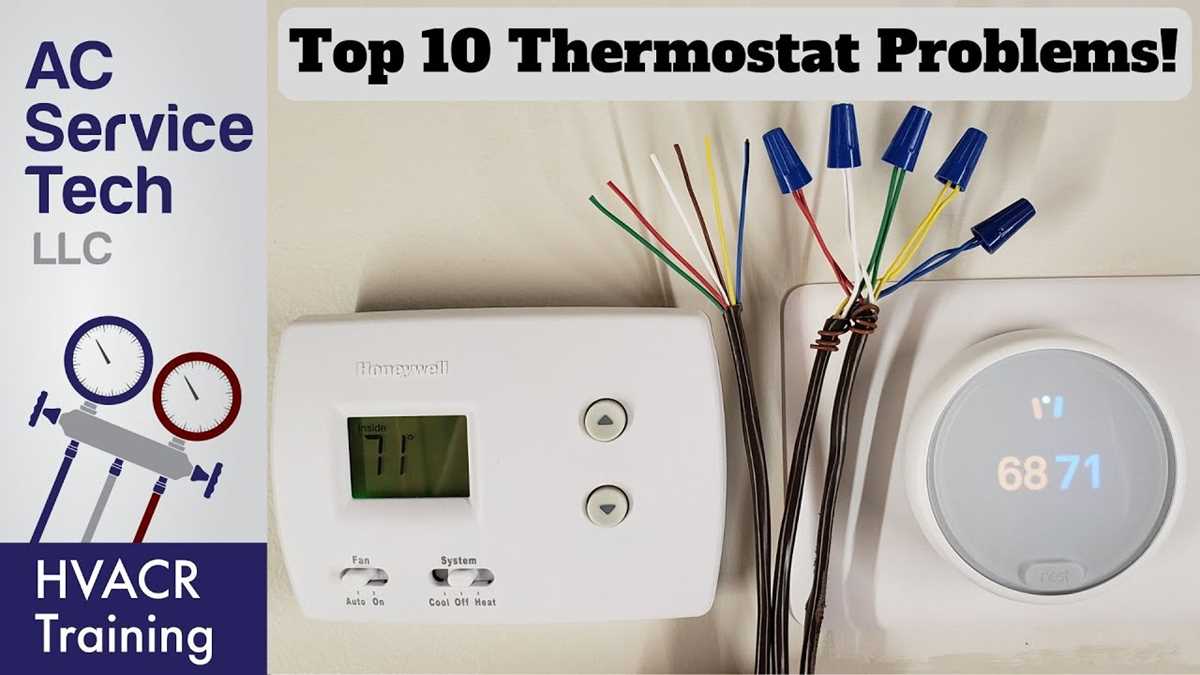
Check terminal R first because it carries the 24-volt supply from the system transformer to the wall temperature controller. On most control boards the marking “R” sits near a red conductor. Use a multimeter set to AC voltage and measure between R and C; a reading close to 24 volts confirms the supply line. Some installations include a small jumper linking R to RC or RH, distributing the same voltage to heating and cooling control circuits.
The W terminal indicates the heating call path. When the controller closes the circuit between R and W, the control board receives a signal to initiate the heating cycle. This may activate a gas valve, electric heating elements, or an ignition module depending on equipment design. The conductor connected to W is typically white. Trace this lead from the controller base to the indoor unit control board input labeled W or W1.
Terminal Y controls the compressor contactor in the outdoor condensing unit. When R connects to Y, a 24-volt signal travels through the low-voltage cable to the contactor coil outside. Yellow insulation commonly identifies this lead. On many control boards the Y terminal also routes through a safety switch or time-delay module before reaching the outdoor equipment.
The G marking corresponds to the indoor blower relay. Closing R to G activates the fan motor regardless of heating or cooling demand. Green insulation typically marks this conductor. On the equipment control board the G input connects to a fan relay coil or an electronic blower control circuit. A quick diagnostic method involves briefly bridging R and G at the terminal strip; the indoor fan should begin operating within seconds.
Terminal C functions as the common side of the 24-volt transformer secondary. It completes the electrical loop used by digital controllers, smart controllers, and accessory modules such as humidifiers or Wi-Fi adapters. Blue or black insulation frequently identifies this conductor. Voltage measurements taken between C and any signal terminal–R, W, Y, or G–should show approximately 24 VAC, confirming correct identification of the reference line in the control layout.