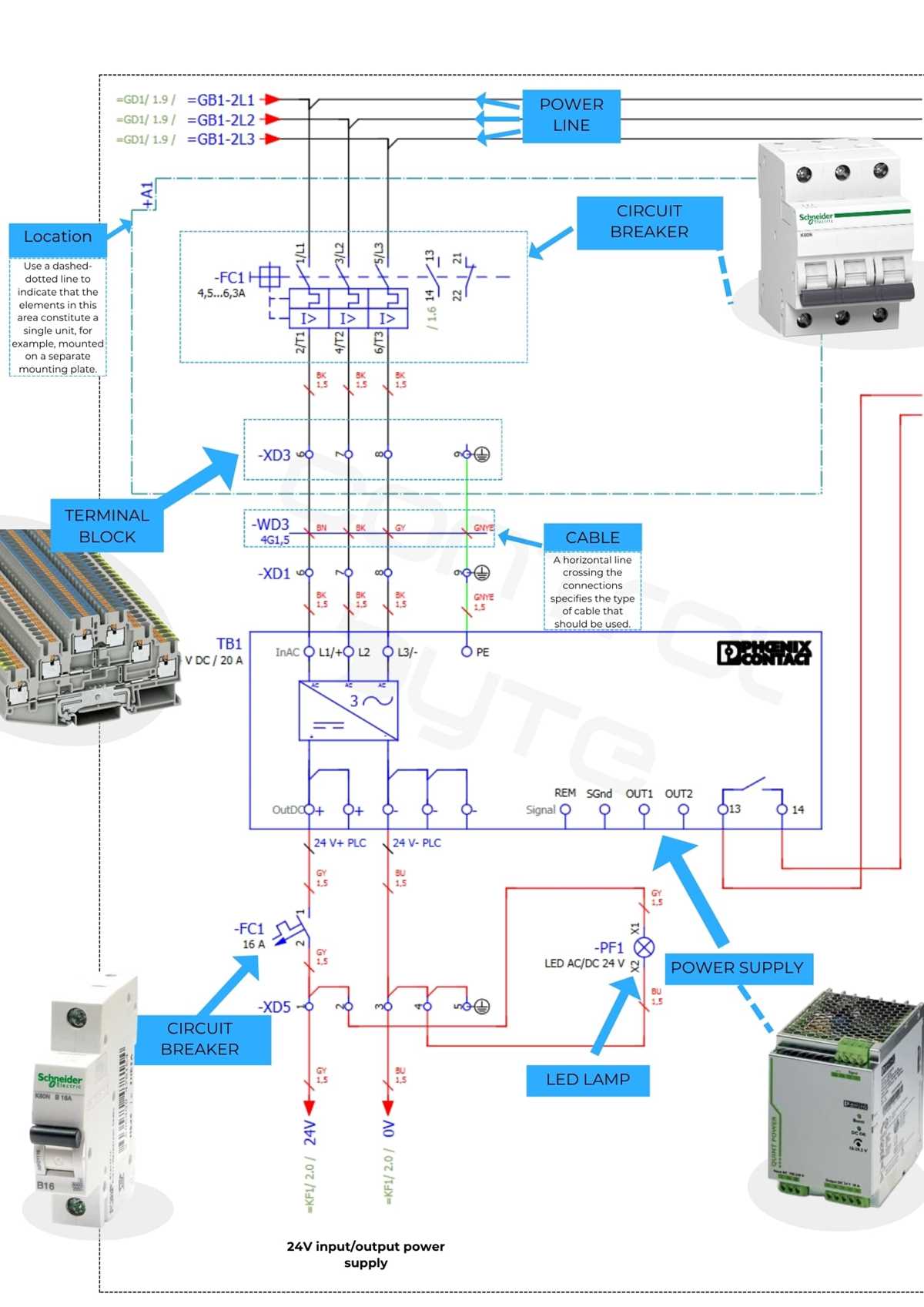
Locate the power source first: batteries, DC supplies, or AC inputs usually appear at the edge of the drawing and connect to the rest of the system through clearly marked rails. Trace these rails across the page and note where voltage branches into separate paths. Symbols such as parallel plates for capacitors, zig-zag lines for resistors, and triangular or comb-like ground marks reveal where energy is stored, limited, or returned to reference potential. Recognizing these shapes allows quick orientation within the drawing.
Observe reference labels placed next to each component. Marks like R1, R2, C5, Q3 or U1 indicate part categories and their unique identifiers. Letters correspond to component families: R for resistance elements, C for capacitance devices, D for rectifying parts, and U for integrated modules. Numbers distinguish individual parts. Cross-checking these identifiers with a parts list clarifies ratings such as 10 kΩ, 100 µF, or transistor models like 2N3904.
Follow connection nodes where lines intersect or terminate at a filled dot. Each node represents a shared conductor with identical potential. When two lines cross without a dot, they remain separate paths. Pay attention to labels like VCC, GND, OUT, or CLK; these names indicate functional signals rather than physical wires. Many professional drawings repeat these labels instead of stretching long lines across the page, reducing clutter.
Interpret signal movement through active parts such as transistors, operational amplifiers, and logic gates. Arrows on transistor emitters or diode triangles indicate permitted current direction. Amplifier blocks usually show + and − inputs, while digital gates display shapes for AND, OR, and NOT logic. Combine these visual cues with measured values from a multimeter–voltage at nodes, resistance across components–to confirm that the drawing matches the physical assembly.
Interpreting a Wiring Schematic for Power Systems
Examine the symbol legend first. Every connection plan relies on standardized graphic marks that represent components and links between them. Without understanding these marks, the page appears as random lines. Focus on typical elements such as resistive loads, switching devices, protection units, and energy sources. A short review of the legend often clarifies the entire page structure.
Trace the flow of current from the power source toward loads. Most technical schematics place supply points on one side and consumers on the opposite side. Follow each line carefully and observe where branches occur. Each branch indicates distribution toward another component or subsystem. Interruptions such as contacts, coils, or protection units mark functional control points.
Recognize frequent graphic symbols used in power schematics:
- Zigzag line – resistive element or heating load
- Two parallel plates – capacitor
- Series loops – inductive coil
- Break in a line with pivot – manual switch
- Triangle with bar – diode allowing one-direction current
- Circle with letter marking – lamp, motor, or measuring device
Observe reference labels printed near components. Letters and numbers connect the page to equipment lists or technical documentation. A mark such as R5 normally indicates the fifth resistor in the system. Similar labeling appears for capacitors, relays, transformers, and terminals. Matching these identifiers with the component table reveals ratings, tolerances, and physical placement.
Analyze node intersections carefully. A solid dot where lines meet indicates a real junction where conductors share current. Crossing lines without a dot usually represent independent paths that pass over one another without connection. Confusing these two situations often leads to incorrect interpretation of the system structure.
Follow a structured inspection routine:
- Locate supply source and ground reference.
- Track main conductors across the page.
- Identify switching or control elements interrupting current flow.
- Inspect branches leading to loads.
- Confirm junction points and terminal labels.
- Compare component identifiers with specification tables.
Practice with real schematics from household devices, automotive systems, or industrial panels. Repeated analysis improves speed of symbol recognition and makes complex connection plans far easier to interpret.
Identifying and Interpreting Common Symbols in Circuit Schematics
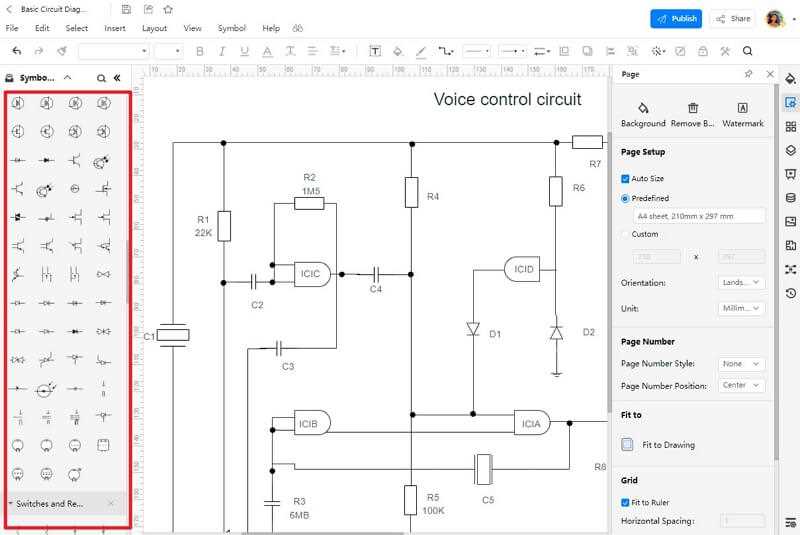
Match each glyph on a schematic with its standardized form before analyzing connections: a zigzag line usually marks a resistor, two parallel plates indicate a capacitor, and three descending horizontal lines represent ground. Verifying these shapes against IEC or ANSI symbol tables prevents confusion between similar marks such as a fuse (small rectangle or S-shaped link) and a resistor. Accurate recognition at this stage reduces interpretation errors when tracing signal paths or power routes.
Recognizing Passive and Power Components
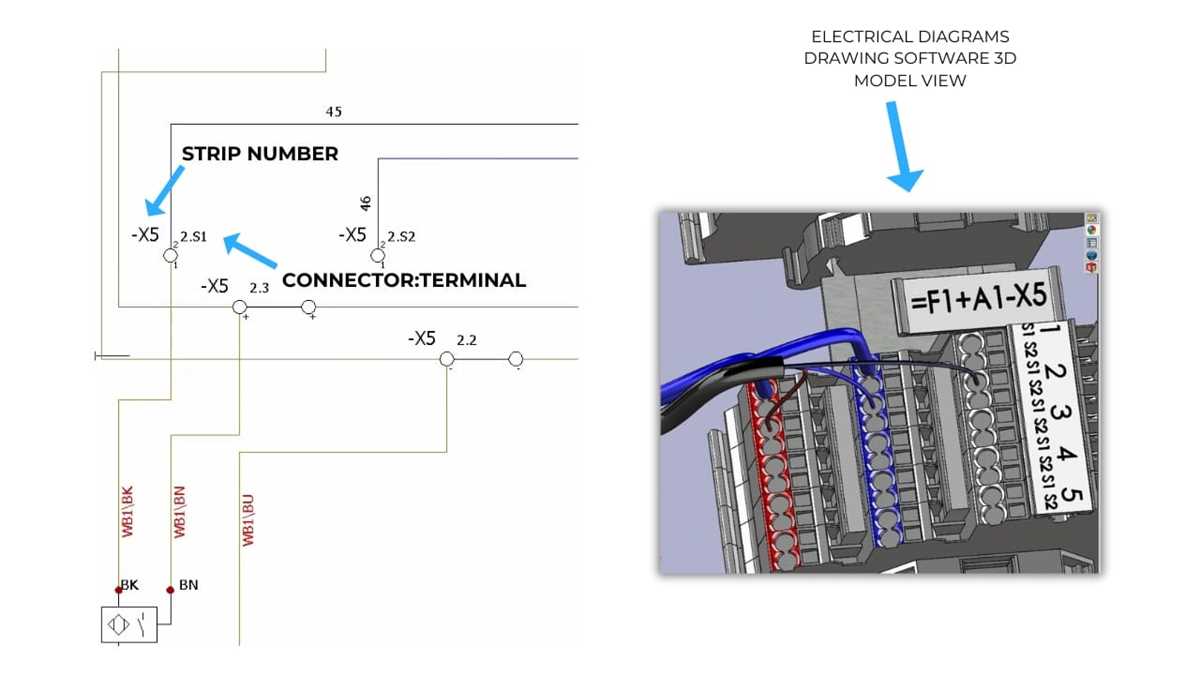
Passive elements rely on very consistent graphic conventions. A resistor appears as a zigzag line in ANSI notation or a simple rectangle in IEC style; both represent the same component that limits current flow and drops voltage. Capacitors show two facing plates; unequal plates suggest a polarized type, typically used with DC supplies. Inductors appear as several curved loops or a sequence of semicircles, symbolizing a coiled conductor that stores energy in a magnetic field. Power sources use distinctive icons: a long and short line pair denotes a single cell, repeated pairs show a battery pack, while a circle with sine wave inside often marks an AC supply. Ground references appear in multiple forms–three stacked lines for chassis ground, a triangle pointing downward for signal reference. Identifying these marks allows quick classification of the power network and energy-storage parts within the schematic.
Interpreting Active Devices and Directional Marks
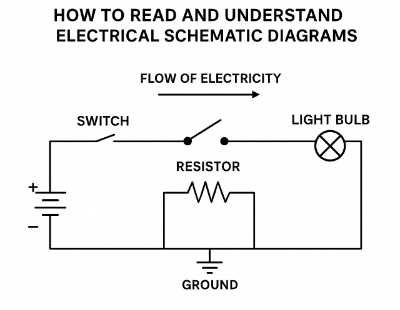
Focus on arrow direction and terminal layout for semiconductors. A diode appears as a triangle pointing toward a vertical bar, indicating permitted current direction. Light-emitting variants add small outward arrows. Bipolar transistor icons contain three terminals–base, collector, emitter–with an arrow on the emitter showing current direction for NPN or PNP types. Field-effect transistors display a gate separated from a channel line, often with arrows that distinguish N-channel from P-channel devices. Orientation of these symbols clarifies signal flow, switching behavior, and polarity requirements within the wiring plan.