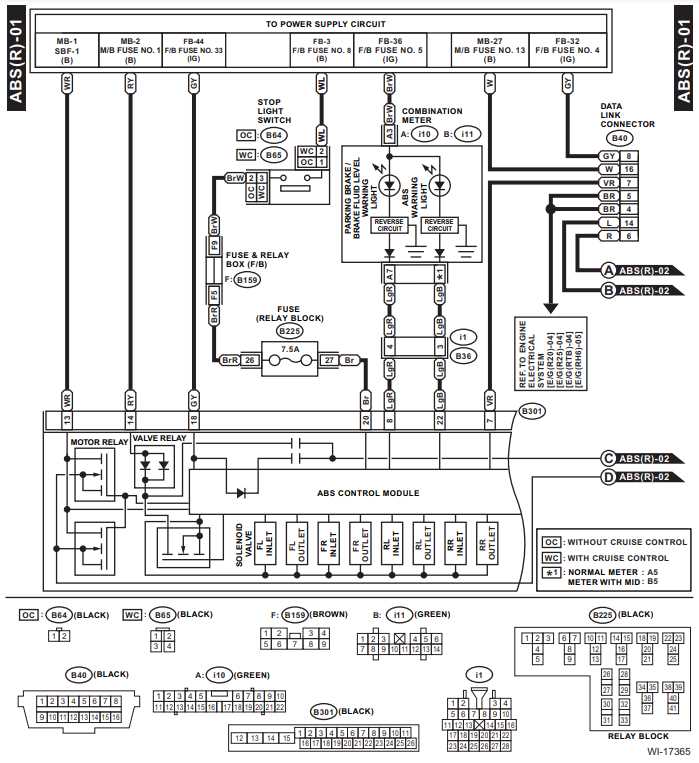
If you’re facing an issue with your vehicle’s electrical system, understanding the circuit maps is key. The first step is to familiarize yourself with the symbols that represent components like switches, sensors, and connectors. These symbols are standardized, so once you learn them, they’ll apply to almost any model.
Next, focus on how the lines connect each part. These lines represent wires and show the flow of current. Identifying the color codes or line types on the diagram will help you pinpoint which wire to test or replace. Be sure to follow each circuit carefully to understand where power starts and ends, especially when diagnosing faulty components.
For troubleshooting, use the diagram to cross-reference symptoms. If a light isn’t working, check the fuse, switch, and wire connections in that specific circuit. An electrical diagram will tell you where to measure voltage, continuity, or check for short circuits.
Reading Automotive Circuit Blueprints
Start by identifying the symbols that represent various components. Each device, like fuses, relays, and switches, has a distinct icon. These icons are often standardized across vehicle makes and models, so once you recognize them, they will appear in most electrical systems.
The connections between components are shown with lines. These lines represent the flow of electricity, and each type of line has its meaning. For example, solid lines indicate main power, while dashed lines may represent optional or auxiliary connections. Pay attention to color coding and line thickness, as they can indicate wire type or voltage ratings.
Understanding Circuit Flow and Connections
When tracing a circuit, follow the path from the power source to the component it controls. Start at the battery or fuse box and follow the wires to the target device, such as a light or sensor. Check for any junctions or connectors that might affect the current flow.
- Look for color-coded wiring to match components with their diagrammed counterpart.
- Understand whether the circuit is complete or if it requires additional components like resistors or ground connections to function properly.
Troubleshooting with Electrical Schematics
When diagnosing electrical issues, use the circuit blueprint to find the problem area. Check the voltage across components and follow the path of the current. If a component isn’t functioning, verify whether the problem lies within the power source, connection, or the device itself.
Understanding the Key Symbols and Components in Circuit Maps
Begin by learning the standard symbols for components like switches, fuses, resistors, and diodes. Each symbol represents a specific part of the electrical system, and knowing them will allow you to quickly identify devices in any blueprint. For example, a rectangle usually represents a switch, while a zigzag line often indicates a resistor.
Next, understand the meaning of connectors and junctions. In schematics, a dot typically represents a point where two wires are connected, while an unmarked intersection indicates that the wires are not connected. If you see a wire crossing over another without a dot, it’s important to know that there is no electrical connection between them.
When looking at a fuse, the symbol often appears as a rectangle with a line through the middle. This represents a protective component designed to prevent overloads in the circuit. Always check the specifications for the fuse used in the diagram to ensure it matches the required amperage for the system.
Another important component to identify is the relay. It’s typically shown as a rectangle with contacts inside, sometimes with a coil symbol next to it. Relays are used to control high-power devices with low-power signals, such as activating a motor or light. In diagrams, pay attention to the coil’s polarity and ensure the relay is correctly wired to avoid misfires.
Lastly, ground connections are often depicted with a downward-pointing triangle or a set of three horizontal lines. These represent the point at which electrical devices return their current to the vehicle’s chassis or a dedicated ground system. Proper grounding is necessary for safety and to prevent electrical malfunctions.