Choose a simple two-transistor blinking indicator layout when a stable on-off light signal is required for LEDs, small lamps, or relay triggers. A practical configuration uses two NPN components such as BC547 or 2N2222, paired with cross-coupled capacitors between 10 µF and 100 µF. This arrangement produces alternating switching without a microcontroller. For a supply between 5 V and 12 V, collector resistors near 470 Ω–1 kΩ keep current within safe limits for common indicator LEDs.
Control of the blinking rate depends mainly on the capacitor-resistor timing pair. With 47 µF capacitors and 10 kΩ resistors, the light pulse appears roughly once per second. Increasing capacitance lengthens the interval; lowering resistance speeds it up. For warning beacons or turn-signal style indicators, many builders target a period between 0.5 s and 1.5 s because it remains clearly visible without appearing chaotic.
For higher load devices, place a small switching relay or a logic-level MOSFET after the transistor stage. A device such as IRLZ44N can handle currents above 10 A while the timing network still draws only a few milliamps. Add a flyback diode across inductive loads like relays or motors to prevent voltage spikes that may damage semiconductors.
Stable operation improves when the power rail includes a 100 nF ceramic capacitor placed close to the switching components. Keep wiring short and avoid running timing nodes next to high-current traces. With these adjustments, the blinking generator remains steady across temperature changes and supply variations.
Blinking Signal Wiring Scheme
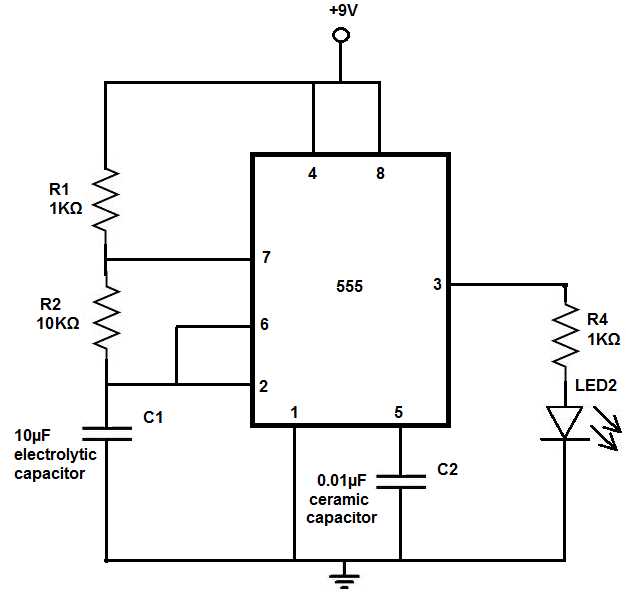
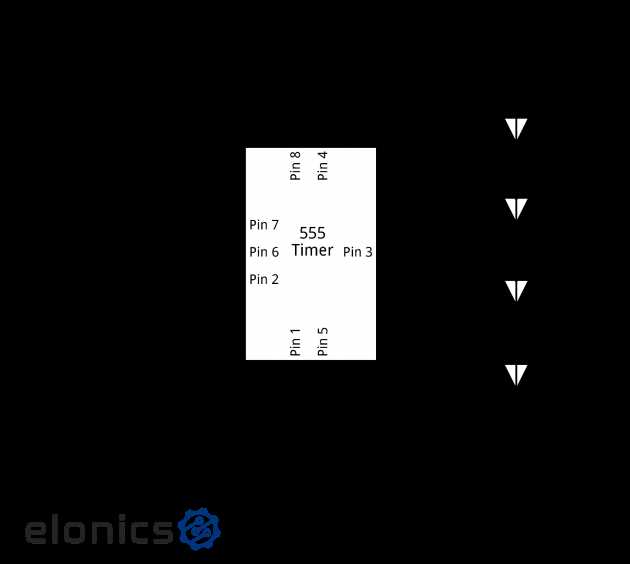
Use a 555 timer in astable mode with a 9–12 V supply and two resistors (e.g., 4.7 kΩ and 47 kΩ) paired with a 10 µF capacitor to generate a repeating pulse that switches an LED or relay on and off at roughly 1–2 Hz. Connect pin 1 to ground, pin 8 to VCC, link pins 2 and 6, and route the timing network between pins 6, 7, and VCC. The output at pin 3 feeds the indicator through a 220 Ω resistor or drives a transistor when higher current is required.
Component Arrangement
Stable blinking depends on the RC timing pair. The delay between light bursts follows the relation T ≈ 0.693 × (R1 + 2R2) × C. With R1 = 4.7 kΩ, R2 = 47 kΩ, and C = 10 µF, the period approaches 0.7 s. Increasing the capacitor to 47 µF slows the sequence to about 3 s. A small NPN transistor such as 2N2222 can switch loads above 100 mA: connect its base through a 1 kΩ resistor to the timer output, emitter to ground, and place the lamp or LED strip between supply and collector. A diode across inductive loads (for example a relay coil) blocks reverse voltage spikes that may damage the timer chip.
Practical Layout Notes
Place the timing capacitor close to the IC pins to reduce stray resistance and noise pickup. Use a decoupling capacitor of 100 nF between supply and ground near the chip. For adjustable blink speed, replace R2 with a 100 kΩ potentiometer wired as a variable resistor.
How to Read and Interpret Symbols in a Flasher Circuit Diagram for Turn Signal Systems
Identify the power source symbol first: a long and short parallel line pair marks the 12-volt vehicle battery. Trace the line leaving the positive terminal toward a rectangular fuse icon labeled with ratings such as 10A or 15A. That symbol indicates overload protection for the turn indicator network. If the fuse marking shows a value lower than lamp consumption (two 21 W bulbs draw about 3.5 A each at 12 V), the protection will trip during operation.
Recognize the relay unit symbol used for indicator blinking. On many wiring maps it appears as a small rectangle marked with terminal numbers such as 49, 49a, and 31 according to DIN standards. Terminal 49 connects to the supply line, 49a feeds the lamps, and 31 links to chassis ground. A dashed line sometimes separates internal contacts from the timing element, indicating a thermal or electronic switching mechanism.
Lamp and Ground Symbols
Look for a circle with a cross inside; that mark represents the turn signal bulb. Two identical icons usually appear on each side of the vehicle path–front and rear units. Wires leading from the relay output split into left and right branches through a selector switch symbol shaped like a movable contact between two terminals. Ground is shown by three descending horizontal lines or a triangular stack, pointing to the metal body used as return path.
Line styles also carry meaning. A solid straight line indicates a conductor carrying current. A line that crosses another without a dot means no electrical connection, while a crossing with a filled dot signals a junction node. Some vehicle schematics include wire color abbreviations beside the lines: GN for green, BK for black, WH for white. Following these markings helps match the drawing with the physical harness during diagnostics.
Switch and Indicator Markings
The steering-column selector is drawn as a pivoting contact touching either the left or right terminal. A small arrow near the contact shows lever movement direction. Dashboard indicator lamps appear as smaller bulb icons linked parallel with the external lights, allowing the driver to see the blinking state. If two arrows point outward from the symbol, the lamp represents the hazard indicator tied to both sides simultaneously.
Numbers printed near components guide interpretation. For instance, a resistor labeled 120 Ω may appear inside an electronic timing module controlling blink frequency near 90 flashes per minute. Capacitor symbols–two parallel plates, sometimes one curved–store charge for the timing stage. Reading these graphic cues step by step allows accurate decoding of the vehicle’s signaling layout and faster troubleshooting when a turn indicator fails to blink or remains constantly lit.