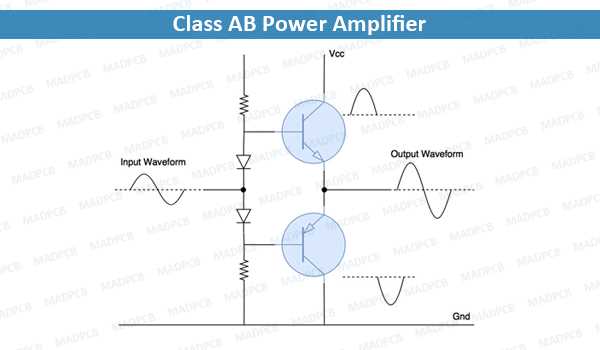
Use complementary transistors with matched hFE values to reduce crossover distortion and achieve stable signal reproduction. Ensure the biasing resistors are calculated precisely for idle current around 20–50 mA depending on load requirements.
Connect the input through a coupling capacitor of 1 µF or higher to block DC components and protect downstream stages. Place a small resistor (10–100 Ω) in series with the base of each transistor to prevent high-frequency oscillations.
Include emitter resistors between 0.1–0.5 Ω to balance the output stage and maintain thermal stability. Use heat sinks rated for 20–30 W per transistor if driving low-impedance loads above 8 Ω.
Verify the layout keeps signal paths short and symmetrical to minimize parasitic inductance and capacitance. Position decoupling capacitors (100 nF–1 µF) near the supply pins to reduce voltage fluctuations and prevent audible hiss or hum.
Test the module with a dummy load before connecting speakers. Gradually increase input voltage and monitor waveform with an oscilloscope to ensure linear operation and avoid clipping at maximum output levels.
Class B Power Amplifier Circuit Diagram
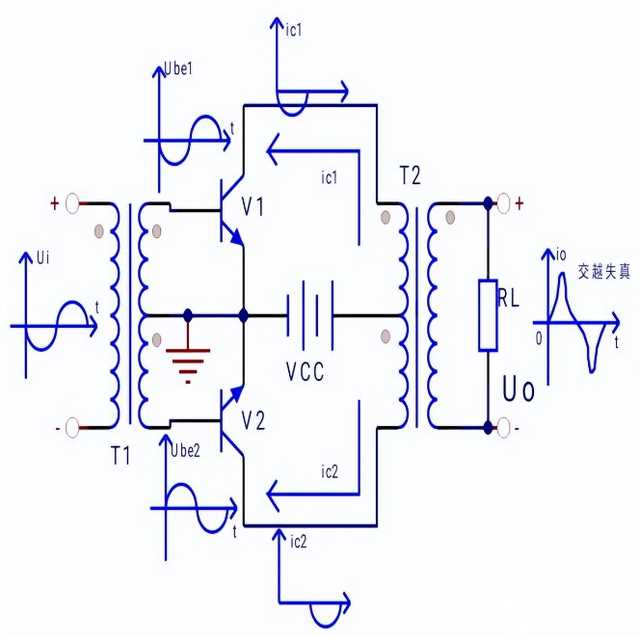
Match NPN and PNP transistors carefully to maintain consistent gain and reduce crossover distortion. Differences in hFE above 10% can lead to uneven output and audible artifacts in the signal.
Use a bias voltage of 0.6–0.7 V across the transistor bases to set the idle current precisely. This prevents thermal runaway while keeping the conduction angle close to 180° for each device.
Include small emitter resistors of 0.2–0.5 Ω to stabilize current and improve linearity. These resistors help balance the output stage and allow safer operation under fluctuating loads.
Keep wiring short and symmetrical between input and output terminals to minimize stray capacitance and inductive coupling. Arrange the layout so that feedback paths are direct and avoid unnecessary loops.
Integrate decoupling capacitors of 100 nF to 1 µF near supply pins to filter high-frequency noise. This reduces hum and hiss, improving clarity and stability at higher output levels.
Test the assembly with a resistive dummy load first to observe waveform integrity. Gradually increase the signal amplitude while monitoring voltage and current to ensure distortion remains minimal and components stay within safe thermal limits.
Selecting Components for a Class B Amplifier
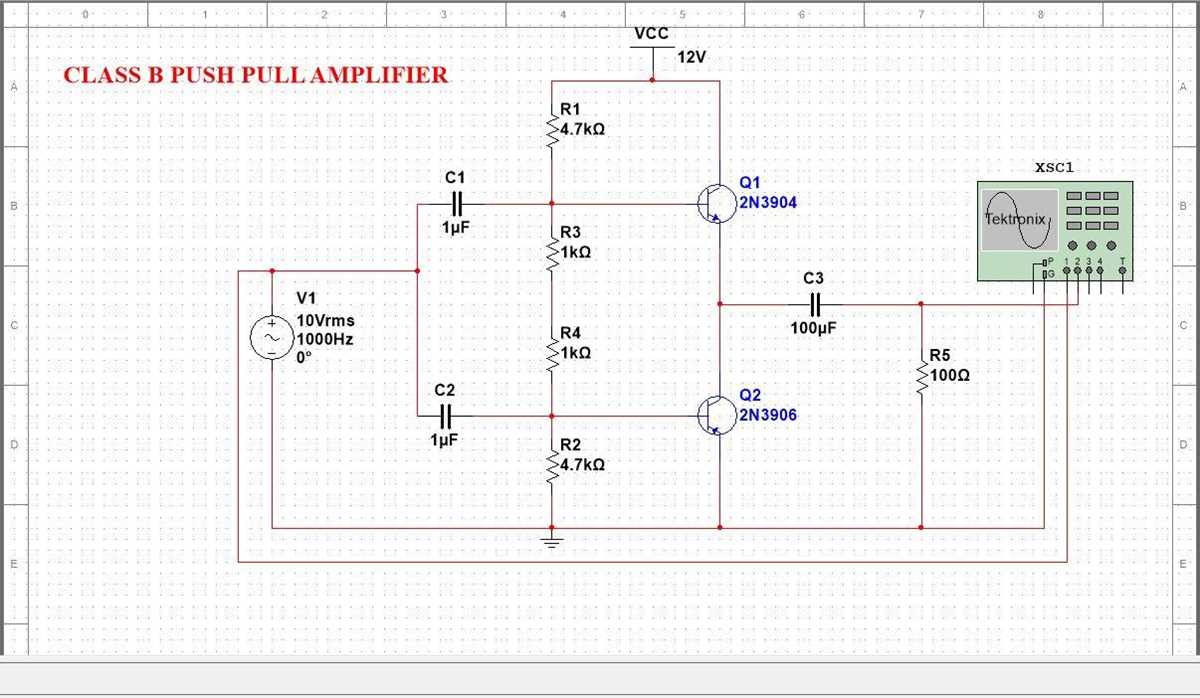
Choose transistors with matching gain characteristics to maintain symmetry in the output stage. Deviations greater than 10% between complementary devices can increase distortion and reduce linearity.
Use metal film resistors for biasing and emitter stabilization since they offer low noise and precise tolerance. Typical values range from 10 Ω to 1 kΩ depending on base current requirements.
Include coupling capacitors rated at least twice the working voltage to block DC while allowing full audio bandwidth. Capacitors of 1 µF to 10 µF are standard for mid-range applications.
Select heatsinks capable of dissipating 20–30 W per transistor when driving low-impedance loads. Proper thermal management prevents drift in idle current and ensures reliable operation.
Pick diodes with fast switching times for bias networks to maintain stable quiescent current. Schottky types with low forward voltage drop help minimize crossover distortion at low signal levels.
Choose decoupling capacitors with low ESR near the supply rails to reduce high-frequency ripple. Values of 100 nF to 1 µF are typical, placed as close as possible to each transistor pair.
Ensure output connectors and wiring can handle maximum current without voltage drop. Use 16–18 AWG wires for loads under 8 Ω and high-quality terminals to maintain consistent signal transfer.