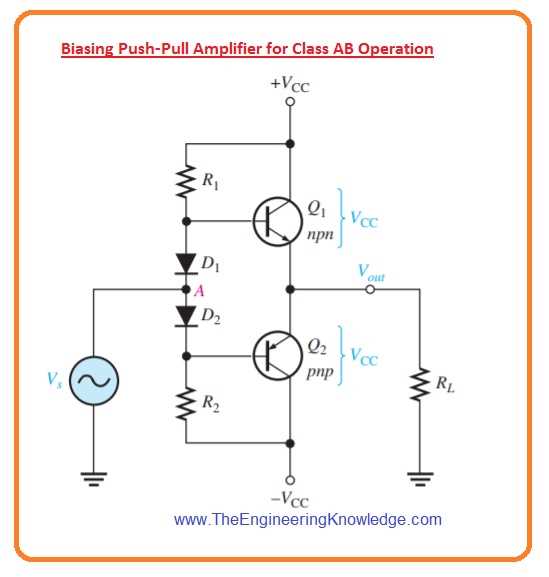
Ensure proper biasing of complementary transistors to maintain minimal crossover distortion and stable idle current. Set voltage drops precisely using a low-tolerance resistor network for consistent operation across the output stage.
Verify thermal stability by mounting transistors on adequate heat sinks. Monitor temperature variations to prevent drift in quiescent current and maintain linear amplification under varying load conditions.
Use matched pairs of transistors for the positive and negative halves to balance gain and reduce harmonic imbalance. Selecting devices with similar hFE values enhances symmetry in the push-pull arrangement.
Implement local bypass capacitors close to driver stages to suppress high-frequency oscillations and improve transient response. Capacitor values between 100nF and 1µF are typically recommended depending on stage impedance.
Check all connection points for low-resistance solder joints to avoid signal loss or hum. Cold or high-resistance connections in the signal path can introduce unwanted noise and degrade audio clarity.
Class AB Amplifier Construction and Layout
Position output transistors directly on the heatsink to maintain thermal stability and prevent drift. Ensure uniform spacing and tight mechanical contact to reduce thermal resistance.
Route power and ground paths separately to minimize interference. Use thick conductors for high-current sections and short, direct lines to maintain voltage integrity across all active devices.
Organize driver and pre-driver stages to keep signal paths minimal. Place decoupling capacitors near the supply pins of each stage to reduce high-frequency oscillations and improve transient response.
- Install bypass and filter capacitors strategically:
- Across the power rails to stabilize supply voltage
- Near driver stages for high-frequency noise suppression
- Close to input nodes to reduce coupling from adjacent sections
Check component polarity and orientation before soldering. Correct placement of transistors, diodes, and polarized capacitors is critical to maintain linearity and avoid distortion in the output stage.
Selecting Transistors and Resistors for Stable Performance
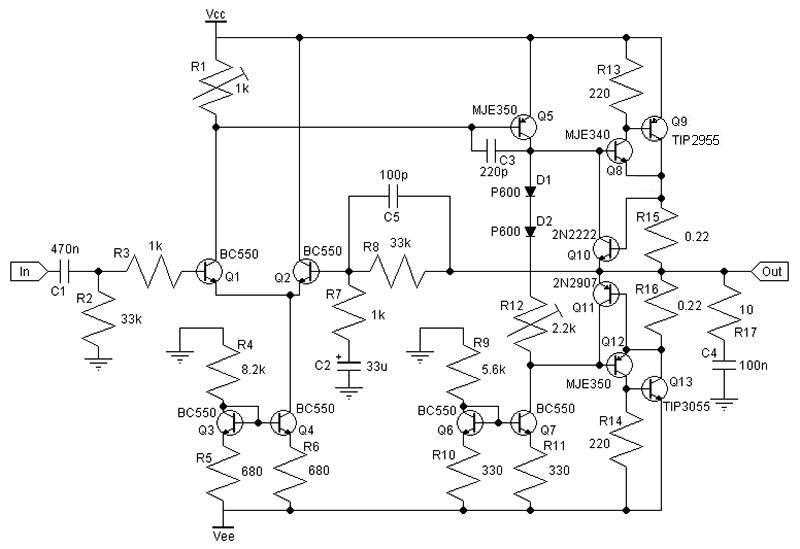
Choose output transistors with matching hFE and thermal characteristics to maintain balanced conduction and prevent crossover distortion. Ensure Vce ratings exceed maximum supply voltage by at least 30% for reliability.
Use low-tolerance resistors for bias networks to keep quiescent currents stable. Metal film resistors with 1% tolerance minimize drift and maintain linear operation under varying temperatures.
Select driver transistors with sufficient bandwidth to handle high-frequency signals without phase lag. Fast switching types reduce crossover errors and improve transient response in the final stage.
Power Dissipation Considerations
Calculate resistor wattage using expected current through each branch. Oversize resistors by 50% to prevent thermal drift and maintain voltage stability under continuous operation.
Ensure thermal coupling between output transistors and biasing resistors when possible. Mounting bias resistors on the same heatsink reduces thermal runaway and keeps operating points steady across temperature changes.
Component Matching Techniques
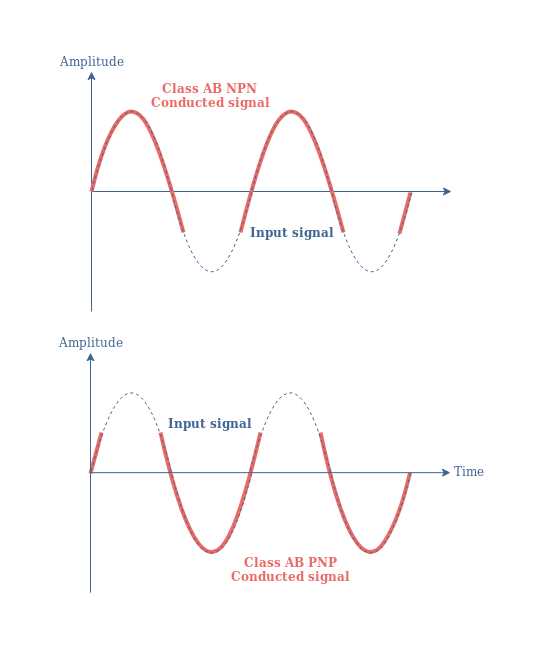
Pair complementary transistor types with similar gain and saturation characteristics. Use a matched set for both halves of the output stage to reduce distortion. Measure hFE under realistic load conditions to confirm balance before assembly.