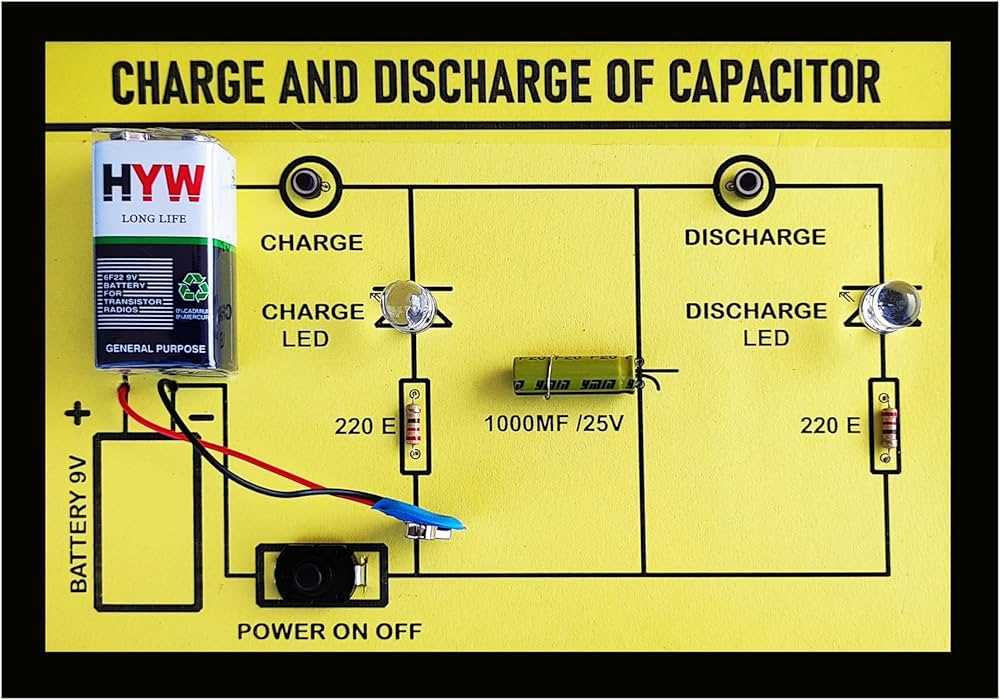
Connect the energy storage component to a DC supply through a series resistor so current entering the plates remains limited during the initial moment after power is applied. Without this resistor, the current spike can become very high because the device initially behaves almost like a short connection.
The resistor controls the rate at which voltage builds across the storage element. For example, using a 10 kΩ resistor and a 100 µF storage component produces a time constant of about 1 second. After roughly five time constants, the voltage across the plates rises to more than 99 percent of the supply level.
During the first instant after connection, current flow reaches its maximum value determined by Ohm’s law using the supply voltage and resistor value. If a 9 V source feeds the network through a 1 kΩ resistor, the starting current approaches 9 mA. As voltage builds across the plates, current gradually decreases toward zero.
Voltage measurement across the storage element shows an exponential rise. A digital meter connected across its terminals displays a steadily increasing reading until it matches the supply voltage. Laboratory demonstrations often use an oscilloscope to visualize this curve, which follows the mathematical expression V(t) = Vs(1 − e−t/RC).
Lead length and contact resistance influence measurement stability in small experimental setups. Use short conductors between the DC source, resistor, and storage element so the observed voltage curve reflects the theoretical RC behavior rather than unwanted resistance from long leads.
Capacitor Charging Circuit Diagram With Resistor and DC Power Source Layout
Connect the DC supply positive terminal to a resistor, then route the other end of that resistor to the energy storage element plate. The second plate returns directly to the negative terminal of the power source. This arrangement limits initial current flow and forms a classic RC network used in many electronics experiments.
Role of the Series Resistor
The resistor determines how quickly voltage rises across the storage device. For instance, pairing a 5 kΩ resistor with a 220 µF unit produces a time constant close to 1.1 seconds. After one time constant the voltage across the plates reaches about 63 percent of the supply level. After five time constants the value approaches the full source voltage.
During the first moment after connection, the storage component behaves like a short path. Current equals the supply voltage divided by the resistor value. A 12 V supply feeding a 2 kΩ resistor creates an initial current of roughly 6 mA. As voltage builds across the plates, the current gradually drops.
Voltage Rise Across the Storage Element
Attach a digital meter across the plates to observe voltage increase over time. The displayed value follows an exponential curve described by V(t) = Vs(1 − e−t/RC). Laboratory demonstrations often capture this rise using an oscilloscope connected across the component terminals.
Keep conductor lengths short between the DC source, resistor, and storage component. Long leads introduce stray resistance and inductance that distort the voltage curve in small experimental setups.
Select resistor power rating based on the starting current and supply voltage. For example, a 12 V supply through a 1 kΩ resistor produces about 144 mW of dissipation, so a 0.25 W resistor provides adequate margin.
How to Connect a Resistor and Capacitor to a DC Source for Charging
Connect the positive terminal of the DC supply to one lead of a resistor, then link the opposite resistor lead to the storage element plate. The second plate returns directly to the negative terminal of the power source. This simple RC network controls current flow during the energy accumulation process.
Use proper component values based on the supply voltage and the desired time constant. Typical laboratory setups follow this structure:
- DC supply between 5 V and 12 V
- Resistor between 1 kΩ and 10 kΩ
- Electrolytic storage component between 10 µF and 470 µF
Observe polarity when using an electrolytic storage device. The positive lead must connect toward the resistor side that links to the positive supply terminal, while the negative lead connects toward the supply return line.
The connection order usually follows a simple sequence:
- Positive terminal of the DC supply connects to the resistor
- The resistor output connects to the storage device positive plate
- The negative plate returns to the power source negative terminal
Attach a digital meter across the storage device terminals to monitor voltage rise. The reading gradually increases until it approaches the supply voltage level.
Keep leads short and secure connections tightly. Loose contacts introduce extra resistance that alters the RC time constant and produces inaccurate measurements during experiments.