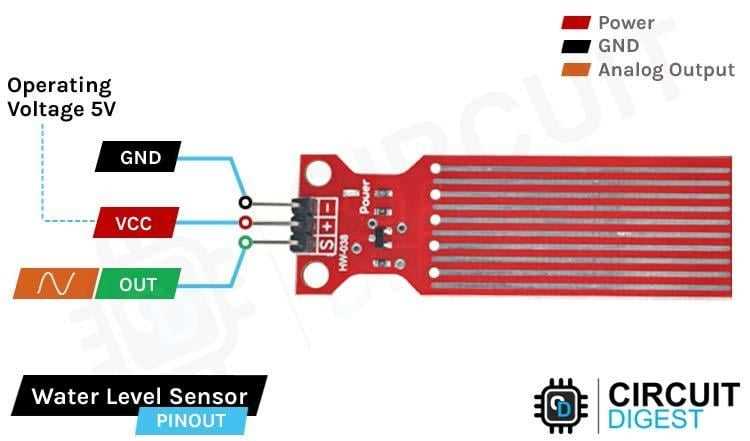
Place two metal probe plates vertically along the tank wall with a spacing of 5–20 mm. As liquid rises between them, the dielectric constant around the plates increases, which changes the electrical capacitance measured by the detection electronics. Dry air has a relative permittivity close to 1, while typical liquids such as fresh H₂O have a value near 80, producing a measurable shift.
The sensing plates connect to an oscillator or timing stage built around components such as a 555 timer, RC oscillator, or microcontroller input pin. Capacitance change alters oscillation frequency or pulse width. For example, a probe pair with baseline capacitance around 20–40 pF in air may rise to 150–300 pF once submerged, depending on plate area and spacing.
Use corrosion-resistant materials for the probes. Stainless steel rods or copper plates coated with epoxy reduce oxidation during long-term tank installation. A typical plate size of 30–50 mm width and 100–200 mm height provides stable readings for small reservoirs and household storage tanks.
Signal processing stages convert the capacitance variation into a clear output. A comparator, transistor stage, or microcontroller analog input can translate frequency or voltage shifts into a pump control signal or visual indicator. Proper shielding of probe wires and keeping cable length under 1–2 meters helps reduce noise and false readings.
Capacitive Water Level Sensor Circuit Diagram With Electrode Plates and Signal Output
Install two vertical metal probes along the tank wall and connect them to an RC oscillator input. The plates act as a variable capacitor whose value changes as liquid surrounds them. In air the capacitance often remains between 15–40 pF, while immersion in liquid can raise it to 150–300 pF. This variation alters the frequency of the timing stage built with components such as a 555 timer, CMOS oscillator, or microcontroller input pin. The oscillator output then feeds a comparator or transistor stage that converts the frequency shift into a digital signal used for pump control or status indication.
Probe Geometry and Signal Output Arrangement
Use stainless steel strips or rods with a spacing of 8–15 mm and an active sensing length of 100–250 mm for small tanks. Larger spacing reduces sensitivity, while extremely narrow spacing can cause unstable readings from condensation or mineral buildup. The oscillator output typically drives a transistor switch or logic input. When capacitance rises above the preset threshold, the comparator output changes state and can activate a relay, LED indicator, or controller input. Shielded cable between probes and electronics helps reduce stray capacitance and keeps measurement drift below 5–10 pF over several meters of wiring.
How Capacitive Probe Plates Detect Water Height in a Tank
Mount two conductive plates vertically along the container wall with a gap of 8–20 mm. As liquid rises between them, the dielectric constant around the plates increases. Air has a relative permittivity near 1, while liquid such as H₂O reaches values close to 80. This difference causes a measurable change in capacitance that corresponds to the liquid height inside the tank.
The plate pair forms a variable capacitor connected to an oscillator or timing stage. When the tank is empty, capacitance may remain around 20–40 pF. As the liquid column covers more surface area of the probes, capacitance can increase beyond 150–300 pF. The oscillator converts this change into a shift in frequency or pulse duration, which electronic control stages can measure.
Recommended Probe Dimensions
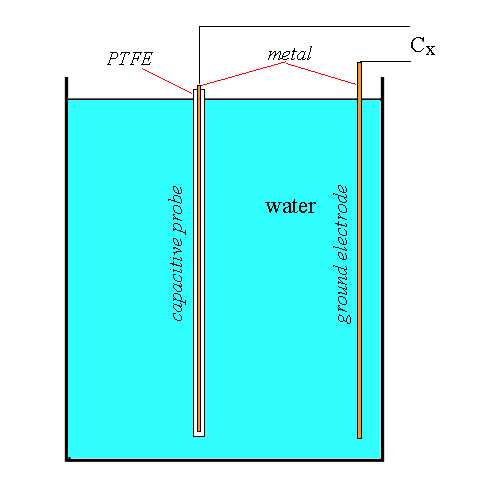
Stable readings depend on proper geometry and material selection.
- Plate width: 20–50 mm
- Active sensing height: 100–300 mm
- Spacing between probes: 8–15 mm
- Material: stainless steel or epoxy-coated copper
As the liquid surface moves upward, a larger portion of the probe area becomes surrounded by a high-permittivity medium. This gradually raises capacitance, producing a smooth electrical response that corresponds to the liquid column height.
Measurement Stability Factors
- Keep probe wiring shorter than 2 m to limit stray capacitance
- Use shielded cable when the electronics module is placed away from the tank
- Avoid placing probes near metal tank walls without insulation spacing
- Clean probe surfaces periodically to remove mineral deposits