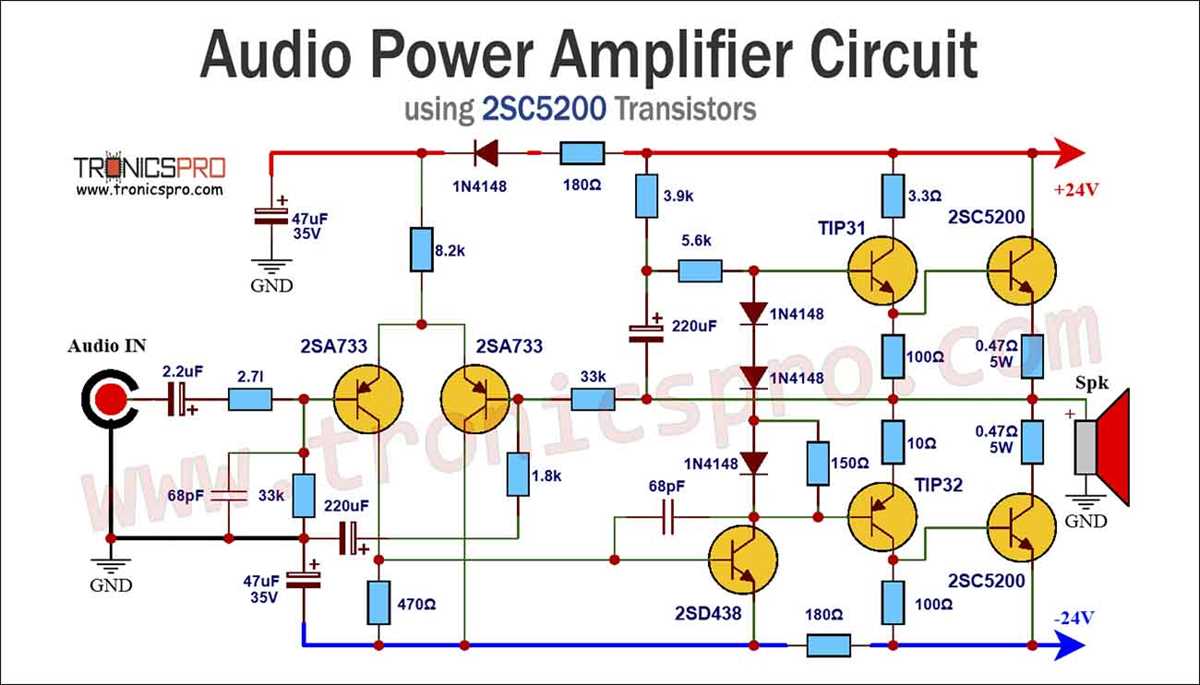
Trace the signal path from the input jack to the speaker terminals before connecting any component. A typical sound amplifier layout shows input stage, gain stage, tone section, and output driver. Identify resistors, capacitors, transistors, and integrated amplifiers along the path. For small stereo boards operating at 5–24 volts, signal normally enters through a coupling capacitor rated between 1µF and 4.7µF, which blocks DC while allowing the waveform to pass.
Locate the amplification stage immediately after the input section. In many consumer devices this stage uses an operational amplifier such as LM358 or a transistor pair in a differential configuration. Check component values printed near each symbol: resistors often range from 1kΩ to 100kΩ to control gain, while feedback paths stabilize output levels and reduce distortion.
Observe how filtering components shape the sound before it reaches the speaker driver. Capacitors combined with resistors create high-pass or low-pass filters that remove unwanted frequencies. For example, a 0.1µF capacitor with a 10kΩ resistor forms a filter that limits low-frequency noise, improving clarity in small radio or portable speaker assemblies.
Follow the final stage leading to the loudspeaker connection. This section usually contains a push-pull transistor pair or an integrated amplifier package such as TDA2030 or TDA2822. Output traces carry higher current, so board layouts often use wider copper paths. Confirm ground reference points and supply lines to avoid noise or overheating during operation.
Audio Circuit Diagram for Amplifiers Speakers and Basic Sound Signal Connections
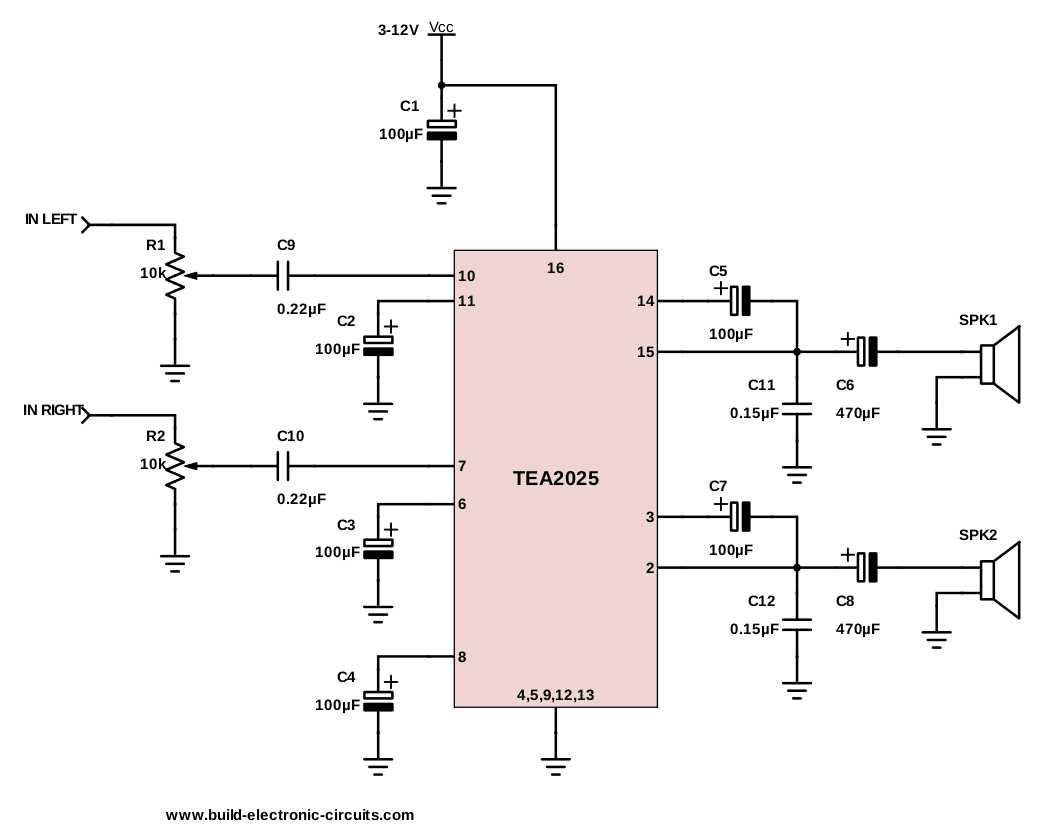
Follow the signal route from the input connector to the speaker terminals before assembling any sound amplifier board. A typical layout shows three main sections: input conditioning, gain stage, and output driver. Each section uses different component groups that shape and increase the signal before it reaches the loudspeaker coil.
Main stages in a typical amplifier layout
- Input coupling capacitor that blocks DC from the source device
- Voltage gain stage built with a transistor pair or operational amplifier
- Tone shaping network formed by resistors and capacitors
- Driver stage that prepares current for the output section
- Output transistor pair or integrated amplifier connected to the speaker
Keep component values within common ranges used in small sound amplifier boards. Input coupling capacitors usually fall between 1µF and 10µF. Feedback resistors near the gain stage often range from 4.7kΩ to 100kΩ, which sets amplification level. Output sections using integrated amplifier chips such as TDA2030 or TDA2822 operate from supply rails between 9V and 24V, while compact portable modules may run from a single 5V source.
Basic signal path from source to loudspeaker
- Signal enters through input jack from phone, radio, or playback device
- Coupling capacitor blocks DC components
- Amplifier stage increases voltage level
- Driver stage boosts current capability
- Output transistors feed the loudspeaker voice coil
How to Read Audio Circuit Diagram Symbols for Amplifiers Filters and Speakers
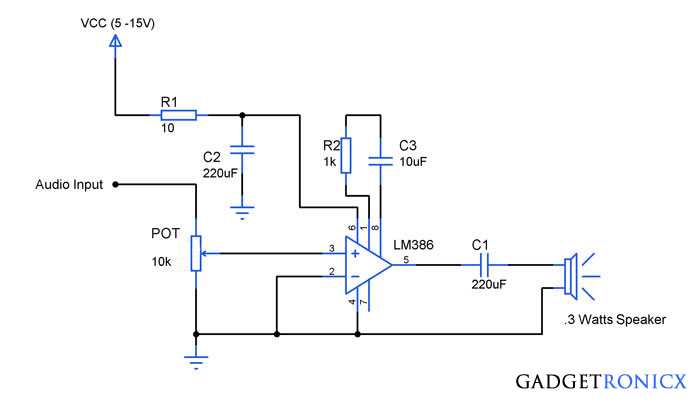
Identify each component symbol before tracing the signal route across the electronic layout. Small zigzag lines represent resistors that limit current or divide voltage. Parallel straight lines mark capacitors that pass AC signal while blocking DC. These parts appear repeatedly in amplifier input stages and tone shaping networks.
Recognize transistor symbols because they control amplification. Bipolar junction transistors appear with three leads labeled base, collector, and emitter. Arrows on the emitter indicate device type. NPN devices push current toward ground, while PNP types direct current toward the supply rail.
Operational amplifier symbols appear as triangular shapes with two input leads and one output lead. The negative input usually receives a feedback path formed by resistors or capacitors. Gain depends on the ratio between feedback resistance and input resistance, often between 10kΩ and 100kΩ.
Capacitors used in filter networks appear in two common forms. Non-polarized units show two identical plates, while electrolytic types display one curved plate and polarity marks. In sound filtering stages values often range from 0.01µF to 100µF depending on the frequency range being shaped.
Locate ground symbols that appear as stacked horizontal lines or triangular marks. These indicate the shared reference point of the entire electronic layout. Incorrect ground connections produce hum or unstable amplification.
Speaker symbols usually appear as a circle or cone shape connected to the output stage. This element converts electrical signal into mechanical movement through a voice coil placed inside a magnetic field. Typical impedance values printed nearby include 4Ω, 6Ω, or 8Ω.
Inductor symbols appear as a series of curved loops. These components work with capacitors to build frequency filters. A coil rated at 100µH to several millihenries may appear in crossover networks that divide low and high frequencies before they reach separate speaker drivers.
Trace the complete path from input connector through amplification stages and filtering networks until reaching the loudspeaker output. Understanding each graphical symbol allows quick identification of gain stages, feedback loops, and frequency shaping sections across complex electronic layouts.