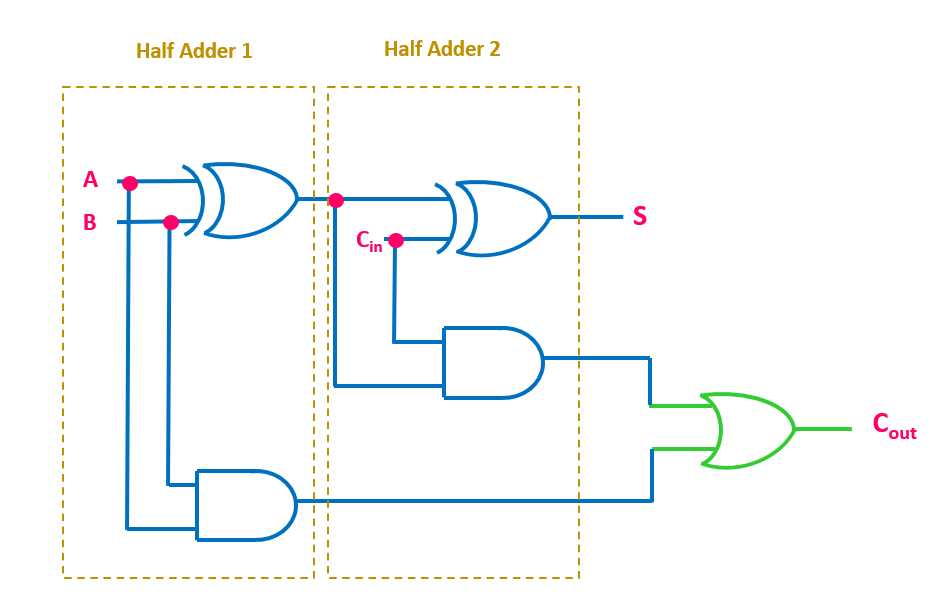
To build an effective arithmetic logic system, start by focusing on the core components: binary adders and their interconnections. These elements are fundamental for performing addition tasks in digital devices. Begin by ensuring that each component, such as the half adder or full adder, is properly aligned with the expected output logic. Double-check that inputs and outputs are connected without interference, ensuring a clean flow of data through the system.
The next step involves understanding how the sum and carry outputs work in conjunction with each other. The sum output represents the least significant bit of the result, while the carry output indicates an overflow, which is important when handling larger numbers. When constructing the design, ensure that each gate used in these components is wired to handle the necessary logic operations: AND, OR, and XOR gates.
Finally, testing the system is critical. Use a logical sequence to input values and monitor the outputs. Identify any faulty connections or incorrect logic gate behavior. Proper testing will ensure that the addition process works as expected and that the system can reliably handle varying binary inputs without error.
Adder Circuit Design and Implementation
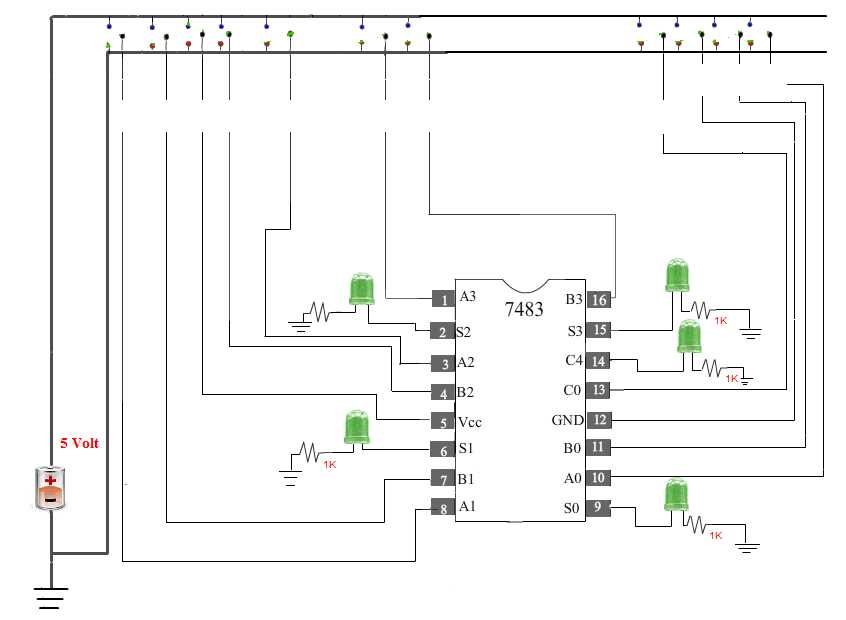
Start by choosing the basic building blocks for the addition operation. A half adder is the simplest form, combining XOR and AND gates to produce sum and carry outputs. If you need to manage carry propagation, use a full adder, which integrates both the XOR and AND gates along with an OR gate to handle the carry bit. This design can be expanded by chaining multiple full adders for multi-bit operations, ensuring proper bit manipulation across the entire system.
Consider the functionality of each gate in the setup. The XOR gate is key for calculating the sum, as it outputs a 1 when the inputs differ. The AND gate produces the carry bit when both inputs are 1. Organize the gates logically so that they work together seamlessly, ensuring that no bits are lost during addition. Pay attention to how carry bits are transferred to the next bit in a multi-bit system to prevent errors.
After designing the layout, it’s time to implement and test your design. If you’re working with hardware, wire the gates on a breadboard, ensuring each connection is secure and follows the design carefully. Test the system with different input values to verify correct operation. Use a variety of test cases, including edge cases like adding zeros or ones, to confirm the reliability and accuracy of the output.
Once you’ve validated the design on the hardware level, integrate it into the larger system. Ensure it connects smoothly with other components, such as memory elements or data processors. Maintain focus on signal integrity and prevent issues like signal delays, which may cause incorrect outputs. A successful design should be robust and able to handle a wide range of input scenarios with consistent performance.
How to Build a Simple Binary Adder Circuit
To begin, gather the necessary components: two XOR gates, two AND gates, one OR gate, and a few resistors and wires. The XOR gates will be used to generate the sum output, while the AND gates will handle the carry bit. The OR gate is used to combine the carry bits from each stage of the addition process. Start by identifying the inputs for your system, which will be two binary values (A and B) that you want to add together.
Next, connect the first XOR gate to the two input values. This gate will generate the preliminary sum by outputting a 1 when either of the two inputs is 1, but not both. The result from this gate will serve as the partial sum. At the same time, connect an AND gate to the same inputs to produce the carry bit. This carry bit is crucial for adding values beyond the current bit and propagating it to the next stage of the operation.
Now, the carry bit from the AND gate must be combined with the sum from the XOR gate to continue the addition. Use another XOR gate to sum the results and produce the final sum bit. Additionally, use an OR gate to combine the carry from the second AND gate with the sum from the XOR gate. This ensures that the carry bit will be added to the final result of the current bit position.
If you are working with a multi-bit addition, repeat this process for each pair of bits. For example, to add two 4-bit numbers, create four XOR gates, four AND gates, and three OR gates. Each pair of input bits will be processed in the same manner as described above, and the carry bits will propagate through each stage.
After the design is completed on paper or a breadboard, begin wiring the components. Ensure that each gate is securely connected according to the plan. Use jumper wires for connections and place the resistors in line to avoid any short circuits. Test the system with different binary inputs to verify that the expected sum and carry bits are outputted correctly.
Once the wiring is complete, perform systematic testing. Test with both small and large values, including edge cases where carry bits are generated at each stage. This ensures that the system behaves as expected and that no errors occur in the summation process. If any issues arise, check the connections to the AND and OR gates to make sure the carry propagation is functioning properly.
Finally, ensure that your system can handle a range of binary numbers accurately. This simple binary adder setup provides a foundation for understanding basic digital addition and can be expanded for more complex operations. By mastering this setup, you can scale up to more advanced arithmetic logic units (ALUs) in larger projects, enhancing the overall capabilities of digital systems.