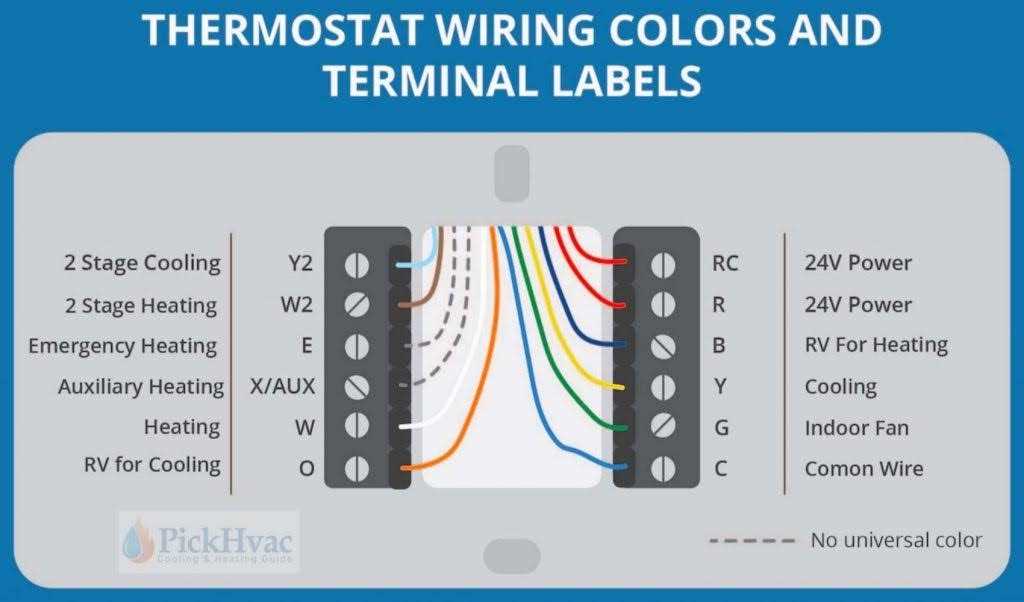
When setting up a climate control system, it’s important to correctly understand the role of each connection. A 6-terminal model typically includes several key components: heating, cooling, fan, and power connections. These are essential for enabling different modes, such as switching between heating and cooling, and operating the fan independently.
Start by identifying the terminals on your unit. The standard setup usually includes terminals for “R” (power), “C” (common), “Y” (cooling), “W” (heating), “G” (fan), and sometimes a “O” or “B” terminal for reversing valve control. Each of these corresponds to a specific function that must be wired correctly to ensure smooth operation.
Before you begin connecting, make sure the power is turned off to prevent any electrical hazards. Carefully map each wire to its corresponding terminal. Using a label for each wire can help avoid confusion, especially if your system has additional components that differ from the basic configuration.
In some cases, issues may arise, such as improper connections or system failure to respond to changes in settings. If the system doesn’t behave as expected after setup, double-check the wiring to ensure there are no misplacements and that the unit is receiving consistent power.
Honeywell Thermostat Wiring Guide with 6 Wires
To correctly set up a six-wire connection for a climate control system, begin by identifying the terminal labels. Common terminals include “R” for power, “C” for common, “Y” for cooling, “W” for heating, “G” for fan, and sometimes “O” or “B” for reversing valve control. Ensure each wire is securely attached to the correct terminal, as improper connections can cause malfunction or failure to operate correctly.
After turning off the power, connect the red wire (often labeled as “R”) to the power terminal. This will be your system’s main power source, delivering 24V current to the unit. The “C” terminal, marked as common, should be connected to a blue or black wire, providing a return path for the power. This ensures a continuous electrical loop and stable operation.
Next, attach the yellow wire to the “Y” terminal for cooling. The “Y” terminal is responsible for activating the cooling mode in the system. When the cooling cycle is needed, this wire sends a signal to the unit, enabling it to switch on the cooling components.
For heating, the white wire connects to the “W” terminal. This terminal controls the heating function of the system, and the wire will direct the signal to activate the heating components when the temperature falls below the set point.
Connect the green wire to the “G” terminal. This terminal manages the fan operation. When the thermostat signals the need for air circulation, the green wire allows the fan to turn on, circulating air throughout the space. The fan may run during both heating and cooling cycles.
If your system uses a reversing valve, you will need to connect the “O” or “B” terminal to control the valve’s direction. The O or B terminal will determine whether the valve sends the refrigerant in the cooling or heating mode, depending on the system’s requirements.
Once all the wires are connected securely to the terminals, test the system by restoring the power. Adjust the temperature settings to test each mode: cooling, heating, and fan. If the system operates as expected, the wiring setup has been completed successfully. If issues arise, double-check the connections for any errors or loose connections.
Understanding the Role of Each Wire in a 6-Wire Thermostat Setup
The first wire to understand is the red one, typically labeled “R”. This is the primary power supply for the system, bringing 24V current from the HVAC control board to the unit. It powers the entire system and is essential for activating the heating or cooling cycles. Ensure that this wire is securely connected to the “R” terminal to guarantee proper operation.
The second wire, often blue or black, is connected to the “C” terminal. This wire serves as the common return path, completing the circuit back to the power source. It ensures that the system has a continuous flow of electricity, which stabilizes the operation of the system and allows the thermostat to function correctly without losing power intermittently.
The yellow wire is responsible for activating the cooling cycle and connects to the “Y” terminal. When the room temperature exceeds the set threshold, this wire triggers the air conditioning unit, allowing cold air to circulate through the space. Proper connection to this terminal is crucial for a responsive and effective cooling cycle.
The white wire is connected to the “W” terminal and controls the heating cycle. When the temperature drops below the desired level, this wire signals the system to initiate heating. It is necessary for controlling the furnace or heater and is one of the most important wires for maintaining comfort during colder months.
The green wire connects to the “G” terminal and manages the operation of the fan. When the thermostat calls for air circulation, this wire signals the fan to turn on and distribute air throughout the room. It ensures consistent airflow during both heating and cooling modes, contributing to even temperature regulation.
If your HVAC system includes a reversing valve, the orange or sometimes brown wire will connect to the “O” or “B” terminal. This wire controls the direction of the valve, determining whether the system switches to cooling or heating mode. The correct wiring of this component is important for systems that handle both heating and cooling efficiently, as it directs the refrigerant flow.