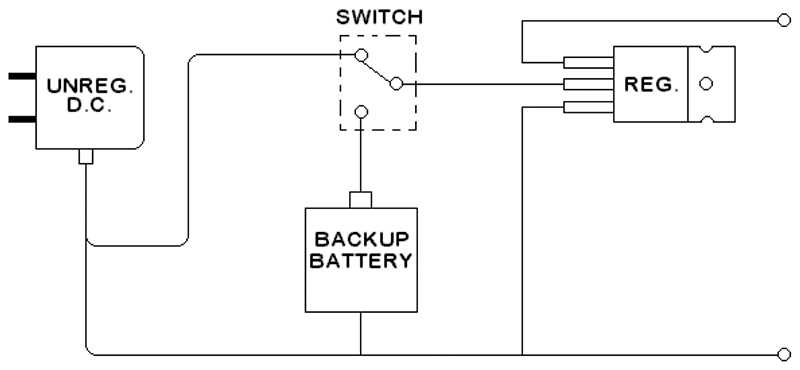
Select a line-interactive power backup layout that separates charging, energy storage, and load switching into clearly defined stages; this structure reduces overheating and simplifies maintenance. A practical design places the AC input filter at the entry point using a metal-oxide varistor rated around 470–560 V and a 10–20 A fuse. Directly after this protection stage, a rectifier bridge rated at 25–35 A converts mains supply to DC, feeding a charging block that stabilizes voltage near 13.6–13.8 V for a 12-volt battery or 27.2–27.6 V for a 24-volt pack. Maintain trace spacing above 2 mm on the board when working with mains potential above 220 V.
The storage stage normally relies on sealed lead-acid or lithium iron phosphate cells. Connect them through a current-limiting resistor or MOSFET charging controller capable of handling 10–30 A depending on capacity. Thermal sensors attached to the battery terminals help regulate charge voltage; a reduction of roughly −3 mV per cell per °C prevents overheating during long charging cycles. Place electrolytic capacitors between 2200 µF and 4700 µF across the DC rail to smooth ripple produced by the rectifier bridge.
Energy conversion occurs in the inverter block built around PWM control ICs such as SG3525 or TL494 driving paired MOSFETs like IRF3205. These switches alternate current through a ferrite or laminated transformer, producing a stepped or sinusoidal output near 50 Hz. Gate resistors between 10 and 33 Ω limit switching spikes, while snubber networks using a 0.1 µF capacitor and 100 Ω resistor suppress voltage overshoot across the transformer windings.
The load-transfer section uses a relay rated for 250 V AC at 10–16 A. When mains voltage disappears, a comparator built around an operational amplifier senses the drop below roughly 180–190 V and triggers the relay to connect the inverter output to household equipment. Add a delay network using a 47–100 µF capacitor and a 100 kΩ resistor so the relay changes state after several milliseconds, preventing rapid oscillation during unstable supply conditions.
Electrical Layout of a Backup Power Inverter
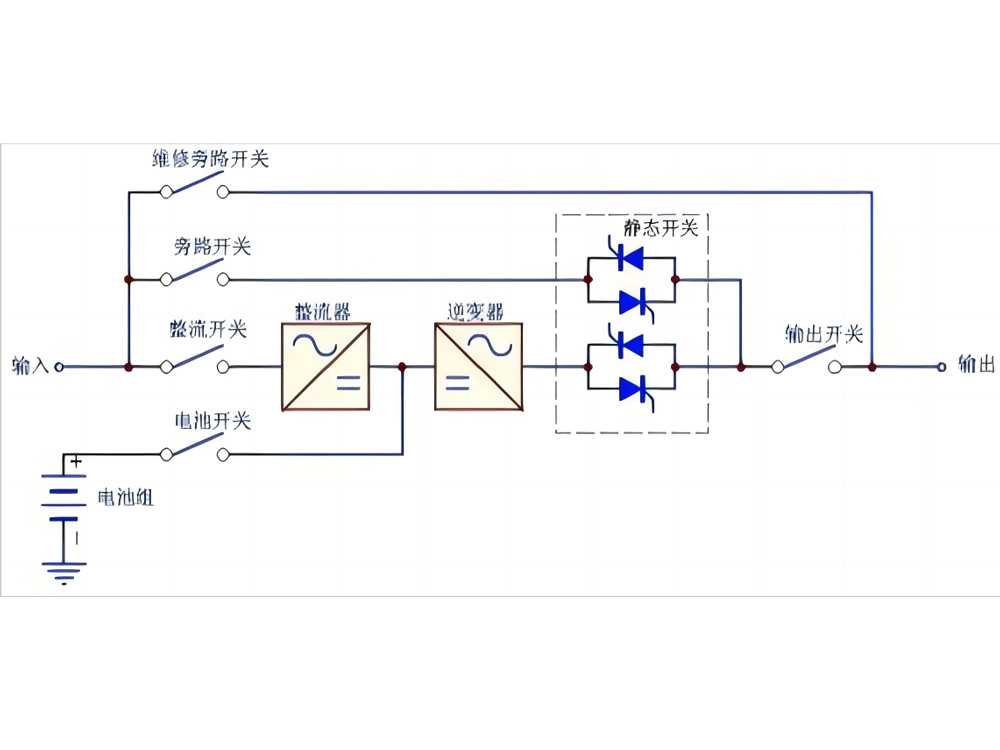
Use a line filter followed by a bridge rectifier and a charging stage as the entry section of the power backup inverter layout. The AC mains first passes through an EMI filter composed of a 0.1–0.47 µF X-class capacitor and a pair of 2–10 mH chokes. After filtering, a full-bridge rectifier built from four diodes rated 600–1000 V converts alternating input into direct current. A smoothing capacitor between 220 µF and 470 µF (400 V rating) stabilizes the bus voltage before it reaches the battery charging regulator.
The battery charging block normally relies on a step-down transformer or a high-frequency switching supply depending on design goals. In small units a 12 V or 24 V lead-acid battery is connected through a current-limiting resistor and a control IC such as LM317 configured for constant-voltage charging at 13.6–13.8 V. Charging current commonly stays within 10–20 % of battery capacity; a 7 Ah battery therefore receives roughly 0.7–1.4 A.
The energy storage section includes the battery, a protection fuse, and a low-voltage cutoff network. A comparator monitors battery potential and disconnects the load if voltage falls near 10.5 V for a 12 V cell pack. This prevents deep discharge that shortens service life. A simple design uses an LM393 comparator, reference divider resistors near 10 kΩ, and a relay or MOSFET switch.
The inverter stage converts stored direct current into alternating output. A pair of power MOSFETs such as IRF3205 or IRFZ44N operate in push-pull mode with a center-tapped transformer primary. Each transistor alternately switches the current at 50 Hz or 60 Hz depending on region. Gate drive signals originate from a timer IC or a microcontroller producing two complementary square waves.
An oscillator block defines switching frequency and timing symmetry. A common approach uses a 555 timer feeding a flip-flop such as CD4013, generating two opposite pulses with 50 % duty ratio. The frequency calculation uses resistor and capacitor values; for example, 10 kΩ and 100 µF produce about 50 Hz. Stable timing avoids transformer saturation and overheating.
The transformer raises voltage from the battery level to mains range. In a 12 V configuration the primary winding typically handles currents up to 20–40 A during peak load, so thick copper wire is required. The secondary winding outputs roughly 220–230 V AC or 110–120 V depending on region. Power rating often ranges between 300 W and 1000 W for home backup units.
An output filter smooths the square waveform produced by the switching stage. A simple LC network with a 1–3 mH inductor and a 0.47–1 µF capacitor reduces high-frequency components and limits electromagnetic noise. While the resulting waveform remains modified square, many computers, routers, and LED lighting systems operate without difficulty.
Status monitoring components improve reliability. LEDs connected through 1 kΩ resistors indicate mains presence, battery charging activity, and backup mode. Some designs add a small buzzer driven by a transistor that activates when battery voltage approaches the cutoff level, warning the user that stored energy is nearly depleted.