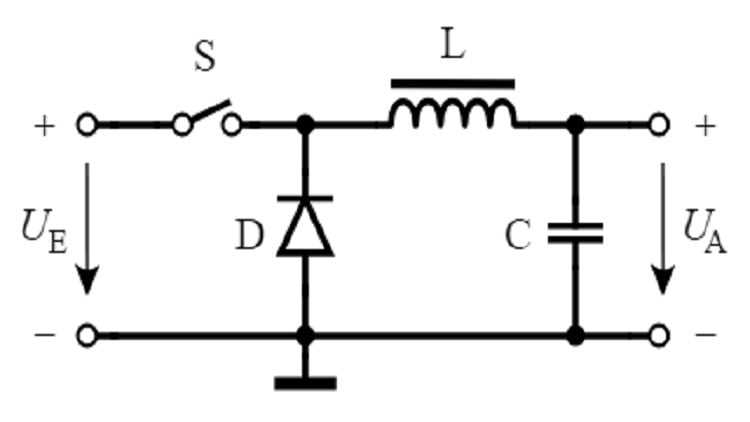
Use a regulated switching topology to maintain a steady low-voltage output from a higher supply. Select a controller with fast transient response and overcurrent protection to prevent damage under sudden load changes.
Choose inductors and capacitors carefully to minimize ripple and voltage spikes. For a 12V to 5V reduction at 2A, use a 33µH inductor with a saturation current above 2.5A and low ESR capacitors of at least 470µF on the output rail.
Position components strategically on the board to reduce loop area and EMI. Place the switching transistor and diode close to the inductor and keep input capacitors near the power source connection to maintain stable operation.
Verify switching frequency and duty cycle settings against the load profile. For typical MOSFET-based designs, a frequency between 100kHz and 500kHz balances efficiency and thermal performance without generating excessive noise.
Step Down Converter Layout and Component Connections for Stable Voltage Regulation
Place the main switching element and diode close to the inductor to minimize parasitic inductance and reduce voltage spikes. Keep input capacitors adjacent to the supply terminals, and route the feedback signal trace away from high-current paths to ensure accurate voltage sensing and stable regulation.
Use short and wide copper traces for power paths to lower resistance and heat buildup. Output capacitors should be positioned near the load, and decoupling capacitors placed directly at IC pins to filter high-frequency noise and maintain consistent voltage under dynamic load conditions.
Selecting Inductors and Capacitors for a Step Down Converter
Choose inductors with low DC resistance and sufficient current rating to handle peak load without saturation. For a 5V, 3A output, an inductor of 10–15µH with a saturation current above 4A ensures minimal ripple and stable operation.
Electrolytic and ceramic capacitors should be combined at the input and output. Place a 100µF electrolytic capacitor at the input for bulk filtering, and add a 10µF ceramic capacitor nearby to suppress high-frequency switching noise effectively.
Output capacitance must match load requirements. For a 5V, 3A load, use at least 220µF of low ESR electrolytic capacitors, supplemented with 22µF ceramics across the output terminals. This configuration reduces voltage deviations during transient loads.
Minimize trace length between components to reduce parasitic inductance and resistive losses. Position the inductor close to the switching element and place output capacitors directly across the load, ensuring consistent voltage regulation and lower electromagnetic interference.