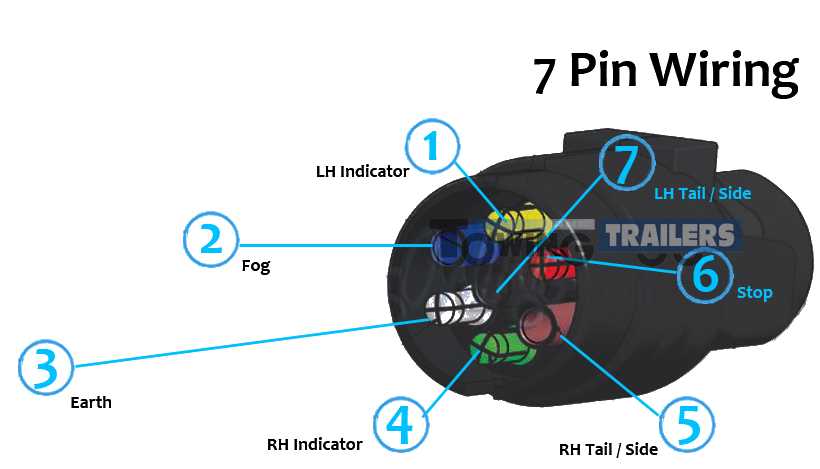
Check terminal numbering on the tow vehicle socket before attaching any conductor. A seven-contact trailer connector distributes power to brake lamps, turn indicators, tail lights, reverse light, and ground return. Each terminal inside the round coupler corresponds to a separate circuit. Misplacing a single conductor can disable signal lamps or trigger fuse failure.
Most European and many global towing setups use the ISO 1724 layout. In this arrangement the ground return typically uses a white lead connected to terminal 3, while the left indicator usually runs through a yellow conductor on terminal 1. The right indicator is often green on terminal 4. Tail lamps commonly share a brown lead connected to terminal 7. Brake lamps frequently use a red conductor linked with terminal 6. Rear fog light circuits may run through a blue lead attached to terminal 2.
Use conductors rated around 1.0–1.5 mm² cross-section to support lighting loads without voltage drop. Strip insulation by roughly 6–7 mm, twist strands tightly, then secure each lead under the terminal screw or clamp inside the trailer connector body. After tightening, pull gently on each conductor; movement indicates poor contact and possible lighting faults during towing.
Seal the housing with its rubber grommet and route the cable so water cannot enter the connector shell. Corrosion inside the coupler often causes dim lamps or intermittent signals. A small amount of dielectric grease on metal contacts slows oxidation and improves long-term electrical continuity.
7 Pin Plug Wiring Diagram With Pin Layout Wire Colors and Trailer Light Connections
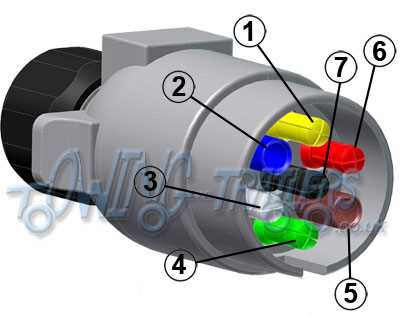
Verify terminal numbering inside the seven-contact trailer socket before attaching any conductor. Each contact controls a specific lighting circuit on the towed unit. A common European layout uses contact 1 linked with the left indicator, contact 4 linked with the right indicator, contact 6 connected to brake lamps, and contact 7 feeding rear position lamps. Incorrect placement often leads to reversed indicators or brake lights activating with turn signals.
Contact Layout and Circuit Roles
Use the typical ISO arrangement used on many tow vehicles. Contact 1 carries the left turn signal through a yellow lead. Contact 2 usually serves the rear fog lamp through a blue lead. Contact 3 works as the ground return and normally uses a white conductor. Contact 4 supports the right indicator through a green lead. Contact 5 may handle the right tail lamp with a brown conductor, while contact 6 powers brake lamps through a red lead. Contact 7 often supplies the left tail lamp through a black conductor.
Strip insulation by roughly 6 mm and twist copper strands tightly before inserting them into terminal clamps inside the round connector body. Tighten screws firmly yet avoid crushing the copper. A gentle pull test confirms that each conductor remains secured. Loose terminals lead to flickering lights during travel, especially on rough roads.
Wire Colors and Trailer Light Connections
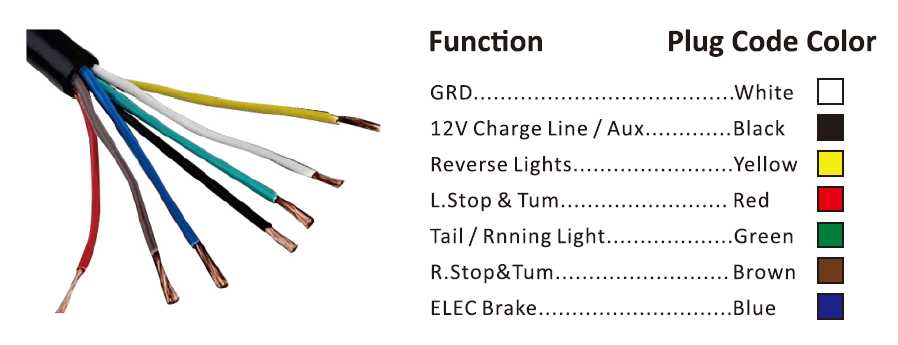
Match conductor colors carefully while connecting the towing cable to the vehicle socket. Yellow normally routes to the left indicator circuit, green to the right indicator, red to stop lamps, brown to tail lamps, blue to rear fog, black to additional tail feed, and white to ground return. These color assignments appear on many factory harness kits and replacement cables used with seven-contact trailer connectors.
Seal the connector housing with its rubber gland after assembling the conductors. Position the cable so rainwater cannot enter the rear cap. Applying a thin layer of dielectric grease on the metal contacts slows oxidation and helps maintain stable current flow through the lighting circuits during long-term towing use.
Pin numbers and functions in a 7 pin plug for trailer lighting circuits
Check the numbered terminals inside the seven-contact trailer connector before attaching any conductor. Each numbered contact routes power to a specific lighting circuit on the towed vehicle. Incorrect placement causes reversed indicators, inactive brake lamps, or blown fuses during operation.
Terminal numbers and circuit roles
- 1 – Left turn signal circuit, usually connected with a yellow conductor
- 2 – Rear fog lamp circuit, commonly linked with a blue conductor
- 3 – Ground return connection, typically using a white conductor
- 4 – Right turn signal circuit, normally attached to a green conductor
- 5 – Right tail lamp supply, frequently paired with a brown conductor
- 6 – Stop lamp circuit delivering current to brake lights, often using red insulation
- 7 – Left tail lamp supply, commonly connected with a black conductor
Match each conductor with the correct numbered contact while assembling the trailer connector body. Use copper leads with a cross-section near 1.0–1.5 mm², strip roughly 6 mm of insulation, insert the strands fully into the terminal clamp, and tighten the screw firmly. After securing all conductors, verify light operation: activate turn indicators, press the brake pedal, switch on tail lamps, and confirm that each lamp on the trailer responds to its assigned circuit without flicker or delay.