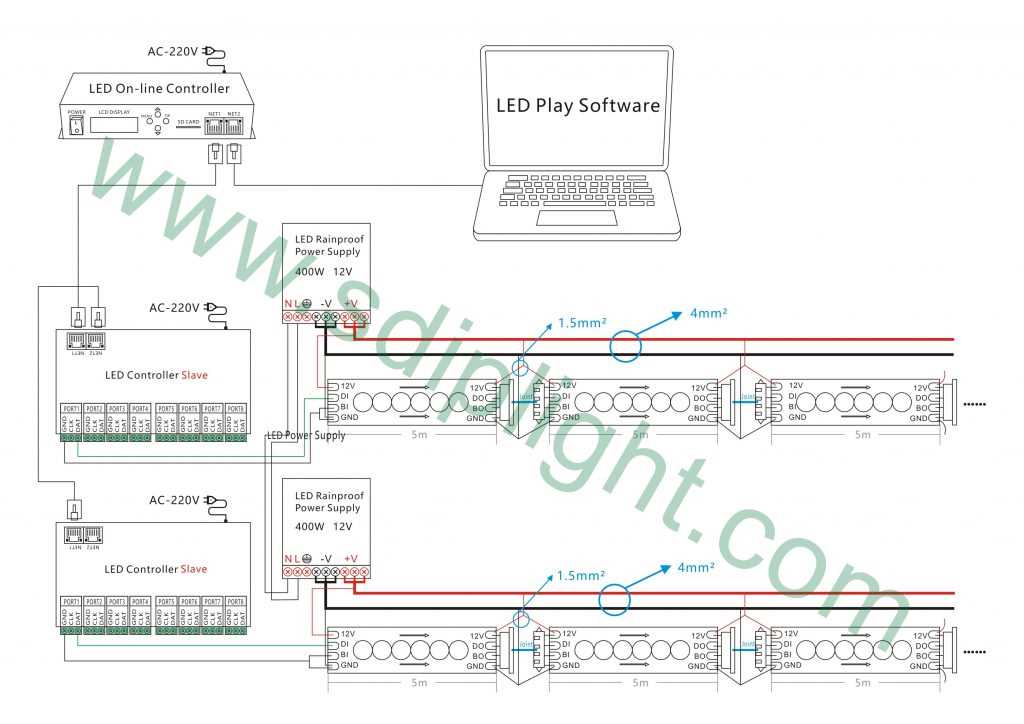
Connect the flexible tape module to a regulated DC power unit rated for the same voltage printed on the circuit board, usually 12V or 24V. Check polarity before attaching conductors. The positive pad is often marked V+ or +, while the negative pad uses V− or GND. Reversing polarity can damage current limiting resistors or controller electronics.
Calculate power demand before selecting the supply unit. Many flexible diode tapes consume between 4.8 W and 14.4 W per meter depending on diode density. A five-meter roll rated at 14.4 W per meter draws roughly 72 watts. Choose a power unit with at least 20–30% reserve capacity to avoid overheating and voltage drop during long operating periods.
Use parallel connection for long installations exceeding five meters. Feeding power only from one end often causes voltage drop along copper traces, which leads to dim sections at the far end of the tape. Adding a second feed point keeps voltage close to 12–24 V across the entire length.
Insert a control module between the power unit and the diode tape when brightness adjustment or color mixing is required. For RGB versions, the controller normally uses four conductors: one common positive lead and three negative channels labeled R, G, and B. Each channel regulates current flow through separate groups of diodes.
Use copper conductors sized 18–22 AWG for short runs under two meters and thicker conductors for longer distances. Protect solder joints with heat-shrink tubing and mount the tape on aluminum profiles when power density exceeds 10 W per meter to improve heat dissipation and extend diode lifespan.
LED Strip Lighting Wiring Diagram with Power Supply and Controller Connections
Connect the flexible diode tape directly to a regulated DC power unit rated for the same voltage printed on the circuit board. Most tape modules operate at 12V or 24V. Attach the positive conductor from the power unit to the pad marked V+ and the negative conductor to V− or GND. Reversed polarity can damage onboard resistors and driver chips.
Select the power unit according to total watt consumption. Multiply power per meter by total tape length. A common high-density version rated at 14.4 W per meter across a five-meter roll draws about 72 watts. Choose a power unit rated at least 90–100 W to maintain stable voltage and reduce heat inside the power enclosure.
Install a control module between the power unit and the diode tape when brightness control or color mixing is required. The connection layout usually follows this order:
- AC mains input connected to the power unit
- DC output from the power unit routed to the controller input terminals
- Controller output terminals connected to the diode tape pads
RGB versions normally use four conductors between controller and tape. The common positive line feeds all diode groups, while three negative channels regulate color intensity.
- V+ common positive conductor
- R red channel return
- G green channel return
- B blue channel return
Power long installations from multiple feed points. Copper traces on flexible circuit boards are thin, so voltage drop becomes visible after about 5 meters. Injecting power at both ends or every 3–5 meters keeps brightness consistent along the entire tape.
Choose conductor size according to current flow. Typical values include:
- 22 AWG copper for loads below 2 amps
- 20 AWG copper for loads between 2 and 5 amps
- 18 AWG copper for loads between 5 and 8 amps
Mount the tape on aluminum channels when power density exceeds 10 W per meter. Metal surfaces draw heat away from the diode packages and driver resistors, lowering operating temperature and extending service life.
Protect solder joints using heat-shrink tubing and route conductors away from sharp edges or moving parts inside cabinets or ceilings. Add a small inline fuse on the DC output side of the power unit rated slightly above the calculated current to protect the circuit during short conditions.
12V and 24V LED strip power supply connection layout and polarity rules
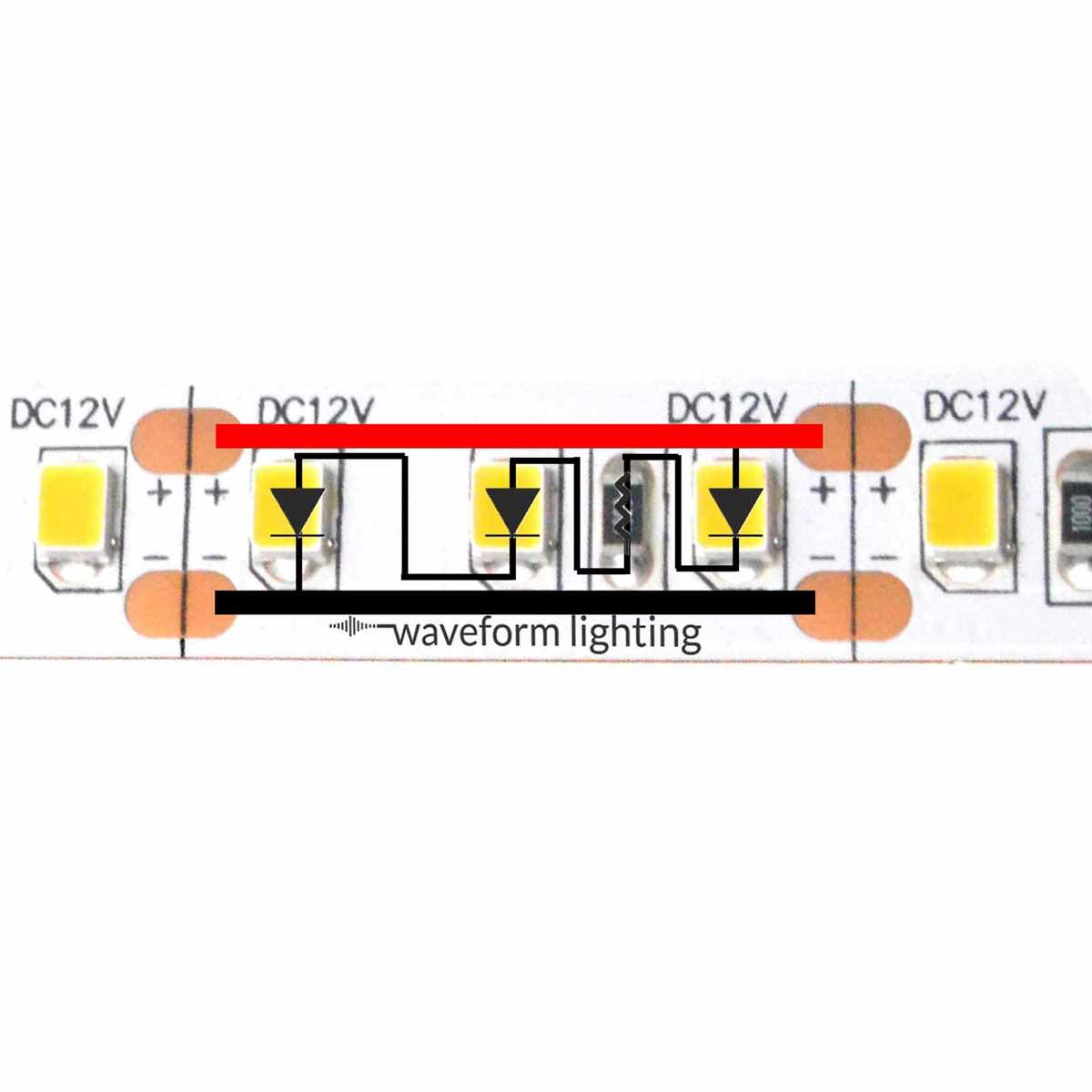
Connect the DC output from the power unit directly to the copper pads marked V+ and V− on the flexible diode tape. Match voltage ratings printed on the circuit board with the power unit output, usually 12V or 24V. The positive terminal from the power unit must connect to the positive pad, while the negative terminal attaches to the ground pad. Reversed polarity can damage current-limiting resistors and integrated driver chips mounted along the tape.
Calculate total load before selecting the power unit and route conductors according to current demand. A five-meter roll rated at 9.6 W per meter draws about 48 W, which equals roughly 4 A on a 12-volt system or 2 A on a 24-volt system. Higher voltage systems reduce current flow and allow longer cable runs with less voltage drop along the conductors. Use copper conductors sized 20–18 AWG for runs longer than two meters and connect additional feed points every 3–5 meters on long installations to maintain uniform brightness across the tape.