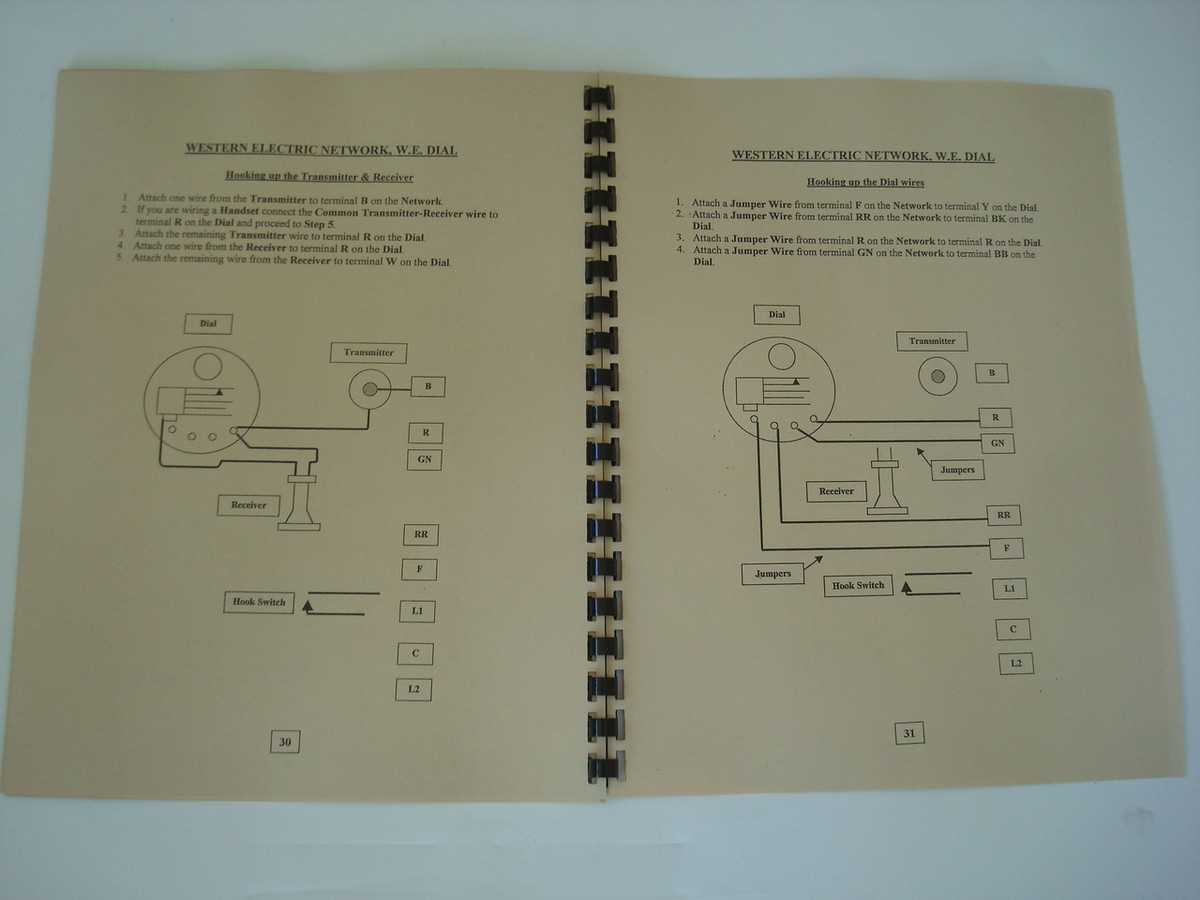
Check conductor colors before connecting a desk set: in many legacy voice installations the red lead carries the ring path and the green lead carries the tip path. These two conductors supply about 48 V DC from the exchange while the handset rests on the cradle. Reversing them rarely damages equipment, yet polarity consistency helps maintain stable signaling with pulse dialing units and early push-button models.
Inside wall plates and junction boxes you may also encounter yellow and black conductors. Those lines commonly supported a second voice channel or a bell control path in multi-room installations from the 1960s–1980s. Mechanical ringers often used the yellow lead routed through a capacitor located in the base of the desk unit or a nearby terminal block. Without that capacitor, the ringer coil can load the main pair and reduce call volume across the circuit.
Many homes used screw terminals labeled T, R, B, and Y. The letters match tip, ring, black, and yellow conductors. Later renovations replaced these blocks with RJ-11 connectors while retaining the same pair mapping: center pins connect to the red-green pair. When tracing cabling behind baseboards or in basements, look for daisy-chain routing where one pair enters a junction point and continues to the next room. This pattern differs from modern star layouts that route each pair back to a single distribution panel.
Reliable voice circuits depend on clean copper contact surfaces and tight terminal screws. Oxidized conductors increase resistance and weaken ring current, which typically ranges between 70 V and 90 V AC during an incoming call. Light abrasion of the conductor end and firm terminal pressure often restores proper ringer response across multiple handsets connected along the same pair.
Old Telephone Wiring Diagram: Identification, Reading, and Practical Use
Check conductor colors and terminal marks first; this step reveals the function of each line in legacy communication cabling. In most analog subscriber lines two conductors carry the signal pair, commonly labeled Tip and Ring. Tip often appears as green or white/blue, while Ring is frequently red or blue/white in North American installations. European systems sometimes rely on grey and white pairs. A quick inspection of these color pairs allows fast recognition of line direction, polarity, and branching inside junction boxes.
Reading a legacy connection chart requires attention to symbol patterns used for junctions, terminals, and distribution blocks. Circles with numbers often represent screw posts, while intersecting lines without dots indicate crossing conductors rather than electrical contact. Many service manuals from the 1960s–1980s depict wall sockets using a rectangular icon containing numbered pins. The numbers correspond directly to terminals inside the outlet housing, which simplifies tracing of each conductor across the scheme.
Identification becomes easier when typical cable structures are known. Multi-pair communication cables follow a strict color hierarchy that repeats every five pairs:
- Pair 1: white/blue – blue/white
- Pair 2: white/orange – orange/white
- Pair 3: white/green – green/white
- Pair 4: white/brown – brown/white
- Pair 5: white/slate – slate/white
These combinations appear in both building risers and external feeder cables. Technicians match them with terminal numbers printed on punch-down blocks or screw strips.
Legacy line schematics often display protective elements placed between the incoming pair and indoor distribution. Carbon block arresters or gas discharge protectors appear as two parallel plates connected to ground. Their presence signals that the line enters from an external pole route rather than an internal branch. Spotting this symbol helps determine where the service entrance sits inside the building layout.
Reading Connection Flow
Follow signal direction from the service entry toward interior outlets. Most schematics place the outside pair on the left and interior branches on the right. Junction nodes show where one pair splits into several branches feeding different rooms. Some plans mark branch numbers directly beside the line segment, while others rely on numbered callouts referencing a legend table.
- Locate the incoming pair at the protection module.
- Trace the pair to the first distribution block.
- Check terminal numbers connected to each branch line.
- Match the numbers with outlet terminals shown elsewhere in the scheme.
This method allows accurate tracking of each conductor without physically opening every wall plate.
Practical Field Application
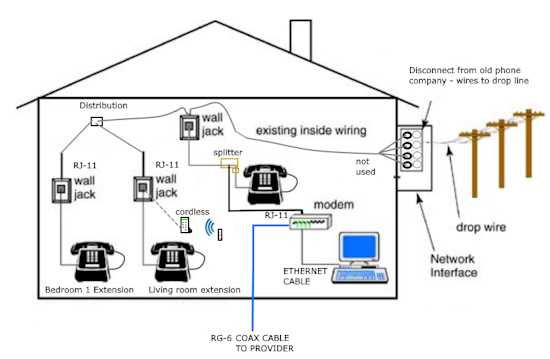
Service technicians frequently use printed connection charts while repairing legacy voice circuits in older buildings. By comparing conductor colors and terminal numbers, they can restore disconnected lines quickly. For example, if a wall outlet stops carrying dial tone, the chart may show that terminal 3 connects to the blue/white conductor running through the hallway junction block. Reconnecting that conductor restores continuity along the pair.
Another practical task involves converting analog voice circuits into DSL or VoIP gateway feeds. The scheme indicates which pair travels directly from the entry protector to the primary outlet. That outlet becomes the correct point for installing the modem or gateway device, preventing interference from parallel branches that may introduce noise.
Accurate interpretation of these legacy connection charts also assists building renovations. Electricians documenting existing cabling trace each pair through distribution blocks and mark them on updated floor plans. The result is a clear map of communication circuits, preventing accidental cuts during wall reconstruction or electrical upgrades.