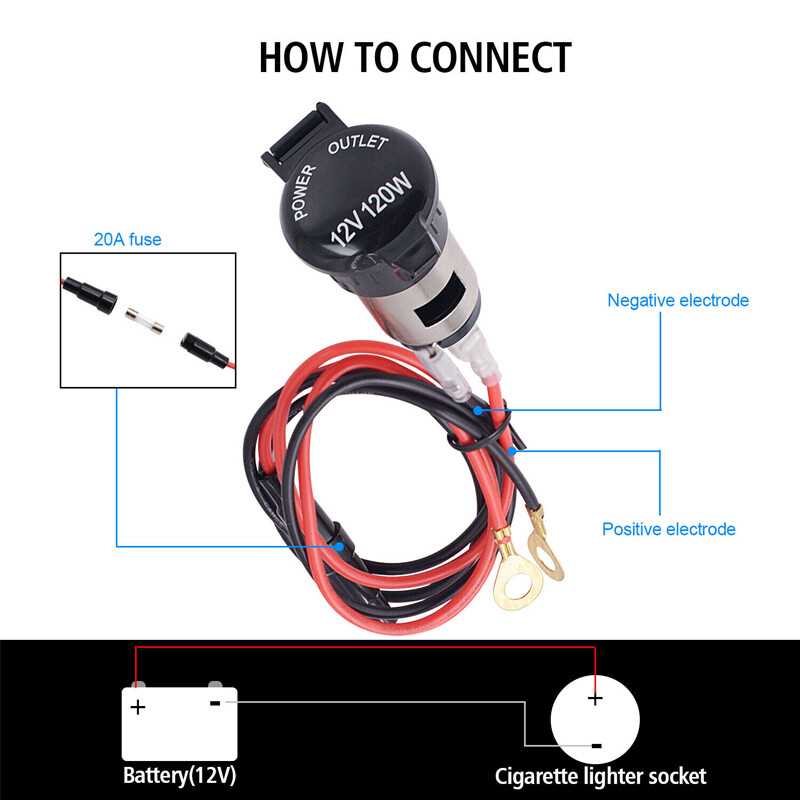
Connect the center contact of the 12-V accessory socket to the +12 V supply and attach the outer metal shell to chassis ground. This arrangement matches the layout used in most passenger vehicles and prevents damage to phone chargers, compressors, dash cameras, and similar equipment designed for automotive power ports.
The inner pin carries the live feed from the vehicle’s electrical system. A fuse rated between 10 A and 15 A should be installed on the supply line no more than 20–30 cm from the battery or fuse block. Copper conductors sized 1.5–2.5 mm² (16–14 AWG) handle the load safely for typical devices such as tire inflators or USB adapters drawing up to about 120 W.
The outer casing serves as the return path and must connect firmly to the vehicle body or a dedicated ground point. Remove paint or corrosion at the attachment spot and secure the terminal with a bolt and star washer. Poor grounding often causes unstable voltage, intermittent device resets, or heat buildup at the socket.
Before powering the circuit, verify polarity with a multimeter set to DC voltage. Place the red probe on the center pin and the black probe on the shell; a reading near 12–14.4 V confirms correct orientation with the engine off or running. If the meter shows a reversed value, swap the conductors immediately to protect connected accessories.
Many installers route the supply through an ignition-controlled relay. This method cuts power when the key is removed, preventing battery drain from devices left plugged into the port. Use a relay rated at 30 A, connect the control coil to an ignition line, and feed the socket through the relay’s switched contacts.
12-V Vehicle Accessory Socket Power and Ground Connection Layout
Connect the center contact of the 12-V vehicle accessory socket to the power lead from the vehicle fuse panel, and attach the outer metal shell to the chassis ground point. This configuration matches the standard used in most passenger cars and trucks, where the inner pin carries supply voltage and the outer sleeve returns current to the vehicle body.
Typical connection layout for a dashboard accessory outlet:
- Center pin → fused power lead from the vehicle distribution block (usually 10–15 A fuse)
- Outer shell → chassis ground bolt or factory grounding stud
- Inline fuse → placed within 20–30 cm of the supply tap
- Conductor cross-section → 1.5 mm² for loads up to 10 A, 2.5 mm² for loads up to 15 A
Use a multimeter before attaching conductors. Measure between the vehicle body and the supply line from the fuse panel; the reading should be around 12–14.4 V when the engine runs. If the outlet will power high-draw devices such as tire inflators or portable compressors, route the supply lead directly from the fuse box rather than tapping into thin dashboard harnesses. Keep the return path short and secure it under a clean metal bolt free of paint or corrosion.
Common installation mistakes and corrections:
- Reversed contacts inside the socket → device plugs may short against the shell
- No fuse near the supply tap → risk of melted insulation during overload
- Ground attached to painted metal → unstable current return and heat buildup
- Thin conductors longer than 2 m → voltage drop causing devices to shut off
A correctly arranged outlet circuit delivers stable 12-V power to dash cameras, phone adapters, portable coolers, and navigation units while protecting the vehicle harness from overload.
How to Identify Positive and Negative Terminals in a Car Cigarette Lighter Socket
Place the red probe of a multimeter on the small metal contact located deep in the center of the 12-volt outlet and touch the black probe to the metal sleeve around the inside wall. If the display shows about 12–14 volts while the vehicle electrical system is active, the center contact carries the 12-volt feed and the cylindrical wall serves as the chassis return.
The internal structure of most automotive accessory ports follows a consistent layout. A single round contact sits at the bottom, isolated by a plastic ring. This insulated piece receives current from the vehicle fuse panel. The surrounding metal barrel connects directly to the body of the car through the mounting bracket, which acts as the electrical return path. Visual inspection often reveals the separation: insulated center pin versus exposed metal shell.
A quick continuity check confirms the return side without energizing the vehicle system. Set the meter to resistance mode and touch one probe to bare vehicle metal such as a dashboard bolt. Touch the second probe to the socket wall. A reading near 0 ohms indicates that the sleeve connects directly to the car body.
Color clues may appear behind the dash if the outlet is removed. In many vehicles the feed conductor is red, orange, or sometimes yellow, while the return conductor is black or brown. These color patterns are common across European and Japanese models, though variations exist, especially in aftermarket installations.
Fuse tracing offers another verification method. The center contact usually links to a fuse rated between 10 A and 20 A located in the interior fuse box labeled “ACC,” “PWR OUTLET,” or “12V SOCKET.” Following that circuit from the fuse holder to the connector reveals which terminal receives the supply line.
A final physical clue lies in the mounting design: the threaded outer barrel clamps against the dashboard metal or a metal retaining clip, forming a direct path to vehicle ground. The isolated pin at the bottom connects through a single insulated lead routed to the fuse block. This structural separation makes misidentification unlikely once the outlet is removed and examined closely.