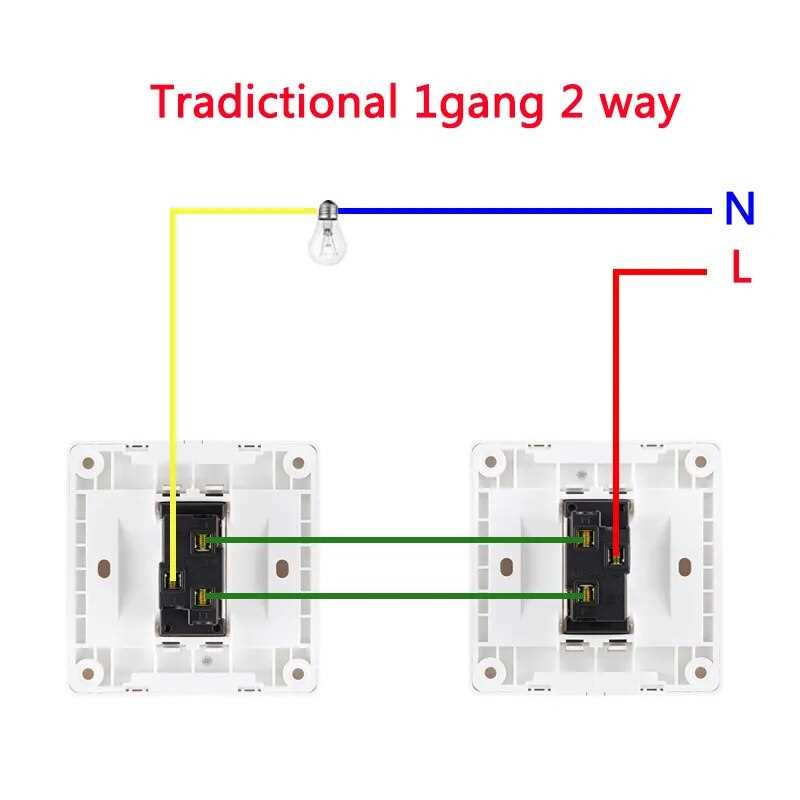
Use a pair of wall controls linked by traveler conductors to manage a single lamp from separate locations such as the top and bottom of a staircase. The first control receives the live conductor from the power source, while the second directs current toward the lighting fixture. Between them run two traveler wires that alternate the path of current depending on the position of each control lever.
This arrangement relies on internal contacts that redirect the live conductor between the traveler lines. When both controls align on the same traveler, the electrical path continues to the lamp and the light turns on. When the levers connect to different travelers, the path breaks and the lamp turns off. This alternating connection pattern allows the lighting state to change from either location without rewiring the load line.
Installers normally use a three-core cable between the paired controls: one conductor for each traveler and one protective ground. The supply line enters the first wall box, while the load conductor leaving the second box feeds the lamp holder. Accurate identification of line, load, and traveler conductors prevents reversed connections, which otherwise lead to constant power at the fixture or unpredictable light behavior.
Detailed Circuit Diagram of a Two Way Switch with Wiring Layout and Switching Operation
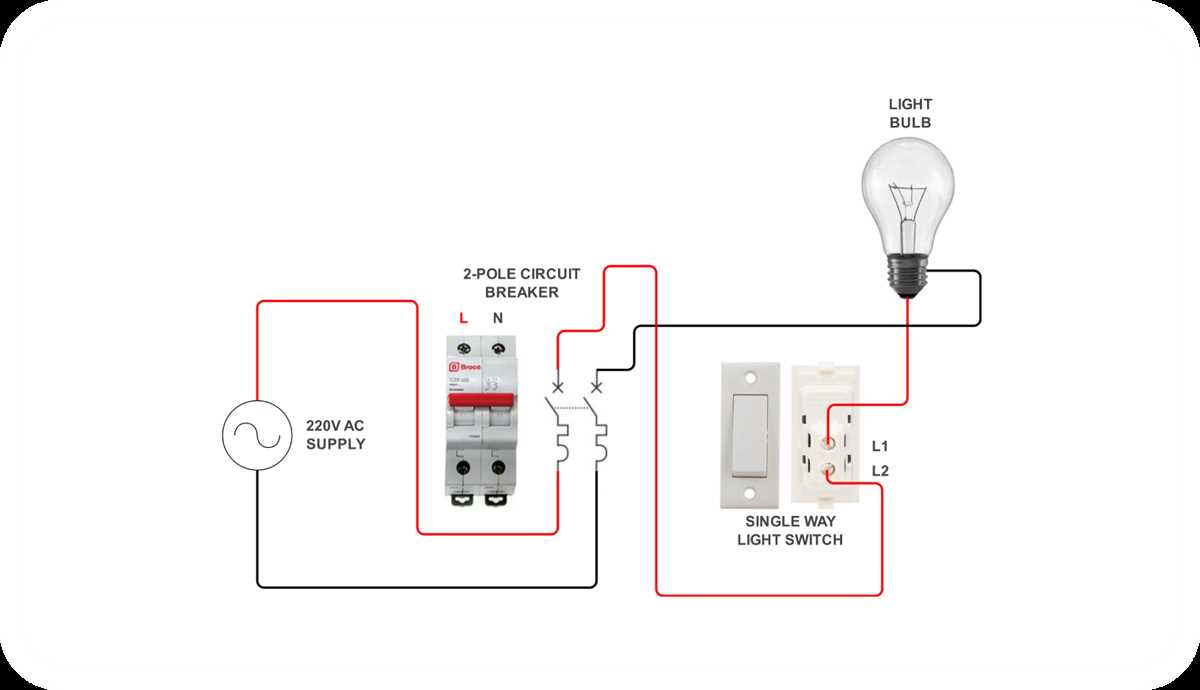
Connect the live conductor from the power source to the common terminal of the first wall control and route the lamp feed from the common terminal of the second control. Place a pair of traveler conductors between the devices. These travelers link the internal contact terminals of each control unit, creating alternate current paths that change depending on lever position.
Use a three-core cable between the wall boxes: brown or black for traveler line A, gray or another color for traveler line B, and green-yellow for grounding. The neutral conductor bypasses the controls and runs directly from the distribution point to the lamp holder. This layout keeps the load energized only when the internal contacts align through the same traveler path.
Inside each control unit, a movable contact connects the common terminal to one of the traveler terminals. When both units select the same traveler conductor, current flows from the supply line through the first device, across the selected traveler, through the second device, and then to the lighting fixture. When the controls select different travelers, the path breaks and the lamp loses power.
Mark terminals before installation and confirm the live conductor with a tester. Reversed connections often occur when the supply wire is mistakenly attached to a traveler terminal instead of the common contact. Correct identification of line, load, and traveler conductors keeps the lighting point responsive from both wall locations and prevents continuous voltage at the fixture socket.
How two way switches connect through traveler wires in a lighting circuit
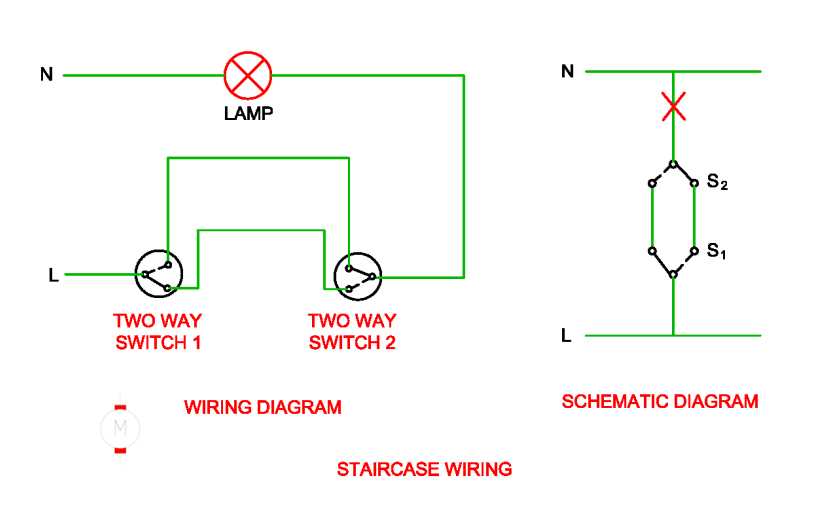
Link the pair of wall controls using traveler conductors placed between the device boxes. Each control unit contains a common terminal and a pair of traveler contacts. The incoming live conductor attaches to the common terminal of the first control, while the lamp feed leaves the common terminal of the second control.
Traveler conductor routing between wall controls
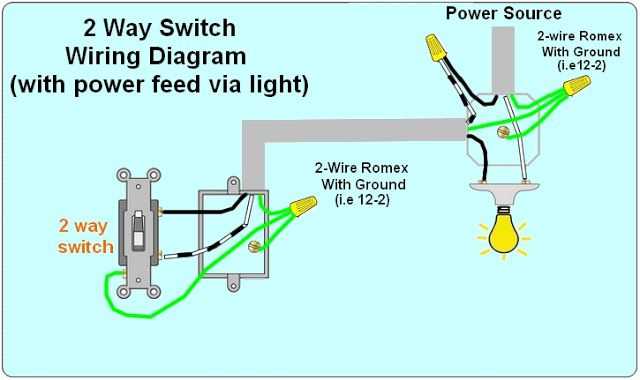
Run a three-core cable between both mounting boxes so that each traveler contact connects directly to its counterpart in the opposite unit. This wiring layout creates alternative paths that redirect current depending on lever position.
- Traveler conductor A connects traveler terminal A of the first control to traveler terminal A of the second control
- Traveler conductor B connects traveler terminal B of the first control to traveler terminal B of the second control
- Ground wire links both metal boxes and device frames
Current flow through the traveler conductors
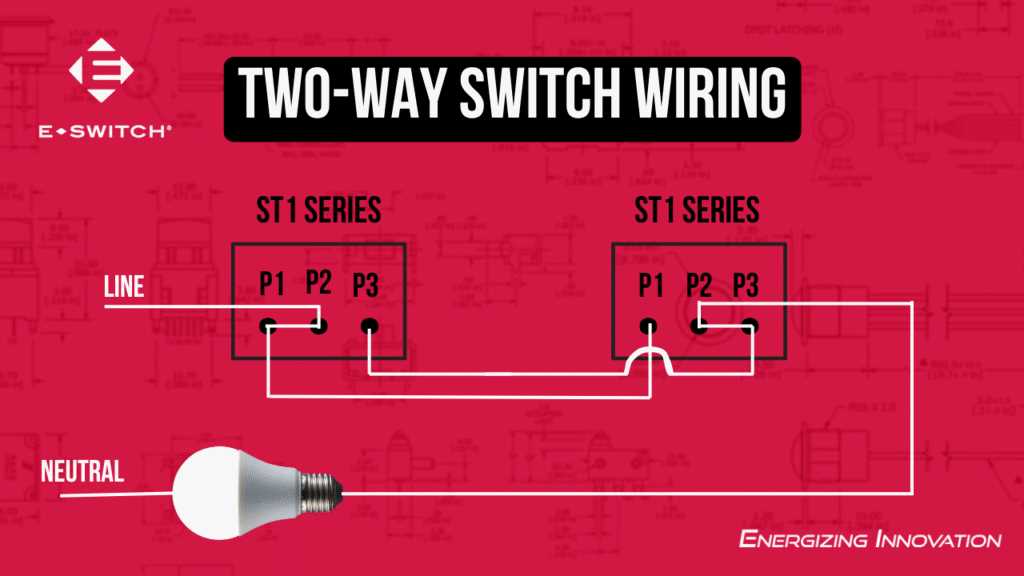
The internal contact inside each device shifts between the traveler terminals. When both devices select the same traveler conductor, the electrical path continues toward the lamp holder. If each device connects to different travelers, the path breaks and the lamp turns off.
During installation verify conductor roles with a tester and label them before tightening terminals.
- Identify the live supply conductor entering the first box
- Mark the lamp feed leaving the second box
- Confirm that both traveler conductors run only between the control units
- Secure terminal screws to prevent loose contact and heat buildup