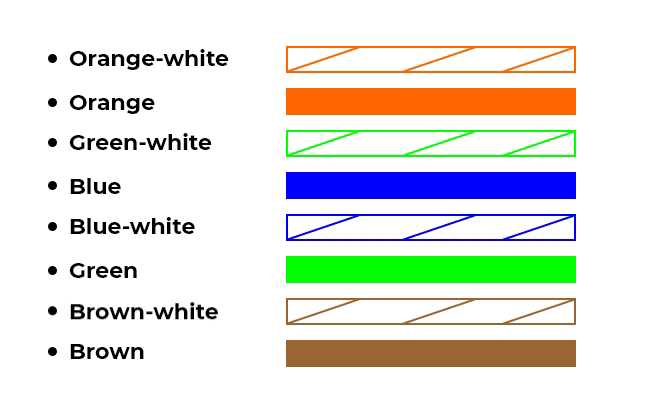
Use standard A or B pin arrangements consistently: mixing schemes within the same network can cause connection failures or data loss. Confirm both ends of a cable follow the same standard before installation.
Arrange each twisted pair according to color codes: for A configuration, place green and white-green on pins 1 and 2, orange and white-orange on 3 and 6. For B, swap the positions of the green and orange pairs. Maintain correct twist integrity for reliable signal transmission.
Trim insulation carefully and avoid untwisting more than 1 cm: exposing too much conductor increases crosstalk and reduces performance. Keep twists intact as close to the connector as possible.
Test continuity and signal quality after termination: use a cable tester to verify correct pair order and ensure no shorts or miswires exist. Replace any defective cables immediately to maintain network stability.
Cat5 A and B Connection Guide
Follow a single standard across each installation: using either the A or B sequence consistently prevents mismatched pairs and ensures proper signal flow. For direct device-to-device connections, match the same standard at both ends.
Identify each color-coded pair before termination. For sequence A, place green and white-green on pins 1 and 2, orange and white-orange on 3 and 6, while B reverses these pairs. Maintain the twists as close to the connector as possible to reduce interference.
Trim and insert conductors carefully into connectors: avoid excessive untwisting beyond 1 cm. Ensure each conductor reaches the metal contacts fully to maintain low resistance and strong connectivity.
After assembly, test every cable with a continuity and performance tester: check for pair order accuracy, shorts, and open circuits. Replace or re-terminate any cable that fails testing to secure network reliability.
Understanding Pin Assignments for A and B Standards
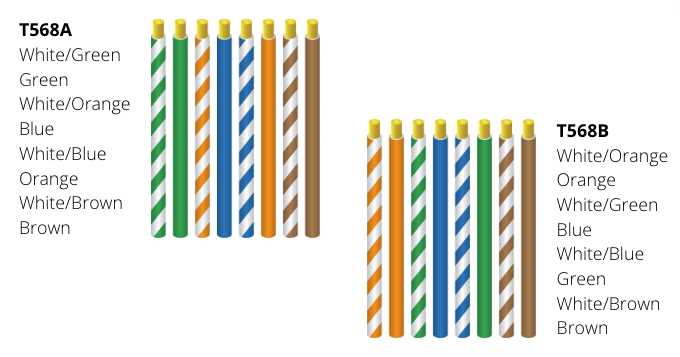
Follow the correct sequence for each standard: in the A format, assign white-green and green to pins 1 and 2, white-orange and orange to 3 and 6. The B format reverses these two pairs, placing white-orange and orange on 1 and 2, and white-green and green on 3 and 6. Keeping this order consistent avoids miscommunication between connected devices.
Use a tester after termination to verify continuity and pair alignment: incorrect placement can cause intermittent signal loss or network errors. Maintain the twists up to the connector to reduce crosstalk and ensure reliable data transmission across the link.