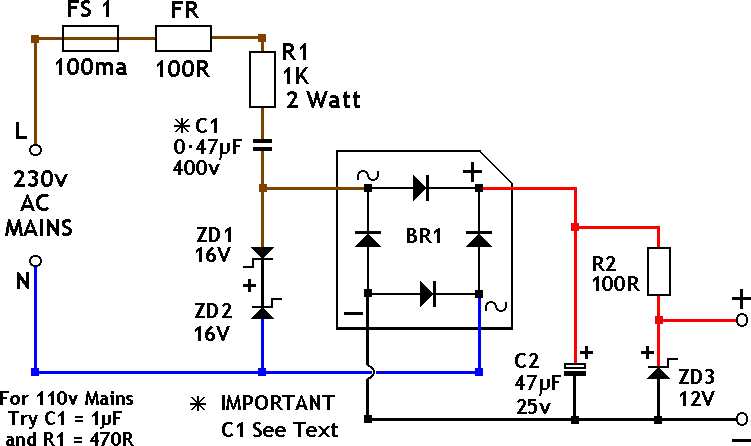
Start by selecting the correct transformer to step down the incoming current to a manageable level. The transformer must match the input voltage and output requirements. It’s critical to ensure that the transformer can handle the load without overloading. A well-chosen transformer guarantees that the system operates within safe limits.
The next step involves rectification. Use a bridge rectifier to convert alternating current to direct current. The rectifier will smooth out the fluctuating input and provide a more stable output. Make sure that the diodes in the bridge are rated to handle the current required by your load to avoid damage.
Once the current has been rectified, you’ll need to filter the output to remove any remaining ripples. A capacitor plays a key role here, ensuring that the direct current is steady enough for sensitive devices. Choose a capacitor with the appropriate capacitance to effectively filter out fluctuations in the output.
Finally, a voltage regulator is necessary to ensure a constant and stable output. The regulator will maintain the voltage at the desired level regardless of variations in load or input. This is particularly important for circuits requiring precise voltage levels to function correctly, such as microcontrollers or communication systems.
AC to DC Conversion for 24V Applications
To begin converting high-voltage alternating current (AC) into the required direct current (DC), use a transformer. The transformer must step down the incoming voltage to a level suitable for your circuit, typically 24V DC. Ensure the transformer’s output matches your load’s requirement without overloading it. A transformer rated for the necessary wattage is essential to avoid potential issues.
Rectification Process
After the voltage is stepped down, use a bridge rectifier to convert the alternating current into pulsating direct current. The bridge rectifier consists of four diodes arranged in a specific configuration to ensure proper rectification. Be sure the diodes can handle the current produced by the transformer and are rated for the expected load. Proper placement of these components is key to avoiding short circuits or system failure.
Once rectified, the output will still have ripples that need smoothing. A capacitor is required to filter out these fluctuations and provide a steady DC output. Select a capacitor with enough capacitance to filter the ripples effectively. Typically, a larger capacitor is needed for higher current applications to maintain smooth operation.
Voltage Regulation
To ensure that the output voltage remains stable despite variations in load or input voltage, use a voltage regulator. The regulator will keep the voltage at 24V regardless of fluctuations. Choose a regulator that can handle the required current and ensure it is rated for the correct input voltage range. With proper regulation, your system will function reliably and efficiently.
Understanding the Components of an AC to DC Converter Circuit
The transformer is the first component in any high-voltage to low-voltage conversion system. It steps down the input voltage to a more manageable level for subsequent stages. When selecting a transformer, ensure it is rated for the input voltage and expected current draw. Overloading the transformer can lead to overheating and damage.
- Transformer: Reduces the input voltage to a lower, safer level.
- Rectifier: Converts alternating current to pulsating direct current.
After the transformer, the rectifier takes the stage. A bridge rectifier, consisting of four diodes, is typically used in these setups. It allows the current to flow in only one direction, thus converting the AC into pulsating DC. Diodes must be rated for the voltage and current of the circuit to avoid breakdowns.
Next, smoothing is done by capacitors. The rectified output is still not perfectly stable, as it contains ripples. Capacitors filter out these ripples, ensuring that the output voltage is smooth and steady. For best results, select a capacitor with a high enough capacitance to handle the current demands of the circuit.
- Capacitors: Smooth the ripple in the DC output, ensuring stable voltage.
The final component in most systems is the voltage regulator. This component ensures that the output voltage remains at a constant level, regardless of fluctuations in the input or load. It is critical for circuits that require precise voltage to function correctly, like microcontrollers or sensors. Choose a regulator that can handle the expected current without overheating or dropping voltage.