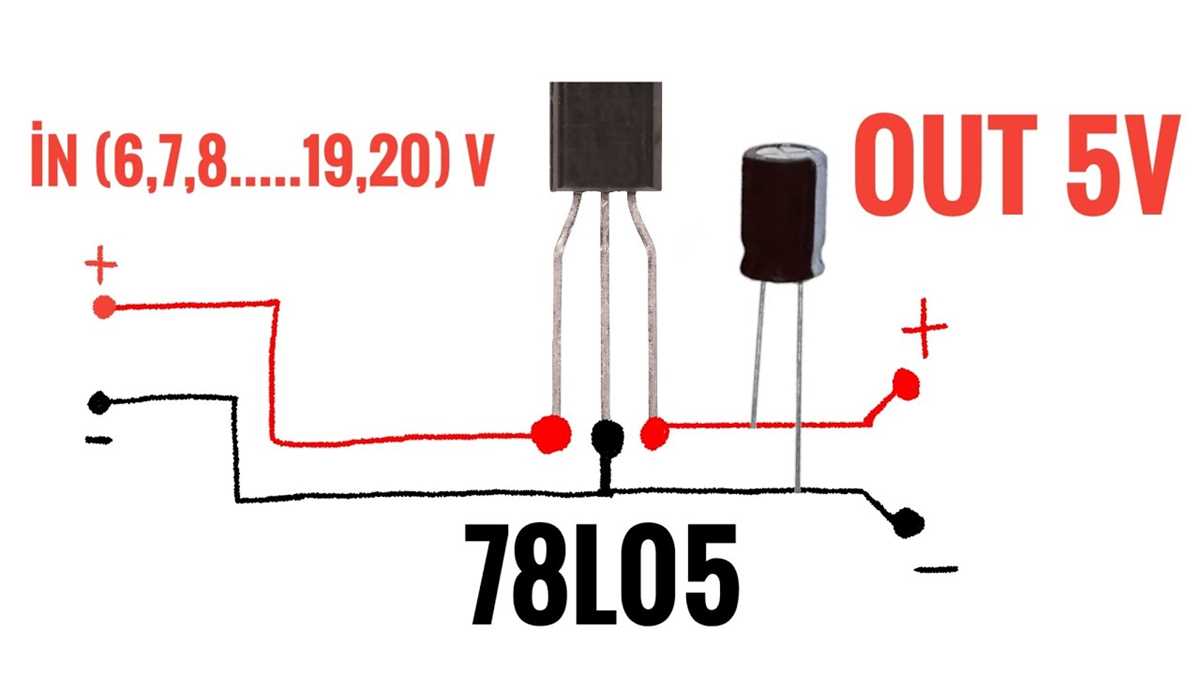
Connect the input pin of the small three-terminal regulator to a DC source between 7V and 20V and route the output pin to the load that requires a stable 5V supply. This device converts a higher input voltage into a fixed five-volt line suitable for microcontrollers, sensors, and logic components.
The component usually comes in a TO-92 package with three leads. When the flat side faces forward and the leads point downward, the pins follow this order from left to right: input, ground, and output. Correct pin orientation prevents reverse connection that could damage the regulator or connected components.
Stable operation requires small capacitors near the regulator terminals. A common configuration uses 0.33µF on the input side and 0.1µF on the output side. These capacitors reduce voltage ripple and help maintain steady output during sudden load changes.
The regulator can supply roughly 100 mA of current under normal conditions. If the input voltage rises far above the output level, excess power dissipates as heat across the device. Maintaining moderate input voltage and proper heat dissipation helps the regulator maintain stable five-volt output for small electronic assemblies.
78L05 Voltage Regulator Circuit Diagram With Pin Connections and Capacitor Setup
Place the small three-terminal regulator between the DC source and the load that requires a steady 5V line. With the flat face of the TO-92 package toward you and the leads pointing downward, the pins follow this order:
- Left pin – input voltage from the power source
- Middle pin – ground reference
- Right pin – regulated 5V output to the load
Supply voltage normally ranges from 7V to about 20V. Values lower than this may cause the output level to drop below five volts.
Add small capacitors close to the regulator leads to stabilize the power path and reduce ripple:
- Place a 0.33µF capacitor between the input pin and ground.
- Place a 0.1µF capacitor between the output pin and ground.
- Keep the leads short so the components sit close to the regulator body.
This layout helps maintain a stable five-volt supply and reduces oscillation when the connected load changes current demand.
78L05 Pin Identification and Proper Input Output Ground Connections
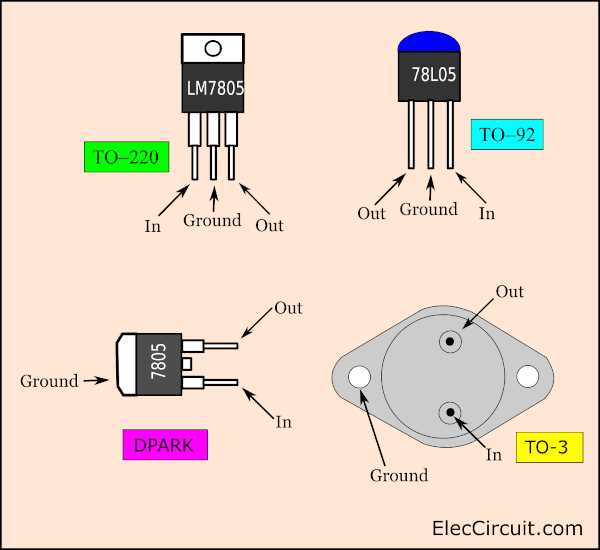
Hold the small three-terminal regulator with the flat side facing you and the leads pointing downward before making any connections. This orientation determines which lead receives the supply voltage, which lead connects to ground, and which lead delivers the regulated output.
The left lead serves as the input connection. Attach the positive line from the DC source here. The supply normally ranges between 7V and 20V. Lower values may cause the output level to fall below five volts.
The center lead connects to ground. This point becomes the reference for both the input source and the regulated output. All return lines from the connected load should join this ground node to maintain stable voltage regulation.
The right lead provides the regulated five-volt output. Connect this pin to the device that requires a constant supply such as microcontrollers, sensors, or small logic modules.
Keep the ground connection short and direct. Long ground paths can introduce noise or small voltage drops that disturb stable output levels.
Attach a small capacitor between the input lead and ground and another between the output lead and ground. These components reduce ripple and help maintain stable regulation when the load current changes.
Verify pin orientation before powering the assembly. Reversing the supply and output leads can damage the regulator and any connected components.