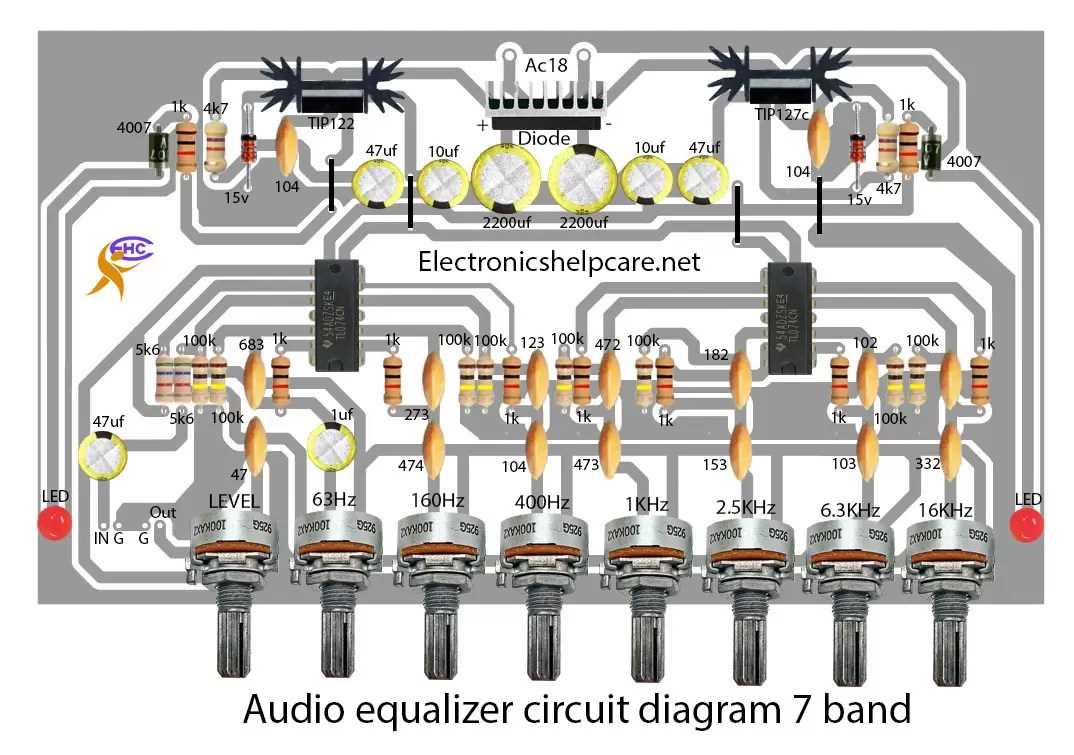
Connect the dual operational amplifiers following the designated input and output pins to prevent phase inversion and signal loss. Ensure capacitors are placed according to the low, mid, and high-frequency paths for accurate tonal balance.
Use resistors with precise tolerance values to maintain uniform gain across all bands. Incorrect values can create uneven amplification or introduce unwanted distortion in the audio path.
Verify all ground connections are solid and free from loops to minimize hum and interference. This includes linking the power supply ground directly to the metal chassis if available.
Align each potentiometer with the corresponding frequency band to allow controlled adjustment. Marking the reference positions before final soldering helps prevent misalignment during assembly.
After assembly, measure signal levels at each stage using an oscilloscope to confirm proper amplitude distribution. Check that low, mid, and high ranges respond independently without cross-coupling artifacts.
Audio Equalizer Assembly and Connection Guide
Position the dual operational amplifiers on a breadboard or PCB, matching each pin to the designated input and output tracks. Confirm that the supply voltages are correctly oriented to avoid permanent component damage.
Use precision resistors and capacitors for each frequency band to ensure accurate tone shaping. Resistors should be within 1% tolerance, and capacitors must match the values specified for low, mid, and high bands.
Connect input and output jacks with shielded cables to minimize interference. Ground the cable shields to the main ground point to reduce hum in the audio signal.
Adjust potentiometers according to the desired frequency response. Each potentiometer should be soldered securely and aligned with its corresponding band, marking the zero or mid-position for calibration.
After completing soldering, inspect all joints for cold solder or shorts. Visual inspection combined with continuity testing helps prevent performance issues before powering the assembly.
Finally, power the assembly and measure signal levels at each stage using an oscilloscope. Verify that low, mid, and high frequencies respond independently and that the overall output maintains clarity without distortion.
Pin Configuration and Signal Path Setup for Accurate Sound Adjustment
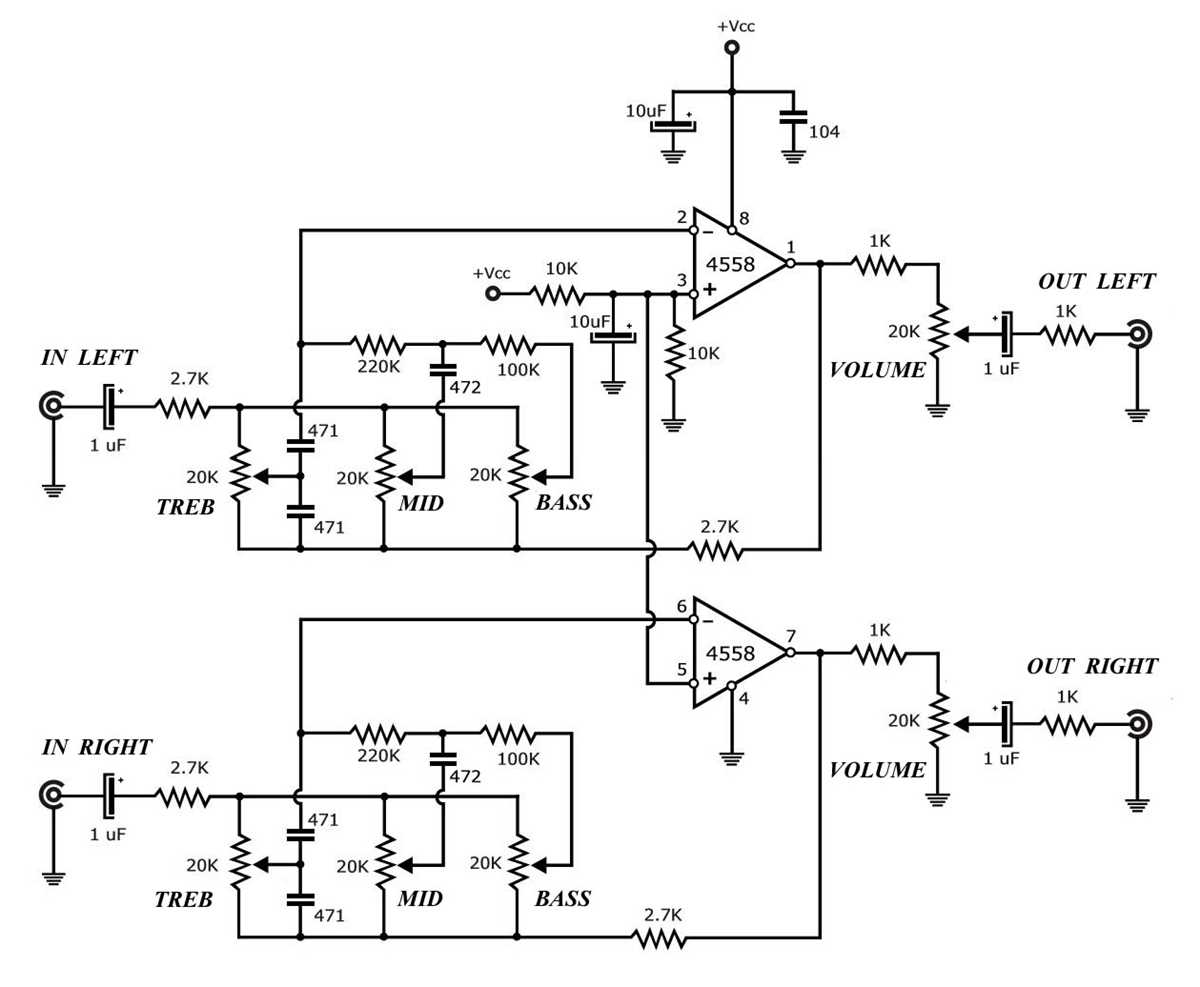
Identify each dual amplifier pin carefully before making connections. Pin 1 and 7 are typically for the input and output of the first channel, while pins 2 and 6 handle the second channel. Ensuring proper orientation prevents signal loss and distortion.
Use color-coded jumper wires to trace the signal path from input terminals to gain and tone control components. Red wires for positive voltage, black wires for ground, and distinct colors for signal lines help avoid misrouting and cross-talk between bands.
Connect feedback resistors directly between the output and inverting input pins to maintain correct gain levels. Select resistor values according to the intended frequency response to achieve balanced low, mid, and high adjustments.
Integrate capacitors along the signal path for accurate filtering. Small value capacitors (10nF–100nF) handle high frequencies, while larger values (1µF–10µF) stabilize lower frequencies and prevent unwanted oscillations.
After assembly, measure signal continuity from input to output using a multimeter. Check each pin connection individually to confirm that the expected signal reaches every gain and tone stage without interruption or shorts.
Finally, test the setup with a known audio source and monitor the output using headphones or an amplifier. Adjust potentiometers gradually to verify that each frequency band responds correctly and that the overall sound remains clear and distortion-free.