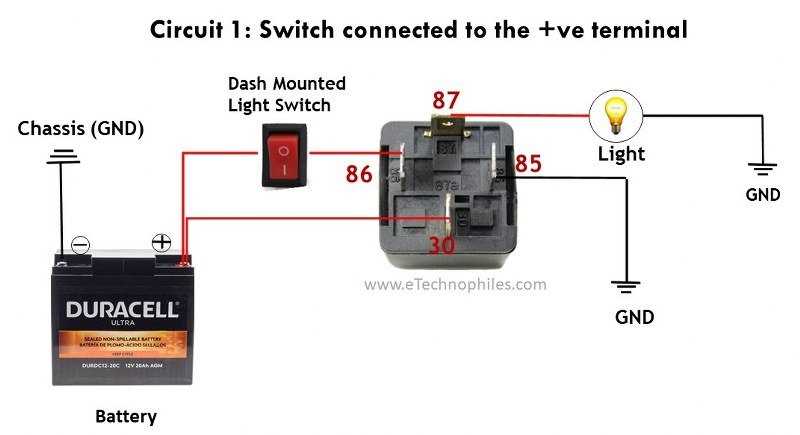
Use a four-terminal electromagnetic control switch to manage high current loads while a low-power circuit activates the internal coil. Two contacts power the coil, while the remaining pair handles the load path. In common automotive units rated for 12 V systems and 30–40 A switching capacity, the coil usually draws 120–200 mA, allowing a dashboard button or control module to activate headlights, cooling fans, auxiliary pumps, or horn circuits without carrying heavy current through the cabin switch.
A typical connection scheme separates the control side from the load side. One coil contact receives +12 V from an ignition-controlled source, while the second coil contact connects to ground through a trigger switch or ECU output. The load pair works like a high-current gate: battery positive enters the common contact and exits through the switched contact toward the device. Use 2.5–4 mm² copper conductors for loads above 20 A and place a fuse 10–15 cm from the battery to protect the circuit.
Internal construction relies on a copper coil wrapped around a ferromagnetic core. When energized, the magnetic field pulls a movable armature that closes the power contacts. Contact materials usually include silver alloy pads that resist arcing during repeated switching cycles. Mechanical life for automotive units often exceeds 100,000 operations, while electrical endurance depends on current level and load type, particularly with motors that generate inrush spikes.
For stable operation, mount the module with terminals facing downward to reduce moisture accumulation. Secure connections with crimped spade connectors rated for at least 105 °C insulation. If the control circuit originates from sensitive electronics, add a flyback diode across the coil contacts to suppress voltage spikes produced when the magnetic field collapses.
4-Terminal Power Switch Connection Layout: Practical Guide for Real Circuits
Connect terminal 30 directly to the battery through a fuse rated 20–30 A when controlling loads such as auxiliary lamps or a radiator fan. Terminal 87 feeds the device that draws current; use copper conductors with a cross-section of 2.5–4 mm² for currents above 15 A. The control side uses terminals 85 and 86: one goes to chassis ground, the second receives +12 V from a dashboard button or ignition source. This arrangement isolates the heavy current path from the cabin switch, preventing overheating of thin dashboard conductors.
- 30 – constant supply from battery through fuse
- 87 – output to lamp, pump, fan, or compressor
- 85 – ground reference for the internal coil
- 86 – trigger voltage from switch or ECU
Route high-current conductors separately from signal leads to limit voltage drop and electrical noise. For a 12 V lighting upgrade drawing 18 A, use a 25 A fuse and keep the supply lead under 1.5 m. Mount the switching module close to the battery or fuse box; shorter power paths reduce resistance and heat. Crimped spade connectors rated 30–40 A provide stable contact pressure and avoid intermittent operation caused by vibration in vehicles or industrial equipment. Ground points should be bare metal with a serrated washer; painted surfaces increase resistance and may cause the coil not to actuate.
How to Identify Contacts 30, 85, 86, and 87 in a 4-Terminal Automotive Switching Unit
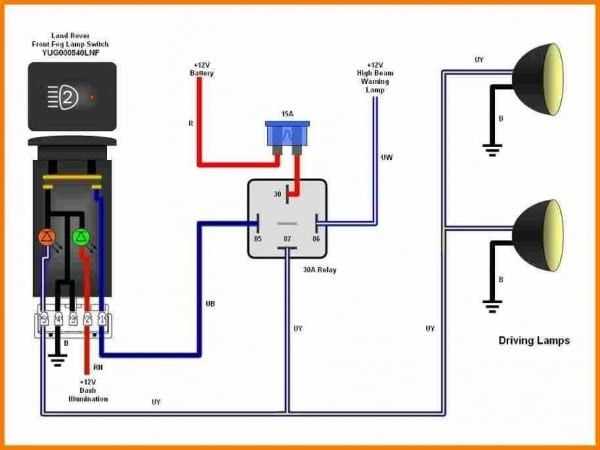
Check the numbers molded into the plastic base and match them with the metal blades before connecting any conductors. In most automotive switching blocks the numbering follows the DIN 72552 standard: 30, 85, 86, and 87 are stamped next to each blade. Use a flashlight if the markings are shallow; dirt and oxidation often hide them.
Contact 30 carries the main power feed. It usually connects directly to the battery positive line through a fuse rated between 15 A and 40 A depending on the load. This terminal supplies current to the internal switch mechanism. When the device activates, electricity flows from 30 to 87 and powers the attached component such as a cooling fan, auxiliary lamp set, or fuel pump.
Contacts 85 and 86 belong to the electromagnetic control circuit. These two blades energize the internal coil that moves the switching arm. One side typically receives ground from the vehicle chassis, while the other side receives a small control signal from a switch, ignition line, or electronic module. Polarity usually does not matter for basic units without suppression electronics.
Contact 87 acts as the output that feeds the electrical load. When the coil energizes, the internal contact bridge closes and connects 30 with 87. Voltage measured between 87 and ground should match battery voltage during activation. If no voltage appears while 85–86 are energized, internal contacts may be worn or burned.
Blade placement often follows a recognizable physical pattern. On many cube-shaped automotive modules, 85 and 86 sit opposite each other across the narrow side of the base. Contact 30 normally occupies the center or a thicker blade position designed for higher current. Terminal 87 usually sits across from 30 or slightly offset. Manufacturers keep this layout consistent to prevent installation mistakes.
A multimeter provides confirmation when markings are unclear. Measure resistance between 85 and 86; values typically fall between 50 Ω and 200 Ω depending on coil design. Then check continuity between 30 and 87 while the control circuit is inactive–there should be no connection. Apply 12 V across 85 and 86; a soft click should occur and continuity should appear between 30 and 87.
Color coding in vehicle harnesses can provide additional hints. Thick red or red-with-stripe leads frequently supply the battery feed to terminal 30. Black or brown conductors often serve as ground for 85. A thin signal lead from a dashboard switch commonly goes to 86, while a heavier wire leading to the electrical device connects to 87.
Correct identification prevents melted connectors and malfunctioning equipment. Mixing the power feed with the coil circuit forces high current through small control lines and may damage switches or electronic modules. Verify the numbering twice, test with a meter, and only then attach the load circuit.