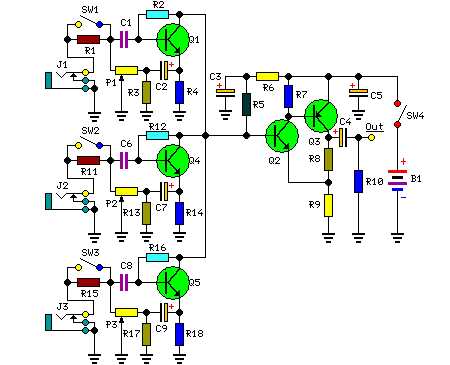
Use a summing amplifier built around an operational amplifier to combine several sound sources into one output line. Each source passes through its own resistor path before reaching the inverting input of the op-amp. This arrangement allows microphones, instruments, or playback devices to feed a single output without direct interaction between sources.
Most small mixing stages rely on resistor values between 10 kΩ and 100 kΩ for the input paths. These resistors isolate the sources and define the gain relationship between them. Lower resistance raises contribution from a source, while higher resistance lowers its presence in the combined signal.
Level adjustment usually uses potentiometers placed before the summing resistors. A typical design places a 10 kΩ or 50 kΩ variable resistor on each input path. Turning the control changes signal amplitude before it reaches the op-amp node, allowing independent balance between microphones or instruments.
The operational amplifier stage often uses integrated components such as TL072, NE5532, or LM358. Feedback resistors connected between output and inverting input define overall gain, commonly set close to unity so the combined signal maintains stable amplitude before entering the next stage such as a power amplifier or recording interface.
Power rails commonly use ±12 V or ±15 V supplies for clean headroom. Single-supply layouts also appear in compact designs, usually operating at 9–12 V with bias networks that shift the signal reference above ground. Proper grounding and decoupling capacitors near the op-amp reduce noise and prevent oscillation.
4 Channel Audio Mixer Circuit Diagram With Op Amp Inputs and Output Stage
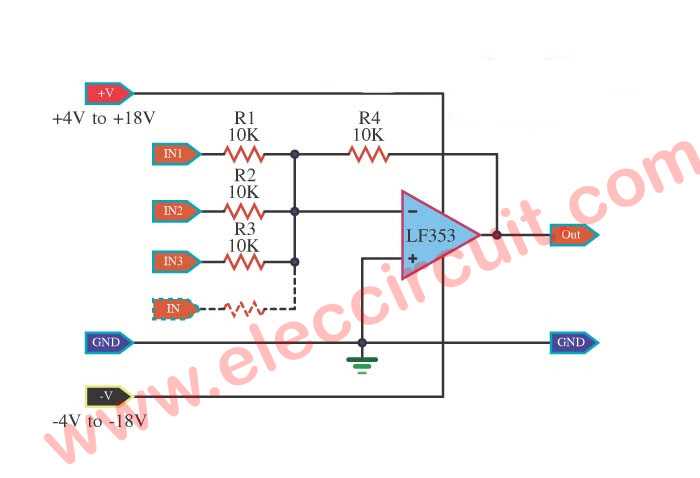
Use a four-input summing stage built around a low-noise operational amplifier such as TL074 or NE5532, assigning each input path its own resistor network. A practical configuration places a 10 kΩ resistor in series with every incoming signal line and routes them into the inverting pin of the op-amp. The non-inverting pin connects to ground through a 10 kΩ reference resistor to stabilize bias. Each source line benefits from a 50 kΩ logarithmic potentiometer placed before the series resistor so level adjustment occurs before summation. Power rails of ±12 V or ±15 V maintain sufficient headroom for line-level sources up to roughly 2 Vrms.
Input Amplifier Stage
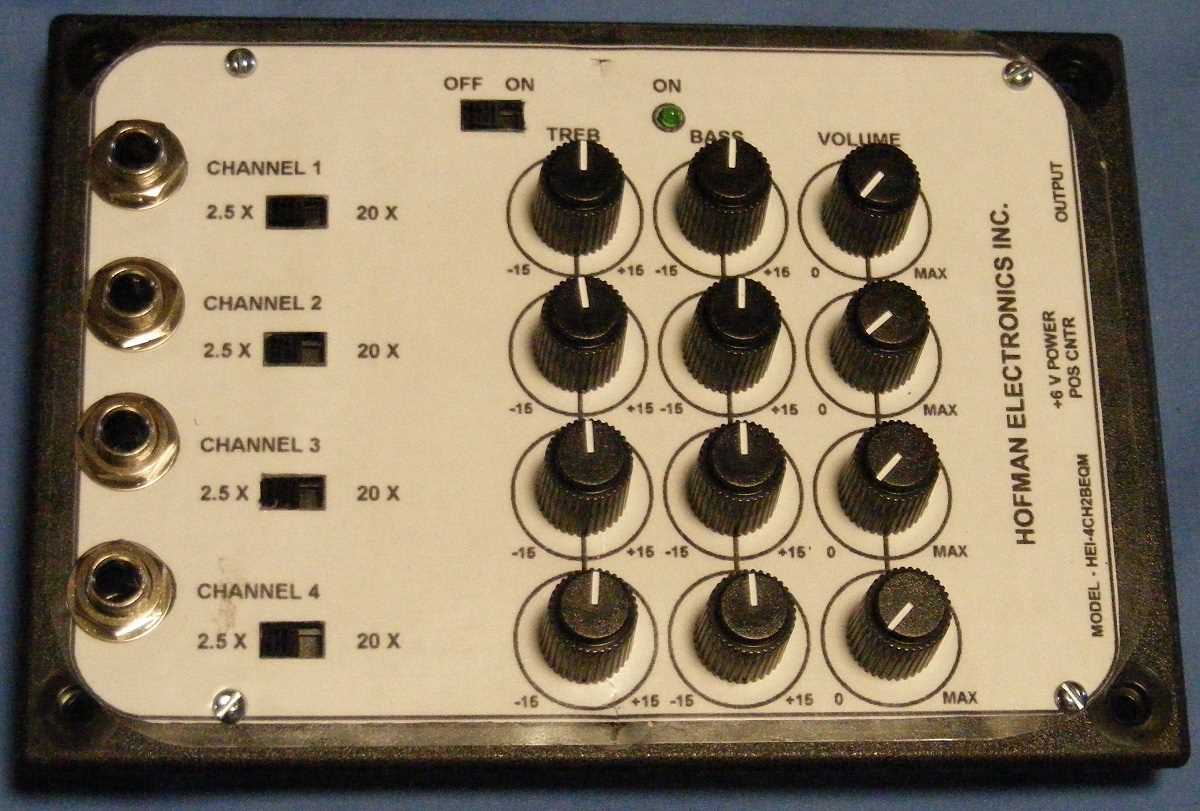
Each signal path can include a preliminary op-amp buffer when sources vary in impedance. A unity-gain buffer using one section of a TL074 isolates the source and prevents loading from the summing node. Place a 100 kΩ resistor from output to inverting pin and connect the incoming signal to the non-inverting pin through a 1 µF coupling capacitor. A 100 kΩ resistor from that pin to ground sets the reference point and removes DC components. This configuration keeps distortion below 0.01 % for line-level material while maintaining input impedance above 100 kΩ.
The summing amplifier combines the four signals through equal resistors (typically 10 kΩ). A feedback resistor of identical value keeps gain at −1 per input path. If higher combined level is required, raise the feedback resistor to 22 kΩ or 47 kΩ. A small capacitor between output and inverting pin (around 47–100 pF) suppresses high-frequency oscillation and stabilizes the op-amp during rapid transients. Decoupling capacitors of 100 nF placed close to the power pins reduce supply noise and prevent unwanted oscillation.
Output Amplification Section
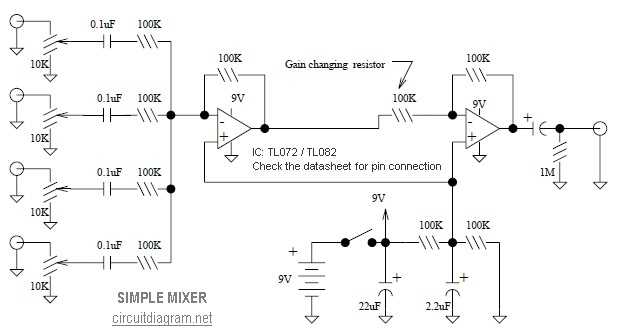
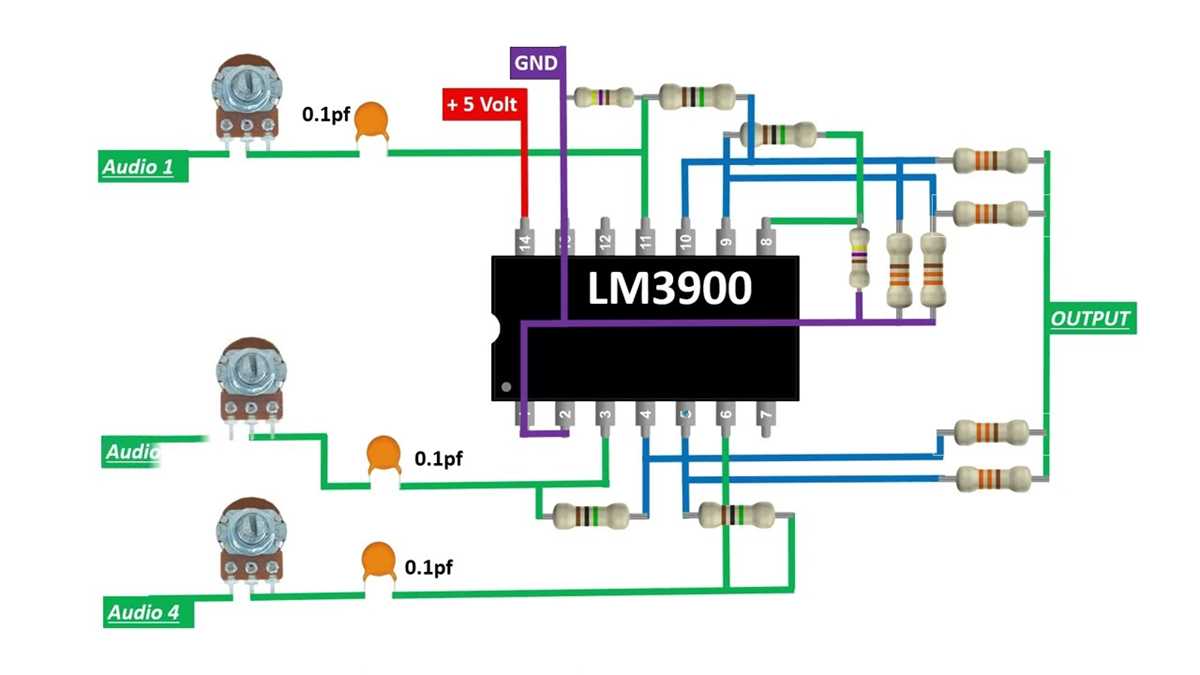
The final stage uses another op-amp configured as a non-inverting amplifier to restore polarity and provide drive strength for external equipment. Connect the summed signal through a 4.7 µF capacitor to the non-inverting pin. A gain network of 10 kΩ (to ground) and 33 kΩ (feedback) yields a gain of about 4.3, suitable for boosting mixed line signals. Add a 100 Ω resistor at the output followed by a 10 µF capacitor when feeding long cables; this reduces load interaction and protects the amplifier from capacitive loads.
Input Resistor Network and Level Control in 4 Channel Audio Mixer Circuit
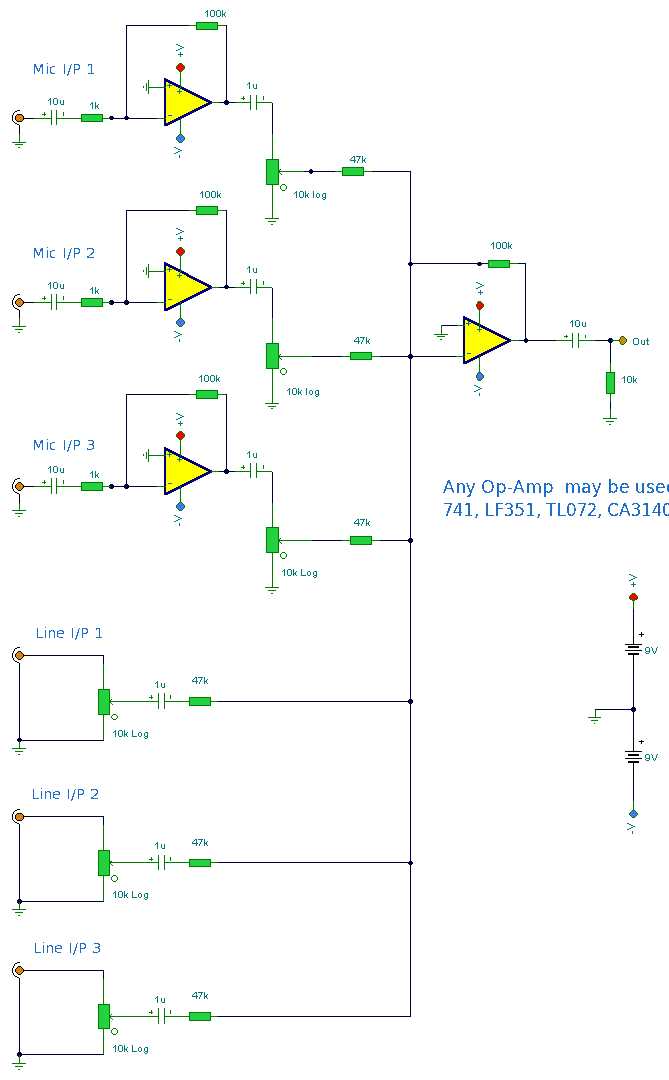
Install identical summing resistors for each signal path to maintain balanced gain and predictable attenuation. A common arrangement uses four 10 kΩ resistors feeding a shared inverting node of an operational amplifier. Equal resistance keeps contribution from every source consistent. For line-level equipment producing about 1 Vrms, this value limits loading while keeping noise low. Place a coupling capacitor of 1 µF before each resistor to block DC components and prevent bias shift at the summing point.
Use logarithmic potentiometers for level adjustment before the resistor network. A 50 kΩ or 100 kΩ log pot provides smooth perceived loudness control across the rotation range. Connect the top terminal to the signal source, the bottom to ground, and route the wiper through the summing resistor.
- 50 kΩ logarithmic potentiometer – smooth attenuation for line sources
- 10 kΩ summing resistor – stable contribution per signal path
- 1 µF coupling capacitor – DC isolation
- 100 kΩ resistor to ground after capacitor – defined bias reference
Prevent interaction between sources by keeping the impedance of each path higher than the feedback network of the op-amp stage. With a 10 kΩ feedback resistor, four 10 kΩ input resistors produce a summed gain close to unity while limiting cross-talk. For installations using long cables or higher output equipment, raise the path resistance to 22 kΩ and pair it with a 22 kΩ feedback resistor. This maintains proportional mixing while lowering current flow into the summing node.
- Choose identical resistor values for all signal paths.
- Place level potentiometers before the summing resistors.
- Keep feedback and input resistor ratios consistent.
- Use film capacitors (1–2.2 µF) for cleaner low-frequency response.