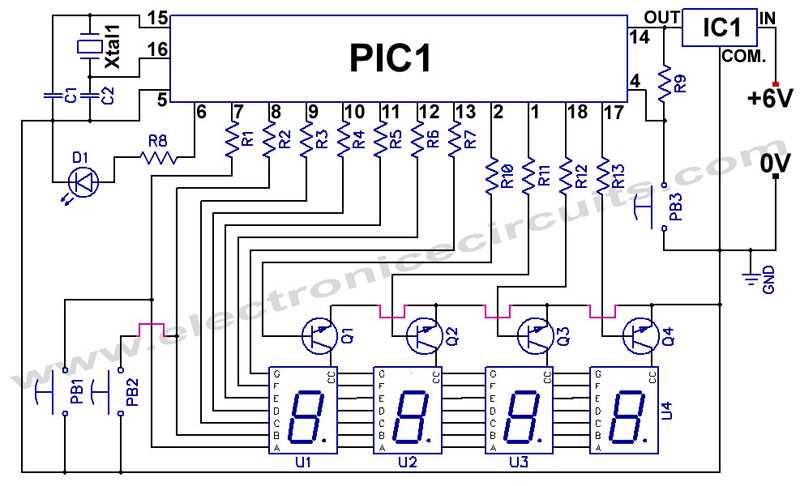
Use a long-period delay design based on CD4060 or NE555 if a device must activate once every 24-hour cycle. A quartz oscillator or RC network generates clock pulses, and a binary counter divides them until the output toggles after one full day. This approach appears in lighting control, irrigation systems, battery charging schedules, and automatic equipment startup.
A practical design with CD4060 combines an internal oscillator and a 14-stage binary counter in one integrated component. With a 32.768 kHz quartz crystal, the counter produces stable long-period intervals. The divided output can drive a transistor that controls a relay module, allowing AC loads such as lamps or pumps to switch on and off after a full 24-hour cycle.
An alternative layout uses the NE555 configured as a long-delay oscillator followed by divider ICs such as CD4017 or CD4040. The 555 produces a repeating pulse stream defined by resistor and capacitor values. Counters reduce the pulse frequency step by step until the output changes state after 86,400 seconds.
Component selection strongly affects accuracy. Large electrolytic capacitors in RC networks may drift by 10–20 percent due to temperature and aging. Quartz-based clock stages maintain stable frequency and provide much tighter daily scheduling. For automation tasks that must repeat at the same time each day, the crystal-controlled approach delivers more stable results.
24 Hour Timer Circuit Diagram Using IC 555 or CD4060 With Component Values
Use a CD4060 with a 32.768 kHz quartz crystal if a device must toggle once every 86,400 seconds. This integrated component combines an oscillator and a 14-stage binary divider, allowing long delay generation with minimal parts. The crystal connects to oscillator pins with two small capacitors around 18–33 pF, creating a stable frequency source that feeds the internal counter stages.
Typical component set for a CD4060 daily delay design
- CD4060 oscillator and binary divider IC
- 32.768 kHz quartz crystal
- 2 capacitors 22 pF for the crystal oscillator
- 1 resistor 1 MΩ controlling oscillator startup
- NPN transistor such as 2N2222 to drive a relay
- Relay module rated for the external load
- Power supply between 5 V and 12 V
An alternative layout uses NE555 as a pulse generator followed by divider ICs like CD4040 or CD4017. The 555 produces periodic pulses determined by resistor and capacitor values, while the counter stages reduce frequency step by step until the output changes state after a full day cycle. Typical oscillator values include:
- R1 = 10 kΩ
- R2 = 1 MΩ
- C1 = 100 µF electrolytic capacitor
- Supply voltage between 9 V and 12 V
The final output from the divider stage drives a transistor that energizes a relay coil. This allows control of lighting, pumps, or chargers connected to mains voltage while the low-voltage electronics handle the timing sequence.
How to Build a 24 Hour Timer Using IC 555 and a Relay Output
Use an NE555 configured as a pulse generator and combine it with a binary divider such as CD4040 if a load must activate once every 86,400 seconds. The 555 produces a continuous stream of pulses defined by an RC network. Divider stages count these pulses until the selected output pin changes state and drives a transistor connected to a relay coil.
Pulse generator stage with NE555
Connect the integrated component in astable mode so it produces a steady clock signal. Typical component values create a low-frequency pulse stream suitable for long delay counting. A common configuration uses R1 = 10 kΩ, R2 = 1 MΩ, and C = 100 µF. Pins 2 and 6 join together, pin 3 serves as the pulse output, and pin 8 connects to the supply line between 9 V and 12 V.
Relay driver and load control stage
The pulse output feeds the clock input of the divider IC. After enough pulses accumulate, the selected counter output goes high and activates an NPN transistor such as 2N2222 or BC547. The transistor switches a relay rated for the external load. Place a 1N4148 or 1N4007 diode across the relay coil to suppress voltage spikes produced during coil de-energizing.
The relay contacts isolate the low-voltage electronics from mains devices like lamps, pumps, or chargers. Select a relay with contact ratings above the expected load current, typically 5–10 A for common household equipment.