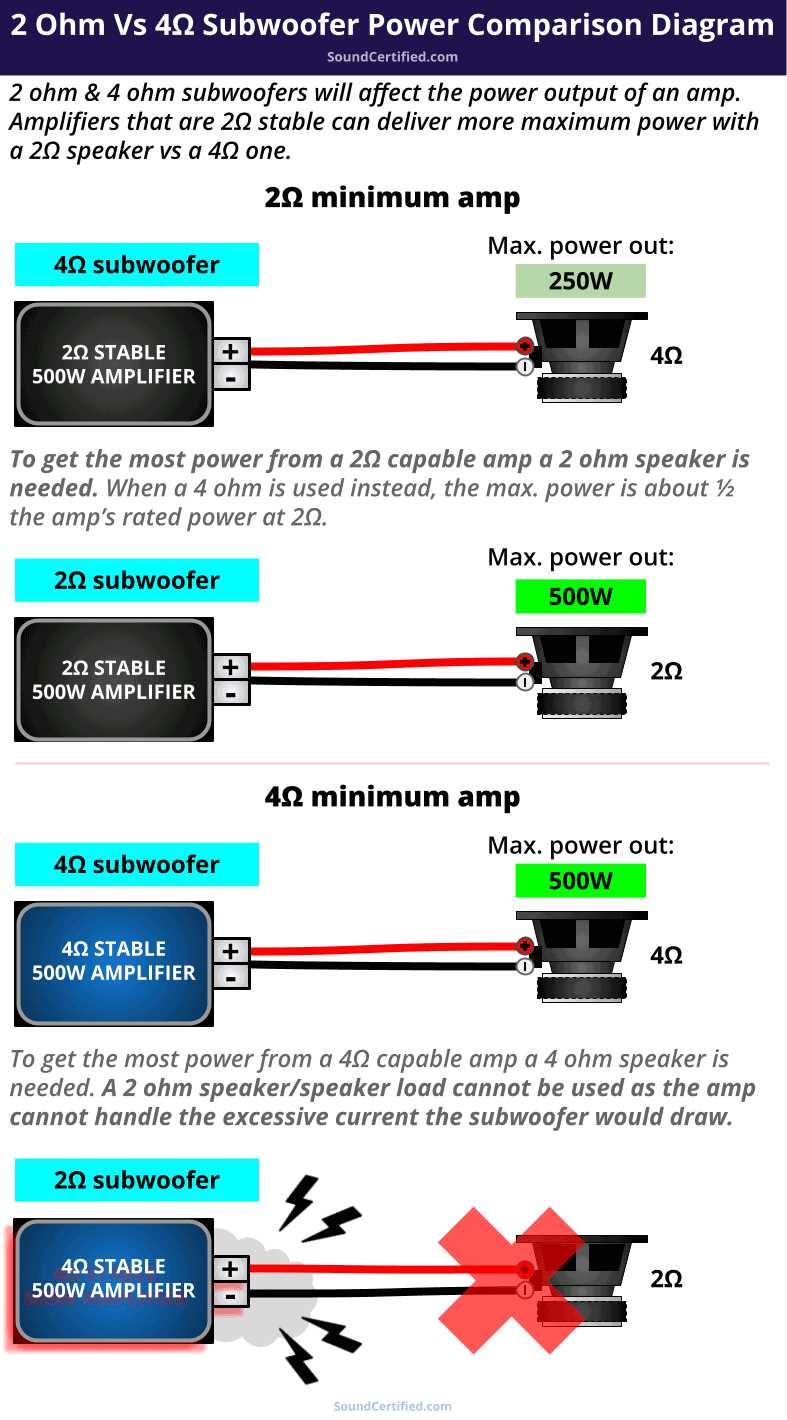
For optimal performance, connecting a dual coil subwoofer requires careful attention to the terminal setup. A common setup involves either series or parallel connections. The configuration you choose impacts the total resistance your amplifier will “see” and influences overall sound quality and power handling.
When using a dual voice coil subwoofer, the coils are typically 2 ohms each. Connecting the coils in series will increase the total resistance to 4 ohms, while a parallel connection reduces it to 1 ohm. Understanding how to connect the coils properly ensures the subwoofer performs to its best capacity and prevents damage to the amplifier.
Before proceeding, make sure the amplifier is compatible with the impedance load the subwoofer will present. Always check your subwoofer’s and amplifier’s specifications to avoid overloading the system. Proper connections will allow your subwoofer to handle more power efficiently and produce better sound output.
2 Ohm DVC Wiring Diagram
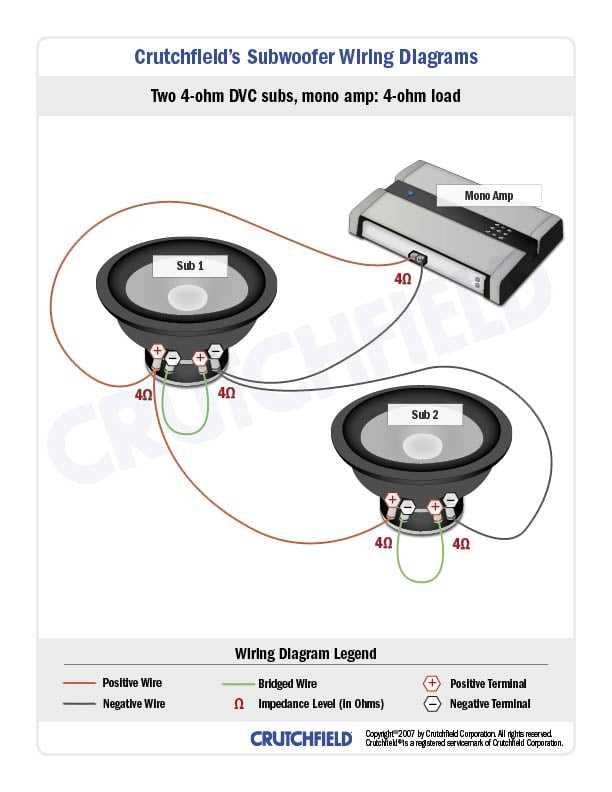
To connect a dual coil subwoofer with two 2-ohm coils, you have two main options: series or parallel. If you connect the coils in series, the total resistance will increase to 4 ohms. This is often the preferred configuration when pairing with amplifiers that are rated for 4-ohm loads. Simply connect the positive terminal of one coil to the amplifier and the negative terminal of the same coil to the positive terminal of the second coil. The negative terminal of the second coil then connects back to the amplifier.
For a parallel configuration, the total resistance drops to 1 ohm, which is suitable for high-power amplifiers designed to handle lower impedance. To achieve this, connect the positive terminals of both coils to the positive terminal of the amplifier, and do the same for the negative terminals. This creates a direct path with lower resistance, allowing the subwoofer to draw more power.
Make sure to check the amplifier’s capabilities before deciding on the connection type. A parallel connection draws more power, and if the amplifier isn’t designed to handle the lower impedance, it could lead to overheating or potential damage. Always verify that the amp supports a 1-ohm load if you plan on using the parallel setup.
Lastly, consider the gauge of the speaker wire you’re using. A thicker wire is recommended for lower impedance configurations (like 1-ohm), as it can carry more current without overheating. Using the correct wire gauge will help prevent signal loss and maintain the system’s performance. Always ensure all connections are secure to avoid any interruptions in sound quality or potential electrical issues.
How to Wire a 2 Ohm DVC Subwoofer in Series
To wire your dual coil subwoofer in series, start by identifying the two terminals on each coil. One terminal will be marked as positive (+), and the other as negative (-). Ensure you clearly mark which coil’s positive and negative terminals are which for the next steps.
Begin with the first coil. Connect the negative terminal of the first coil to the positive terminal of the second coil. This is the key connection that makes the coils function in series, which raises the total resistance to a safe level for most amplifiers.
Now, connect the positive terminal of the first coil to the amplifier’s positive terminal. This completes one side of the subwoofer’s circuit. Similarly, connect the negative terminal of the second coil to the amplifier’s negative terminal.
This configuration will give you a total resistance of 4 ohms (when each coil is 2 ohms). It’s ideal for amplifiers that support 4-ohm loads, ensuring safe operation and effective power delivery without overloading the system.
Before making these connections, ensure that your amplifier can handle the total impedance of 4 ohms. If the impedance is too low for your amplifier, it could lead to overheating or damage. Always verify the specifications of your amplifier to avoid any compatibility issues.
It’s also important to use the correct gauge of speaker wire. The wire needs to be thick enough to carry the power without excessive heat buildup. For most 4-ohm setups, 16-gauge or 14-gauge wire is typically sufficient.
Once all the connections are made, double-check them for tightness. Loose connections can result in poor sound quality or even failure of the subwoofer. Make sure each wire is securely attached to the terminals to prevent any interruptions in power flow.
Finally, power up your system and test the subwoofer. Listen for any distortion or issues, and check the amplifier to make sure it’s not overheating. A properly wired system should perform smoothly with clear and deep sound output.