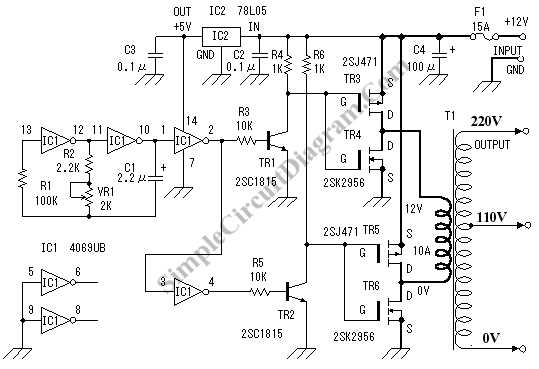
To convert low-voltage direct current to high-voltage alternating current, you need to use a series of specific components. A reliable way to achieve this conversion is by using a combination of oscillators, transistors, and transformers. These parts work together to generate the desired high-frequency alternating current.
Start with a high-frequency oscillator that produces the initial signal. This is crucial, as it determines the waveform for the final output. Using a square wave generator is a common choice for simplicity and efficiency. Once the oscillations are generated, they need to be modulated and amplified.
Next, a transformer steps up the voltage to the desired level. Choose a transformer designed for the voltage increase and frequency of the oscillations. Ensure that it is rated for both the input and output specifications. Properly tuning the frequency ensures minimal energy loss and prevents overheating.
12VDC to 240VAC Inverter Circuit Diagram
The first step in building a reliable power conversion system is selecting the correct high-frequency oscillator. It is responsible for creating the base signal that will later be converted to alternating current. Typically, a square wave generator is used due to its simplicity in operation and ease of implementation. The oscillator frequency should be chosen based on the desired output voltage and load specifications, typically ranging from 50 Hz to 60 Hz for household appliances.
Once the signal is generated, it must be amplified to the desired level. This is done using a transistor amplifier, which modulates the signal strength. A pair of transistors is commonly used in push-pull configurations, providing better efficiency and reducing the likelihood of signal distortion. The transistors should be rated for the input voltage and should be capable of handling the required current without overheating.
For voltage transformation, a step-up transformer is critical. It converts the low voltage direct current to the high voltage alternating current needed for most devices. The transformer’s primary and secondary windings must be correctly matched to the voltage requirements, and its core material should minimize energy loss. A toroidal transformer is often preferred due to its compact size and better efficiency.
Building the Power Supply
The power supply for this system is provided by a battery pack or other DC source, capable of providing stable current at the necessary voltage. A typical configuration involves using several 12V batteries in series to achieve the desired input voltage. Make sure to include proper current protection features, such as fuses or circuit breakers, to prevent damage to the system in case of overload.
Next, a rectifier may be needed to convert any residual AC back to DC before it reaches the oscillators or power amplification stages. This step ensures that the circuit operates smoothly without any interruptions. Depending on the design, a full-wave bridge rectifier may be incorporated into the setup to maximize current flow.
Protecting Your Setup
Proper protection against heat buildup and electrical faults is necessary for the long-term operation of the system. Integrating a heat sink on the transistors will prevent overheating. Similarly, ensure that all components are rated for the appropriate power handling capacities to avoid short circuits or component failure.
Finally, the output stage involves connecting the high-voltage output to an antenna or load. It is vital to ensure that the output voltage remains stable even under varying load conditions. Using a capacitor at the output terminal will smooth out any fluctuations in voltage, ensuring a consistent supply of alternating current to the connected devices.
By carefully following these guidelines and ensuring proper component selection and placement, you can build a reliable and efficient system capable of converting low-voltage DC into high-voltage AC for various applications.
Choosing the Right Components for a 12VDC to 240VAC Converter
Selecting the appropriate components is key to building a reliable power conversion system. Start with the oscillator, which determines the frequency of the output waveform. A square wave oscillator is typically preferred due to its simplicity and stability. Ensure the oscillator can generate frequencies in the range of 50-60 Hz to match standard household power requirements.
The next component to consider is the amplifier. The amplifier boosts the signal to the required voltage levels. Use transistors in a push-pull configuration for better efficiency. The transistors should be rated for the input and output voltage and capable of handling the necessary current. Consider using MOSFETs if you require higher efficiency and faster switching speeds.
Choosing the Right Transformer
The transformer plays a vital role in stepping up the voltage. Choose a transformer with the correct turns ratio to achieve the desired voltage. For example, a transformer with a 1:20 ratio will step up the voltage from 12V to 240V. Make sure the transformer is rated for the expected power load and choose one with low core loss to maintain efficiency.
Power Supply Considerations
The power supply must be able to provide a stable voltage source. A battery pack or a regulated DC power supply is ideal. Choose a power source with adequate current rating to supply the necessary energy without causing voltage dips. A voltage regulator can also be used to maintain consistent input for the oscillator and amplifier stages.
For optimal performance, incorporate protection diodes to safeguard sensitive components from voltage spikes. These diodes should be placed near the transistor and transformer to prevent damage from surges or reverse current flow.
Lastly, ensure that all components are securely connected and that the heat dissipation is well-managed. Add heat sinks to the transistors to avoid overheating and ensure the system operates within safe thermal limits. Proper insulation and wiring ratings are also critical to avoid shorts or power losses.