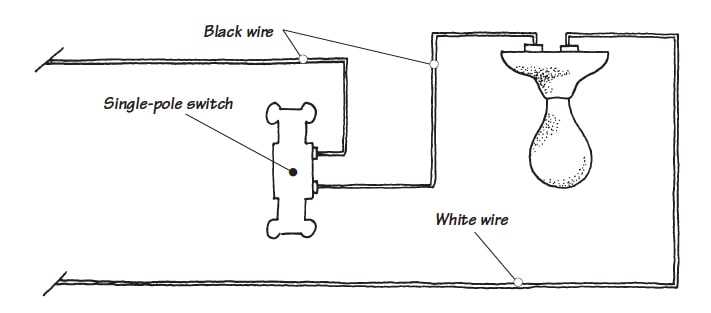
Route the phase conductor through a wall-mounted toggle controlling a lamp circuit; keep the neutral line continuous toward the luminaire. This arrangement prevents energized metal parts during maintenance and simplifies fault tracing. In residential networks with 220–240 V supply, phase typically appears in brown or black insulation, while the neutral core appears blue. Confirm polarity with a tester prior to any cable connection.
A single-key control unit operates through a simple break in the phase line. The incoming phase attaches to the input terminal of the control device, while the outgoing conductor runs toward the ceiling fixture. Cable cross-section around 1.5 mm² copper suits most ceiling lamps up to roughly 3 kW load. Place junction boxes above door level; this shortens cable runs and keeps conductors accessible during inspection.
Corridor or staircase illumination often requires control from two locations. In such cases, install paired changeover modules linked by two traveler conductors. The phase enters the first module, travels through the paired lines, then exits the second module toward the lamp holder. Each toggle action redirects current through alternate contacts, allowing activation or shutdown from either point.
Use clear conductor labeling inside junction boxes. Apply terminal blocks rated above expected current, typically 10–16 A. Avoid twisted joints hidden behind plaster; vibration and thermal expansion weaken them over time. Secure cables with clamps, maintain insulation integrity, and leave several centimeters of spare conductor inside each box to allow later re-termination without replacing the entire cable run.
Lamp Circuit Control Layouts
Turn off the breaker at the distribution panel and verify zero voltage with a multimeter before touching any conductor. Typical residential control of a ceiling luminaire uses three conductors: phase (brown or black), neutral (blue), and protective earth (green-yellow). The phase conductor passes through a wall toggle so current reaches the lamp only after the contact closes. Neutral runs directly from junction box to the luminaire terminal without interruption.
Single Wall Toggle Connection
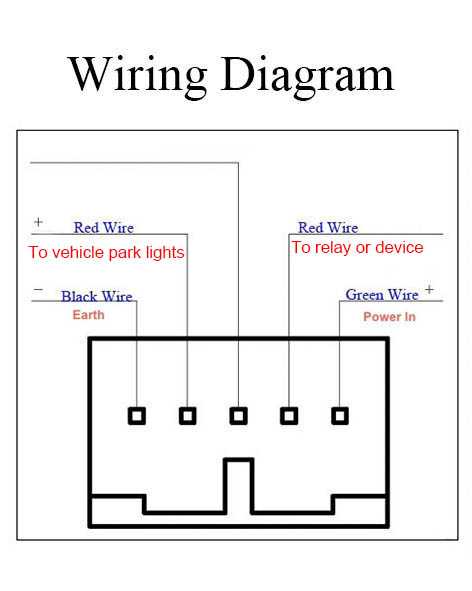
A basic circuit uses one control point between phase supply and the lamp terminal. The toggle interrupts only the live conductor. Neutral bypasses the control device and connects directly to the luminaire holder.
- Incoming phase → common terminal of wall control
- Outgoing conductor → lamp phase terminal
- Neutral → lamp neutral terminal
- Protective earth → luminaire grounding screw
Terminal markings often appear as COM, L, or P on the input side and an arrow or L1 on the outgoing side. Copper conductor cross-section usually equals 1.5 mm² within residential ceilings and wall conduits. Tighten screw terminals with torque around 0.5–0.6 Nm to prevent overheating caused by loose contact.
Two-Point Control Arrangement
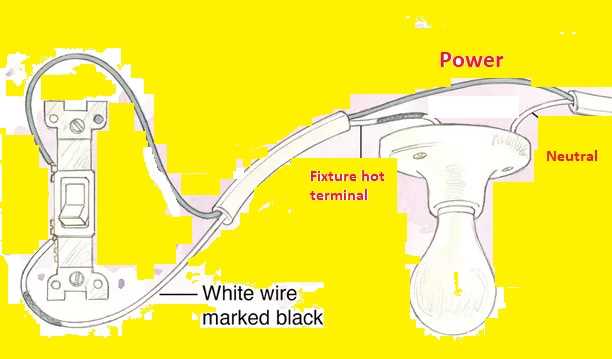
Hallways or staircases frequently require control from two locations. This arrangement uses paired traveler conductors between two wall toggles with changeover contacts.
- Phase supply enters common terminal of first control device.
- Two traveler conductors connect traveler terminals between both devices.
- Common terminal of second device leads toward luminaire phase input.
Traveler conductors often use identical insulation color such as gray or white. Inside junction boxes, label both travelers with sleeve markers; maintenance becomes faster and confusion drops during future repairs.
Three-location control uses an intermediate cross-contact device inserted between two changeover controls. This unit swaps traveler paths depending on rocker position. Inside the box, four terminals appear in pairs; conductors entering on one side exit crossed or parallel depending on rocker state.
Voltage drop rarely appears in short residential runs, yet conductor length above 25 m combined with 1.5 mm² copper may reduce luminaire brightness. In such cases, choose 2.5 mm² phase path or place junction box closer to the luminaire. Temperature rating of insulation should reach at least 70 °C inside ceiling cavities containing recessed luminaires.
How to Read and Interpret Common Symbols and Lines in Light Switch Wiring Diagrams
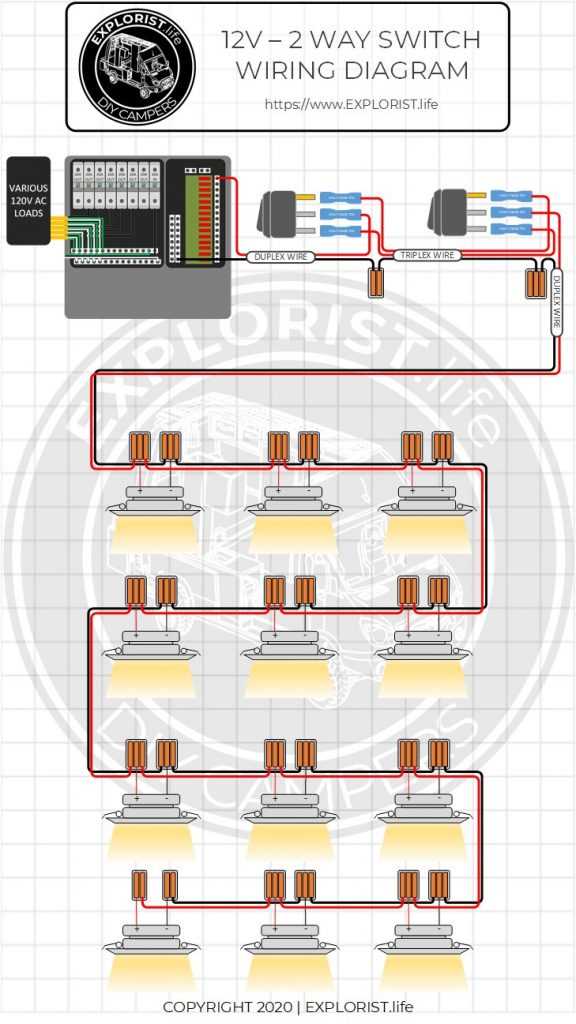
Identify the power source mark first: a solid circle or labeled terminal such as “L” or “Line” usually indicates incoming voltage from the panel. Trace the path leaving that point along straight or angled conductors until it reaches a control key symbol. A break in the path at that symbol shows where current flow can be opened or closed. If the graphic shows two terminals with a movable contact line between them, the contact line position reveals whether the circuit path is open or closed in the illustrated state.
Distinguish conductor types by line style. A single unbroken stroke typically represents a standard conductor carrying phase voltage. Dashed strokes often indicate a traveler path between multi-location control keys. Thicker lines sometimes denote main supply paths, while thinner strokes indicate secondary branches feeding a lamp or another device. Crossing strokes without a dot usually mean no electrical connection; a small filled node at the intersection confirms an actual junction.
Recognize device symbols through shape patterns. A simple break with a pivoted line describes a basic on-off control key. A symbol containing three terminals arranged in a triangular pattern represents a two-way control device used between two locations. Four terminal marks arranged in a rectangle often represent an intermediate control component placed between two two-way units. Lamp loads appear as a circle containing an “X” or filament shape, signaling the end point of the energized path.
Observe directional flow hints added by arrows or terminal labels. Markings such as “COM,” “T1,” or “T2” indicate common and traveler connections. The common terminal normally receives phase input or sends output toward the lamp. Misreading that marking leads to reversed operation where toggling one control key behaves unpredictably. Follow each labeled terminal along its conductor until reaching the next device symbol; this step clarifies how current moves through the circuit.
Check grounding symbols and neutral paths before drawing conclusions. Three descending lines stacked under a vertical stroke denote protective earth. A conductor marked “N” usually returns current toward the distribution panel rather than passing through the control key. In many residential circuits the neutral line runs directly toward the lamp symbol without interruption. Absence of a break along that conductor confirms that only the phase path gets interrupted by the control mechanism.