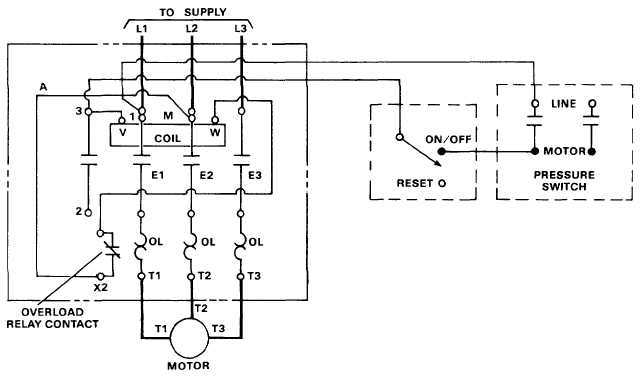
Connect the three supply lines to the contactor input terminals labeled L1, L2, and L3, then route the output terminals T1, T2, T3 through the thermal overload unit before reaching the electric drive. This layout allows the protection device to interrupt current if load temperature or current exceeds the rated limit.
The control section uses a low-current circuit with push buttons and a contactor coil. A normally closed stop switch sits first in the control line, followed by a normally open start switch. Pressing the start button energizes the coil and closes the three main power contacts that feed the rotating machine.
Most industrial installations use a holding contact connected in parallel with the start push button. Once the coil energizes, this auxiliary contact maintains power to the coil after the start button is released. Without this latch connection, the contactor would drop out immediately when the operator releases the button.
Thermal overload protection mounts directly below the contactor. Each supply line passes through a sensing element that reacts to sustained current rise. If the load draws current above the configured level, the overload relay opens the control circuit and disconnects the contactor coil.
Use conductors rated for the drive current and verify terminal torque values specified by the contactor manufacturer. Loose terminals raise resistance and generate heat at the power contacts, which leads to insulation damage and unstable operation of the drive system.
3 Phase Motor Starter Wiring Diagram with Contactor Overload Relay and Control Circuit
Connect the three supply conductors from the distribution panel to the contactor input terminals marked L1, L2, L3. The output terminals T1, T2, T3 route current through the thermal overload relay before reaching the electric drive. This arrangement allows the protection unit to interrupt power if current rises above the relay setting.
The main power path inside a typical industrial control cabinet follows this order:
- three-line supply from the breaker
- input terminals of the contactor
- contactor main contacts
- thermal overload block
- output conductors to the rotating machine
The control section uses a smaller current path that energizes the contactor coil. A normally closed stop pushbutton sits first in the circuit, followed by a normally open start pushbutton. Pressing the start switch sends voltage to the coil and pulls in the contactor armature, closing the three power contacts simultaneously.
Include an auxiliary holding contact connected parallel to the start button. This contact maintains coil voltage after the start switch returns to its open position. If the overload relay trips, its normally closed control contact opens and removes voltage from the coil, which releases the contactor and disconnects the drive unit from the three-line supply.
Power Circuit Connections for Three Phase Motor Starter with Contactor and Overload Relay
Bring the three supply lines from the upstream breaker to the contactor input points marked L1, L2, L3. Use copper conductors with crimped terminals and tighten the screws to the torque value listed on the device label. Loose contacts increase resistance and cause heating at the connection point.
The output side of the contactor uses terminals T1, T2, T3. These conductors pass directly through the thermal overload relay mounted below the switching device. Each line travels through a sensing heater that reacts to sustained current above the configured setting.
Adjust the overload relay according to the rated current printed on the equipment nameplate. A 5.5 kW industrial drive connected to a 400-volt three-line supply usually draws about 11–12 A. Set the dial slightly above that value so normal load variation does not trigger an unnecessary shutdown.
Maintain identical conductor order along the entire power path. The sequence entering the contactor must remain the same at the relay output and at the terminal box of the rotating machine. Interchanging two lines reverses shaft rotation and may damage pumps, fans, or conveyor mechanisms connected to the drive.
Select conductor cross-section according to load current and cable length. Medium industrial installations often use 4 mm² or 6 mm² copper cable. Longer distances require larger cross-section to reduce voltage drop and limit heat buildup under continuous load.
Measure voltage between each pair of incoming supply lines at the contactor input before energizing the system. Balanced readings confirm stable supply conditions. Large deviation between lines indicates a loose terminal or a fault in the upstream distribution network.