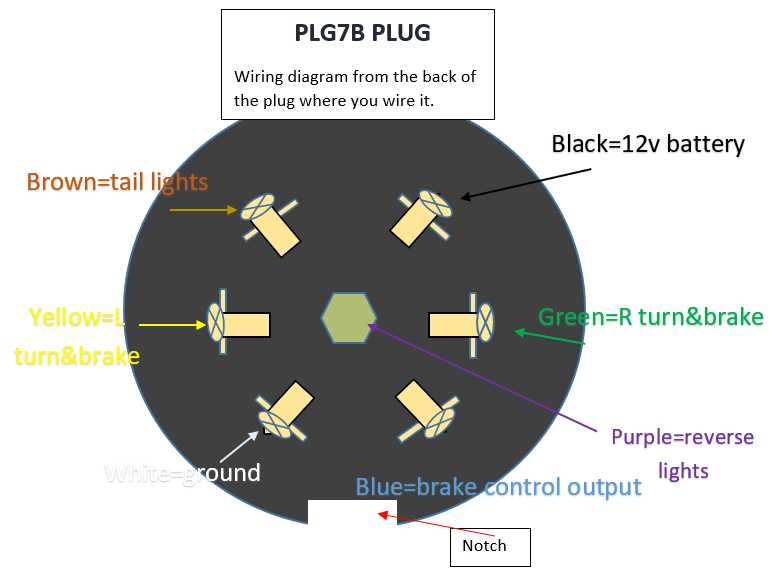
Match each conductor to the correct terminal on the 7-pin towing connector before attaching any leads. Misplacing a single conductor can disable brake lights, reverse lamps, or electric brake control. Standard RV-style 7-pin connectors assign a specific function to every terminal, and each conductor usually follows a recognized color pattern.
The common color assignment used in North American towing setups includes white as ground return, brown for tail lamps, yellow for left turn signal, and green for right turn signal. Additional conductors serve higher-power functions: blue carries the signal from the brake controller, black supplies 12-volt auxiliary power, and purple or sometimes red activates reverse lights.
Terminal layout inside the round 7-pin socket follows a fixed arrangement. The center contact typically handles reverse light activation, while the surrounding six contacts carry lighting signals, ground return, brake controller output, and auxiliary battery power. Checking the pin orientation before connecting conductors prevents crossed signals that may cause lamps to flash incorrectly or electric brakes to fail.
Use a multimeter or test light after installation to confirm each terminal carries the intended signal. Activate left and right turn signals, running lights, brake pedal, and reverse gear while probing the contacts. Voltage should appear only on the corresponding terminal during each function. This verification step helps confirm that lighting circuits, brake control line, and auxiliary power feed operate correctly before towing equipment is connected to the vehicle.
7 Wire Trailer Plug Wiring Diagram with Pin Functions Color Codes and Connections
Check the terminal layout of the seven-pin towing connector before attaching any conductor. Each contact inside the round socket handles a specific electrical task such as lighting signals, brake controller output, or auxiliary battery supply. The typical RV-style connector used in North America places six terminals in a circular ring with one contact in the center.
Standard Terminal Functions
Most vehicle harness systems follow the same electrical assignment pattern.
- White – ground return connected to vehicle chassis
- Brown – running lamps and marker lights
- Yellow – left turn signal and stop lamp
- Green – right turn signal and stop lamp
- Blue – electric brake controller output
- Black – 12-volt auxiliary battery feed
- Purple or red – reverse light activation
The ground conductor should be attached first and connected to a clean metal surface on the tow vehicle frame. Poor grounding often causes dim lamps, intermittent signals, or brake controller faults. Many installers use a ring terminal secured with a corrosion-resistant bolt.
Lighting circuits share the outer ring contacts. Brown supplies tail lamps and side markers, while yellow and green carry directional signals that also activate brake lamps on the corresponding side. These lines normally originate from the vehicle lighting harness or a converter module that combines signals.
Power and Brake Controller Connections
Two conductors handle higher current loads. The blue line transfers braking force commands from the in-cab brake controller to electric brake assemblies on the towed unit. The black conductor carries 12-volt auxiliary power used to charge an onboard battery or supply interior equipment.
Reverse light activation usually connects through the center terminal. When the vehicle transmission shifts into reverse, voltage appears on this contact and activates backup lamps or hydraulic lockout solenoids used on surge brake systems.
Route all conductors through protective loom and secure them along the vehicle frame using insulated clips spaced about 30 to 40 centimeters apart. This prevents abrasion caused by vibration or road debris.
After installation, test each terminal with a multimeter while activating lighting controls, brake pedal, and reverse gear. Voltage should appear only on the intended contact during each function. This verification confirms that every conductor and terminal assignment matches the expected towing connector configuration.
7 Pin Trailer Connector Pinout and Standard Wire Color Functions
Identify each contact in the seven-pin towing connector before attaching any conductor. The round RV-style socket contains six outer contacts and one center terminal. Each point corresponds to a specific electrical task such as lighting signals, brake control, auxiliary power, or ground return.
Typical Pin Layout
The outer ring carries most lighting and power lines while the center point normally handles reverse lamps. Viewed from the front of the vehicle socket, the arrangement usually places the ground return near the bottom position. Lighting and signal contacts occupy the remaining outer locations.
Common color assignments used in North American towing systems follow this pattern: white connects to chassis ground, brown supplies running lamps and side markers, yellow operates the left indicator and brake lamp, and green handles the right indicator and brake lamp. Blue transfers commands from the in-cab brake controller to electric brake assemblies.
Auxiliary Power and Reverse Function
One terminal carries constant 12-volt supply from the vehicle battery. This line often uses a black conductor and feeds onboard equipment such as interior lighting, battery charging circuits, or refrigerator power in larger towed units.
The center contact typically activates reverse lamps. When the vehicle transmission shifts into reverse, voltage appears at this point and energizes backup lights or hydraulic lockout solenoids used in surge brake systems.
Verify each terminal with a multimeter during testing. Activate running lights, turn signals, brake pedal, and reverse gear while probing the connector contacts. Correct voltage at the expected terminal confirms the harness connections match the standard seven-pin towing configuration.