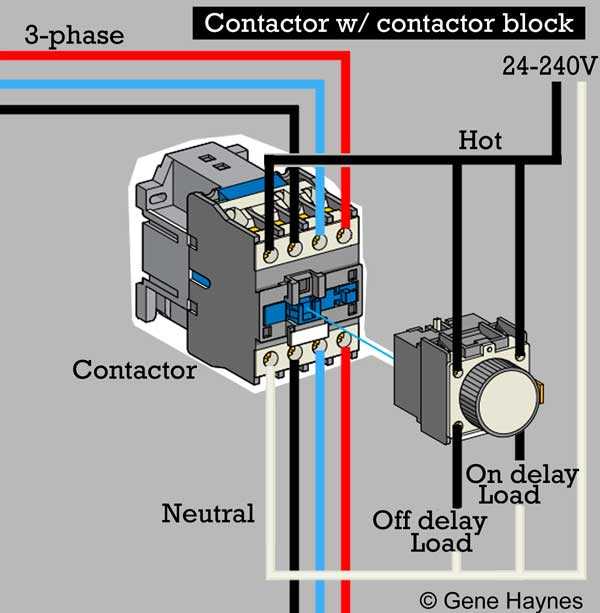
Confirm voltage and current ratings before connecting any terminals. Standard units often require 240 volts with a 30-amp breaker for the main line, while control coils typically operate at 24 or 120 volts. Using incorrect ratings can damage components or trip breakers.
Label all leads and verify color codes: black or red for live connections, white for neutral, and green or bare copper for grounding. Correct identification prevents shorts and ensures reliable operation.
Secure terminals tightly using appropriate screws or connectors. Loose fasteners can cause arcing, overheating, and intermittent switching failures.
Test continuity and polarity with a multimeter before energizing circuits. Checking all paths ensures the coil and load circuits operate correctly and reduces the risk of faults.
Contactor Connection Guide with Terminal Assignments and Safety Instructions
Verify supply voltage before making connections. Main lines usually require 240 volts with a dedicated 30-amp breaker. Control circuits often run at 24 or 120 volts depending on the coil type. Incorrect voltage can damage components and trip protective devices.
Identify all terminals clearly:
- Line terminals for incoming power
- Load terminals for outgoing circuits
- Coil terminals for control signal
- Auxiliary contacts if present
Use properly rated conductors for each terminal. Black or red for hot, white for neutral, and green or bare for ground. Verify that conductor gauge matches the amperage of the circuit to prevent overheating.
Tighten screws and connectors with recommended torque. Loose connections can cause sparking, erratic operation, and damage to contacts over time.
Route leads carefully to avoid strain. Secure conductors with clamps or cable ties to prevent accidental disconnection or insulation wear during operation.
Perform continuity and polarity tests using a multimeter. Ensure coil terminals and load paths are correct before energizing the device. This step prevents misfiring and potential hazards.
Label each conductor and terminal for future maintenance. Clear markings simplify troubleshooting and reduce the chance of errors during replacements or adjustments.
Regularly inspect the assembly after initial operation. Check for loose connections, discoloration at terminals, or unusual heat buildup. Correcting these issues early extends the life of the unit and maintains safe operation.
Identifying Terminals and Their Functions
Check each terminal type before connecting any conductors. Main line terminals carry full load current, while coil terminals handle lower control voltage. Misidentifying these points can cause damage or unsafe operation.
Locate line terminals marked L1 and L2 or similar. These points receive incoming power and must match the source voltage rating. Incorrect placement may overload contacts or trigger protective devices.
Load terminals are typically labeled T1 and T2. These points deliver current to downstream devices such as motors, heaters, or lighting circuits. Ensure connections are secure and the conductor gauge matches the load amperage.
Identify coil terminals marked A1 and A2 or equivalent. These points operate the electromagnetic mechanism that closes or opens the main contacts. Connecting to incorrect voltage can prevent activation or damage the coil.
Auxiliary contacts, often labeled NO (normally open) or NC (normally closed), provide signaling or interlocking functions. Use these for control circuits or feedback without passing the main load through them.
Verify terminal markings against manufacturer specifications. Some units may differ slightly, and confirming the labeling ensures proper operation and reduces the risk of shorts.
After connections, perform a continuity test across all points to confirm correct paths. This step prevents misfiring and ensures both main and auxiliary circuits operate safely under load.