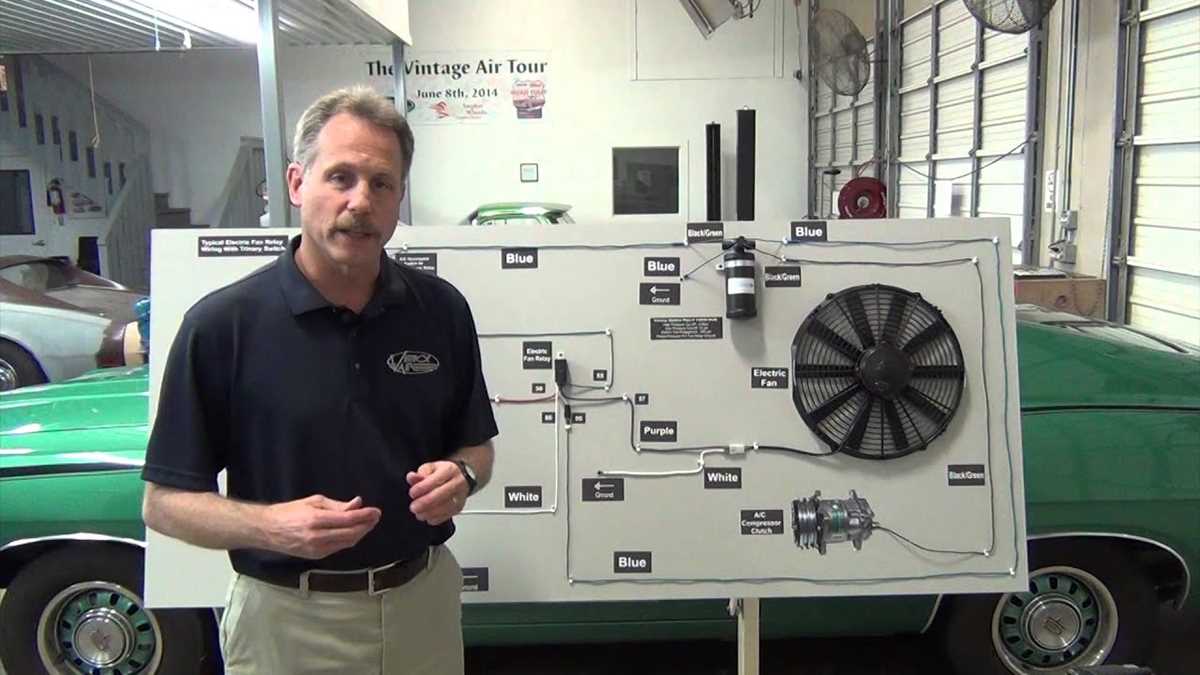
Use a clear circuit map for the climate-control retrofit kit and route each conductor according to load and fuse rating. The compressor clutch line usually carries about 4–5 amps, so a 16 AWG copper lead paired with a 10-amp fuse prevents overheating and nuisance fuse trips. Place the protection block within 20–25 cm of the battery feed so a short circuit cannot travel through the cabin harness.
The control module typically receives a 12-volt ignition-switched supply plus a constant battery line for memory or relay control. Mark these feeds with separate colors; installers often choose red for constant power and pink or yellow for ignition. Route both through a relay rated at 30 amps so the dashboard switch handles only signal current rather than blower load.
Blower motors used in aftermarket climate kits draw 18–22 amps at maximum speed. A 12 AWG conductor between relay and motor reduces voltage drop below 0.3 V across a 3-meter run. Secure the harness along the firewall using insulated clamps spaced every 15–20 cm; loose routing leads to insulation wear and intermittent ground faults.
Ground paths deserve the same attention as power feeds. Attach the negative lead to bare chassis metal with a star washer and a M6 bolt. Resistance between the motor housing and battery negative should measure below 0.2 ohms. Higher readings cause slow fan speed and erratic compressor engagement, problems often mistaken for faulty switches or sensors.
Retro Climate Control Electrical Layout: Practical Guide for Installation and Troubleshooting
Connect the power feed from the battery through a 30–40A fuse placed no farther than 20 cm from the positive terminal; this protects the climate control harness during compressor clutch engagement and blower startup spikes. Route the main red conductor through a relay controlled by the ignition switch so the system shuts down with the key removed. Ground points should attach to bare chassis metal with a star washer; resistance between ground lug and battery negative should remain below 0.2 ohms when measured with a multimeter.
Follow a structured connection plan for the control module and cabin fan circuit:
- Battery feed → fuse holder → relay terminal 30.
- Relay terminal 87 → control module power input.
- Ignition switch output → relay terminal 86.
- Relay terminal 85 → chassis ground.
- Fan speed selector → resistor pack → blower motor positive lead.
- Blower motor negative lead → body ground near the HVAC housing.
Color coding reduces installation mistakes. Many retrofit harnesses use the following scheme: red for constant 12 V supply, yellow for ignition-switched supply, black for ground return, green for compressor clutch trigger, and blue for interior fan control. If colors differ, label each conductor with heat-shrink markers before routing through the firewall grommet. Maintain at least 5 cm separation from exhaust components; high temperature hardens insulation and leads to intermittent faults.
Control Panel and Sensor Connections
The dashboard controller distributes low-current signals to actuators operating blend doors and temperature valves. Typical connector arrangement:
- Pin A – ignition-switched 12 V
- Pin B – chassis ground
- Pin C – evaporator temperature sensor
- Pin D – compressor activation output
- Pin E – interior fan control signal
- Pin F – illumination feed from dash light circuit
If the compressor fails to engage, measure voltage at the clutch connector while the controller calls for cooling. A reading near battery level (12–13.8 V with engine running) confirms signal flow. Zero volts indicates a relay fault, broken conductor, or poor ground. If voltage appears yet the clutch does not click, inspect coil resistance; values between 3 and 5 ohms are typical for many aftermarket units.
Common Fault Isolation
Unstable blower speeds often trace to a damaged resistor pack or overheated connector. Inspect terminals for discoloration or melted plastic. A fan that runs only at maximum speed usually means the resistor assembly has an open circuit. When the cabin fan remains inactive at all settings, check these points sequentially:
- Fuse continuity with multimeter.
- Relay activation click when ignition turns on.
- Voltage present at blower motor positive lead.
- Ground path continuity between motor housing and chassis.
After completing installation, test the system with the engine at idle and again near 2000 RPM. Monitor voltage drop between battery positive and module input; values above 0.5 V suggest thin conductors or weak terminals. Secure harness sections with insulated clamps spaced 25–30 cm apart to prevent vibration damage inside the engine bay.