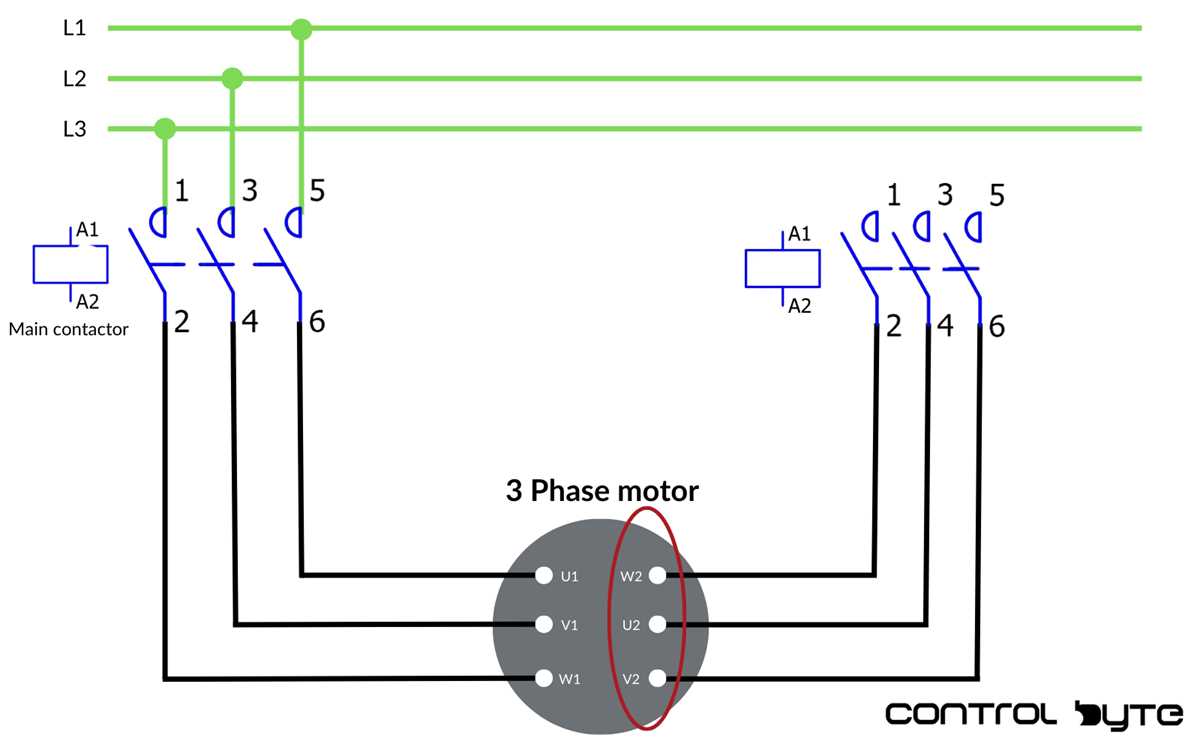
Use a two-pole power relay rated at least 20–30% above the load current and connect the incoming live conductor to the relay input terminal marked L1 while the outgoing conductor to the appliance leaves through terminal T1. Neutral should bypass the switching device and run directly to the load unless a dual-pole relay interrupts both conductors. For a 230 V AC supply with a 2 kW heater, select a unit rated for minimum 16 A to prevent contact overheating.
The control coil usually accepts 220–240 V AC or 24 V control voltage. Attach the coil terminals labeled A1 and A2 to the control circuit: A1 receives live through a push button or thermostat, while A2 connects to neutral or the return line of the control supply. This arrangement allows a low-current signal device to activate a higher-current load such as compressors, pumps, or heating elements.
Correct conductor sizing prevents voltage drop and heat buildup. Copper cable with 1.5 mm² cross-section suits loads up to about 10 A, while 2.5 mm² suits circuits near 16 A. Tighten terminal screws to manufacturer torque values, commonly 1.2–1.8 Nm, and place the relay inside a DIN-rail enclosure with at least 10 mm ventilation clearance around the housing.
Protection should include a miniature circuit breaker matched to conductor capacity and a control fuse rated 0.5–1 A ahead of the coil circuit. Label terminals clearly and verify continuity with a multimeter before energizing. This structured connection layout allows a control signal to operate household AC loads with stable switching and minimal contact wear.
Coil, Power Contacts and Control Circuit Connection Layout
Connect the incoming live conductor to terminal L1 of the electromagnetic switching unit and route the outgoing line from T1 directly to the load. Neutral normally runs straight to the device being powered, bypassing the switching mechanism unless a double-break model interrupts both conductors. For equipment drawing around 10–12 A at 230 V, choose a relay assembly rated for at least 16–20 A to maintain stable contact temperature and avoid surface pitting.
Coil Supply and Activation Path
Apply the control voltage across terminals A1 and A2. Terminal A1 receives the live conductor through a command device such as a push button, float switch, thermostat, or timer module, while A2 connects to the neutral return of the control supply. A coil marked 230 V AC can be linked directly to the main supply through the control switch, while a 24 V coil must receive power from a step-down transformer or regulated control source.
Main Contact Power Path
The high-current path passes through the relay’s main contact pair. When the coil energizes, the internal armature closes the link between L1 and T1, allowing current to flow to motors, heating elements, compressors, or lighting banks. Contact blocks in common industrial models withstand 5–10 million mechanical operations and support resistive loads up to 25 A, though inductive equipment such as compressors may require derating to about 60–70% of the printed rating.
Install a miniature circuit breaker ahead of the line input and a 0.5–1 A fuse in the coil control path to limit fault current. Use copper conductors sized 1.5 mm² for loads up to 10 A or 2.5 mm² for circuits near 16 A, and tighten terminal screws to roughly 1.4 Nm unless the manufacturer specifies another value. Confirm continuity between L1–T1 only after coil energizing during testing with a multimeter set to resistance or audible continuity mode.
Identifying Coil Terminals and Main Power Contacts on a Single Phase Contactor
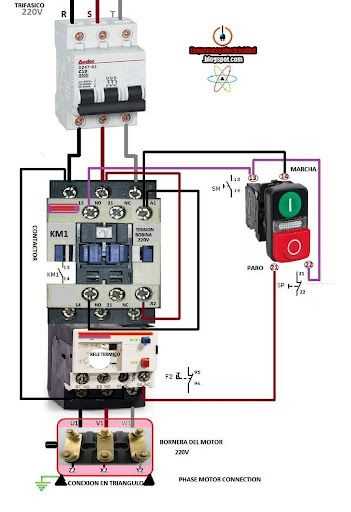
Locate the coil terminals first by finding the markings A1 and A2 on the front or side of the electromagnetic switch body. These points energize the internal magnetic core that moves the armature. A multimeter set to resistance typically shows 150–1500 Ω between A1 and A2 depending on coil voltage rating. Labels near the coil often include 24 V, 110 V, or 230 V AC; applying incorrect voltage can overheat the coil winding within seconds.
Main current paths appear as larger screw terminals marked L1 and T1 on compact devices, or L1/L2 and T1/T2 on models that interrupt both conductors. These terminals handle the load current feeding motors, heaters, or compressors. Their metal pads are noticeably wider than control terminals and often accept conductors up to 4 mm². Manufacturers stamp current limits such as 16 A, 20 A, or 25 A directly beside these connections.
Verify identification by pressing the movable armature manually while measuring continuity between the power terminals. With the armature released, the meter should show an open circuit between L and T. Pressing the mechanism closes the contact pair and resistance drops near 0–0.2 Ω. This quick test confirms which terminals carry load current and separates them from the coil connections before linking the supply conductors.