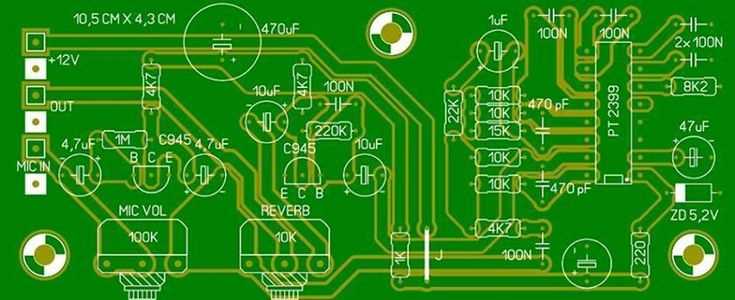
Use a proven layout built around the well-known Princeton karaoke delay IC and a stable RC timing network: a 10–50 kΩ variable resistor connected to the timing pin together with a 47–100 nF capacitor provides adjustable repeat length from roughly 30 ms up to about 340 ms. Keep the timing components close to the chip pins and route them away from the audio input trace; this reduces background hiss and prevents modulation artifacts during long repeats.
The analog input stage performs best with a coupling capacitor between 100 nF and 220 nF followed by a resistor divider that biases the signal near half of the supply voltage. Most builders choose a 5 V regulated rail using a linear regulator such as 7805 or a low-dropout alternative. Decoupling must include at least 100 nF ceramic placed directly between VCC and ground plus an additional 47–220 µF electrolytic nearby. Without these parts the delay processor may introduce clock noise or unstable repeats.
The feedback path controls the number of repeats. A 10 kΩ–100 kΩ potentiometer placed between the delayed output and the mixing node adjusts regeneration depth. Values above roughly 70 kΩ push the system close to self-oscillation, which can be useful for experimental sound design. Adding a small capacitor between 1 nF and 4.7 nF inside the feedback path softens high-frequency buildup during multiple repeats.
Output mixing works well through a simple summing stage: combine the dry signal and the delayed signal using two resistors around 4.7 kΩ–10 kΩ feeding either an operational amplifier mixer or a passive node followed by a buffer. Keep output traces short and separate them from the internal clock lines of the chip; the internal converter operates near several hundred kilohertz and careless routing may leak whine into the audio path.
2399 Audio Delay IC: Practical Design and Wiring Guide
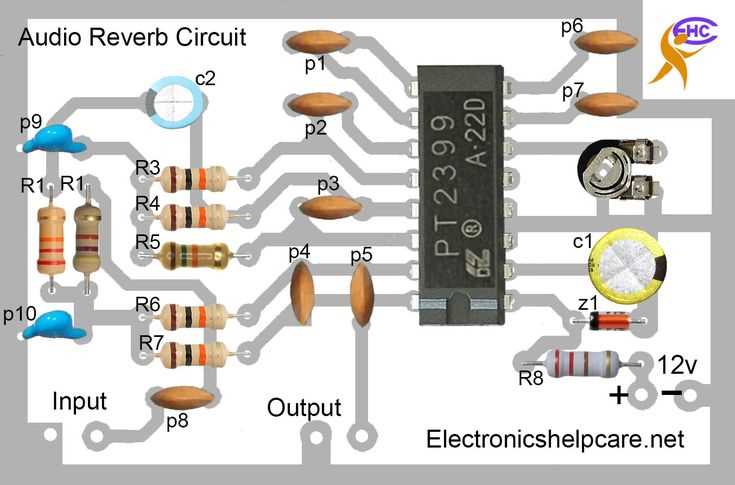
Use a regulated 5 V supply with low ripple (≤10 mV) and place a 100 nF ceramic capacitor directly between VCC and GND pins of the 2399 audio delay IC; add a 47 µF electrolytic within 2–3 cm of the chip to suppress modulation noise. Connect the input through a 10 kΩ resistor and a 100 nF coupling capacitor to block DC offset. Output should pass through another capacitor (220 nF–1 µF) followed by a 10 kΩ–50 kΩ mixing potentiometer that blends dry and delayed signal. Keep signal traces under 5 cm on prototype boards to reduce hiss and clock leakage.
Recommended Component Layout
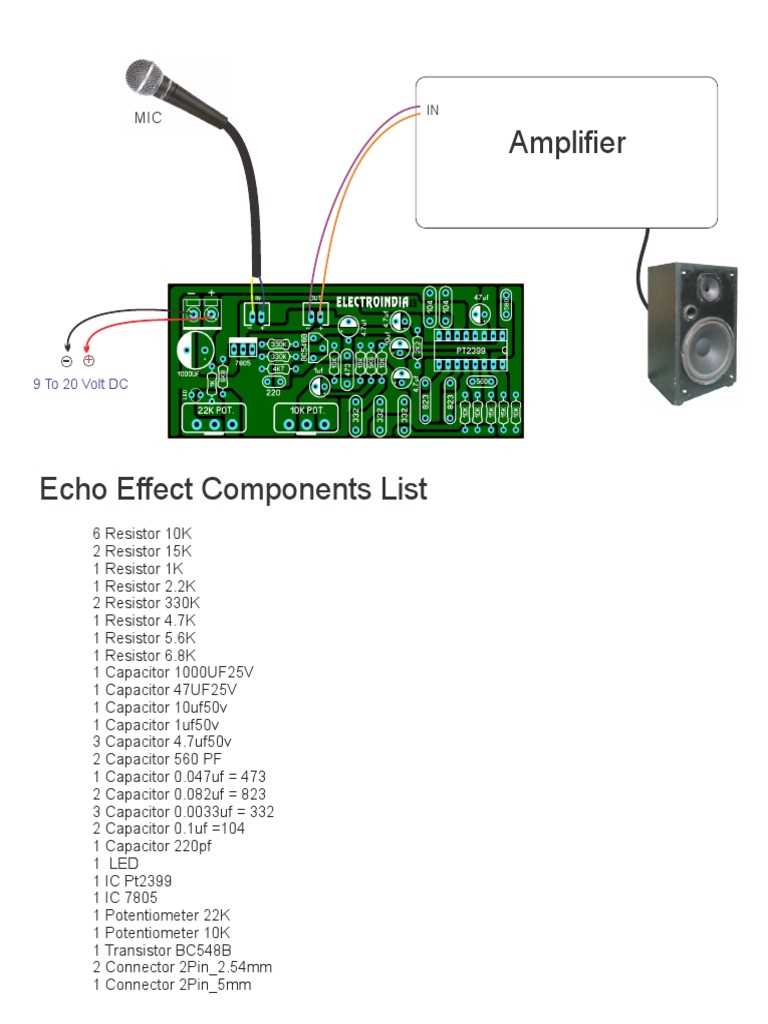
Stable operation depends on a compact arrangement and correct passive values around the delay IC.
- Timing resistor: 2 kΩ–50 kΩ between pin 6 and ground controls delay length.
- Filtering network: 10 kΩ + 47 nF low-pass stage at the output to smooth digital artifacts.
- Input impedance target: 20 kΩ–50 kΩ for guitars and dynamic microphones.
- Feedback loop: 22 kΩ–100 kΩ potentiometer returning processed signal back to the input node through a 10 kΩ resistor.
- Anti-oscillation capacitor: 47 pF–100 pF across the feedback resistor if self-oscillation appears.
Practical Wiring Steps
Short ground paths prevent clock whine. Route ground from the power connector to a single star point, then branch to the IC, input stage, and output stage separately.
- Mount the 16-pin DIP socket and connect pin 1 directly to ground.
- Attach VCC (pin 16) to a regulated 5 V line through a ferrite bead or 10 Ω resistor.
- Wire the audio input through the coupling capacitor and resistor network to the internal ADC input pin.
- Connect the delay-time potentiometer to the timing control pin using shielded wire if the control is panel-mounted.
- Feed the processed signal through the mixing potentiometer before the final output jack.
Noise level depends heavily on filtering stages. A dual RC filter after the digital-to-analog output–two cascaded sections such as 10 kΩ + 22 nF–drops high-frequency switching remnants by roughly 18–24 dB above 7 kHz. Builders seeking longer delay times often increase the timing resistance above 50 kΩ, though background noise rises sharply beyond ~340 ms. Mounting the IC away from transformers, using shielded cable for input lines, and grounding metal enclosures typically reduces hum by 10–15 dB in compact audio projects.
Pin-by-Pin Delay Processor Wiring with Power, Time Control, and Regeneration Paths
Connect the supply rail directly to pin 1 with a stable 5 V source and place a 100 nF ceramic capacitor within 10 mm of the package lead to suppress switching noise from the internal sampling stages. Add a 47–100 µF electrolytic capacitor between the same rail and ground to stabilize low-frequency load variation. Ground reference is pin 3; route it to the main ground plane using a short, low-impedance trace to avoid modulation artifacts caused by current spikes inside the internal ADC and DAC blocks.
Audio input enters through pin 16. Insert a coupling capacitor between 100 nF and 1 µF before this pin, followed by a resistor around 10 kΩ forming a simple high-pass filter that blocks DC from earlier amplification stages. A bias network tied to half the supply voltage (about 2.5 V) stabilizes the internal analog path; many builders use two equal resistors such as 47 kΩ from Vcc to ground with the midpoint feeding the input bias node.
Delay Time Adjustment Network
Time length depends on the resistance connected to pin 6. Typical values range from 2 kΩ to 50 kΩ. Shorter resistance produces compact reflections around 30–60 ms, while values near 50 kΩ push the storage buffer toward roughly 400–450 ms. A linear potentiometer of 50 kΩ wired between pin 6 and ground allows continuous adjustment. Keep the wiring short; stray capacitance near this pin alters the internal clock frequency and introduces grainy artifacts.
Pins 5 and 7 operate with the internal oscillator network that determines sampling frequency. Attach a 10 nF capacitor from pin 5 to ground and another 10 nF from pin 7 to ground. These capacitors filter clock ripple produced by the internal VCO stage. Poor filtering here increases background hiss and creates unstable modulation during long delay settings.
Regeneration (Feedback) Routing
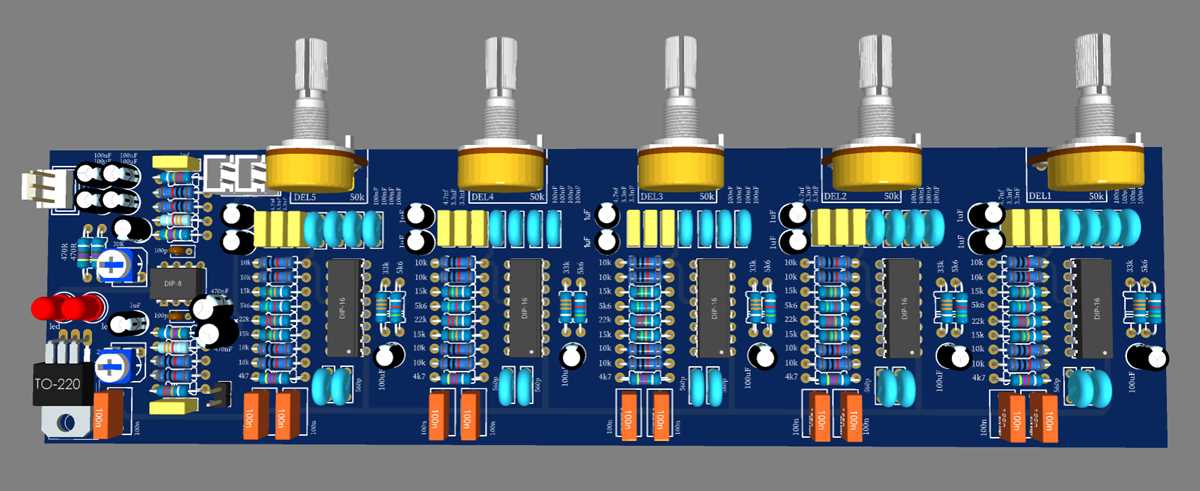
The returning signal used for repeated reflections leaves the chip through pin 14 and can be routed back toward the input stage through a resistor or potentiometer. A typical configuration places a 50 kΩ variable resistor between pin 14 and the summing node before the input coupling capacitor. Adjusting this resistor controls how many repeats occur before the signal decays. Keep the gain below unity; excessive return level leads to runaway oscillation.
Main output is available on pin 15. Pass it through a coupling capacitor around 1 µF and follow with a resistor of 10 kΩ feeding the next amplification stage or mixing node. Some layouts include a simple low-pass filter using a 2.2 kΩ resistor and 4.7 nF capacitor after the output to reduce quantization noise from the internal digital storage.
Pins 2, 4, 8, and 12 serve internal filtering and reference roles. Each should be connected to ground through capacitors between 100 nF and 1 µF depending on the design preference. These capacitors stabilize internal bias nodes and suppress clock leakage into the audio path. Place them close to the package to minimize trace inductance.
Keep analog traces short and isolate the delay processor from high-current sections such as power amplifiers or switching regulators. Use a star-ground layout where the chip ground returns directly to the power supply node rather than sharing long paths with output drivers. This layout practice reduces background noise and keeps repeated reflections clean even at long delay settings.