Use a single 3.7V lithium-ion cell, a TP4056 charging module with protection, and a 5V boost converter if you plan to assemble a portable USB energy source. This configuration supports stable output for phones, wireless earbuds, and small electronics while keeping the component count low. A typical cell capacity ranges from 2000 mAh to 3500 mAh, which can deliver one full smartphone refill or several partial ones.
The internal layout normally includes three functional sections: a Li-ion cell refill stage, a battery protection board, and a DC-DC step-up module. The refill stage regulates input from a 5V USB source and limits current, usually between 0.5A and 1A. Protection electronics disconnect the cell during overcharge above about 4.28V, deep discharge near 2.4–2.7V, or short-current events. This prevents overheating and cell damage.
The voltage from a lithium-ion cell varies between roughly 4.2V when full and 3.0V near empty. USB devices require about 5V, so a boost converter raises the cell voltage to the proper level. Many compact modules can deliver 1A to 2A output current, which suits most handheld electronics. Correct wiring between the cell, the protection board, and the DC-DC module determines whether the portable energy pack operates safely and maintains stable USB output.
Careful component selection improves reliability. Use 18650 lithium-ion cells from reputable manufacturers, choose modules with thermal protection, and keep wiring short to reduce voltage drop. A small slide switch on the output line helps disconnect the load during storage, while indicator LEDs from the TP4056 board show refill status and completion.
Power Bank Charger Circuit Diagram With Battery Charging and Protection Layout
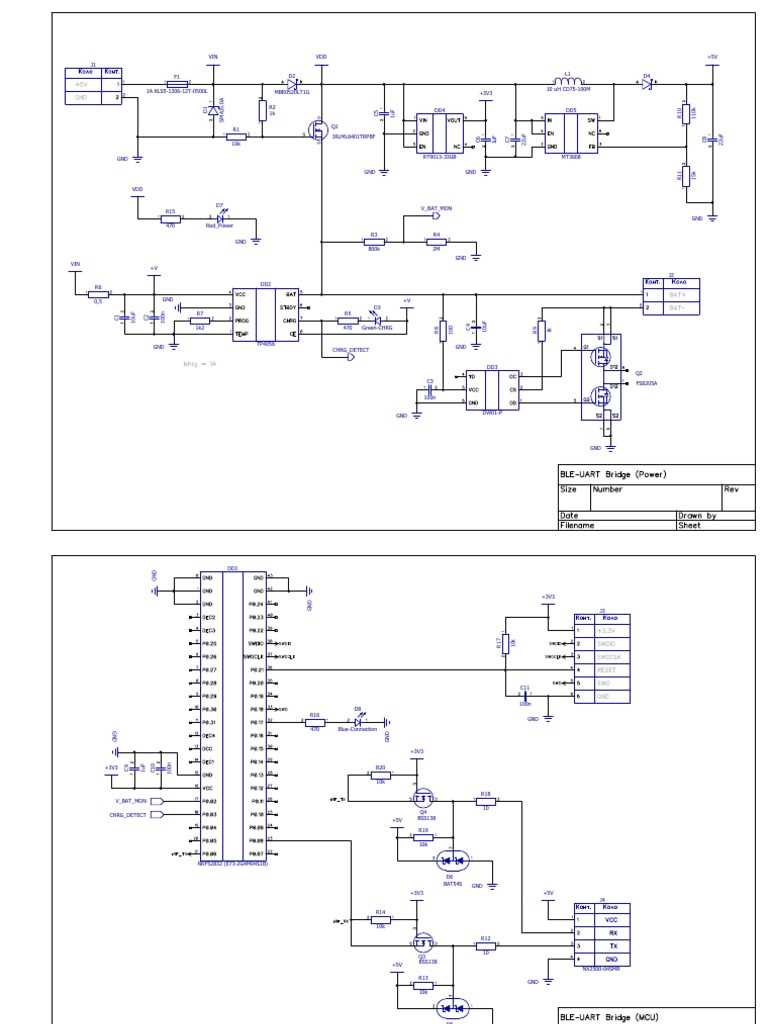
Connect a 3.7V lithium-ion cell, a TP4056 refill module with protection board, and a 5V step-up converter as the base layout for a portable USB energy source. The refill module accepts a 5V input through Micro-USB or USB-C and controls current through a programming resistor. A common configuration uses a 1.2 kΩ resistor, which sets the current close to 1 A. This level suits most 18650 cells rated between 2200 and 3500 mAh.
The lithium cell connects directly to the protection board pads marked B+ and B-. The board monitors voltage and load current through dual MOSFETs and a protection controller such as the DW01A. Charging stops near 4.20–4.25 V, while deep discharge cutoff usually occurs around 2.5 V. If load current exceeds about 3–5 A, the board disconnects the output path within milliseconds.
Charging Stage Layout
The refill module links to the protection board through pads labeled OUT+ and OUT-. Input voltage should remain close to 5 V ±0.25 V. Higher levels raise temperature in the linear charging IC. Place a 1 µF ceramic capacitor near the input pins and a 10 µF capacitor across the cell terminals to reduce voltage ripple and stabilize operation during current transitions.
Status LEDs on the TP4056 module indicate activity. A red indicator shows active cell refill, while a blue or green LED signals completion once current drops below roughly 100 mA. Thermal regulation inside the chip reduces current if board temperature exceeds about 115 °C, preventing damage during prolonged USB input.
Output Voltage Conversion Stage
The step-up module connects to the protection board output pads and raises the cell voltage from 3.0–4.2 V to a stable 5 V USB level. Popular converter ICs such as MT3608 or XL6009 switch at frequencies above 1 MHz, allowing small inductors between 4.7 µH and 22 µH. Output current typically reaches 1–2 A, suitable for phones, Bluetooth devices, and compact gadgets.
Keep wiring between the lithium cell, protection board, and step-up module under 5–7 cm. Thick conductors or short copper traces reduce voltage drop during high load. Add a USB-A female connector to the converter output and include a slide switch in the positive line so the energy source remains disconnected during storage.
Single Cell Li Ion Charging Circuit for Power Bank With TP4056 and Protection Module
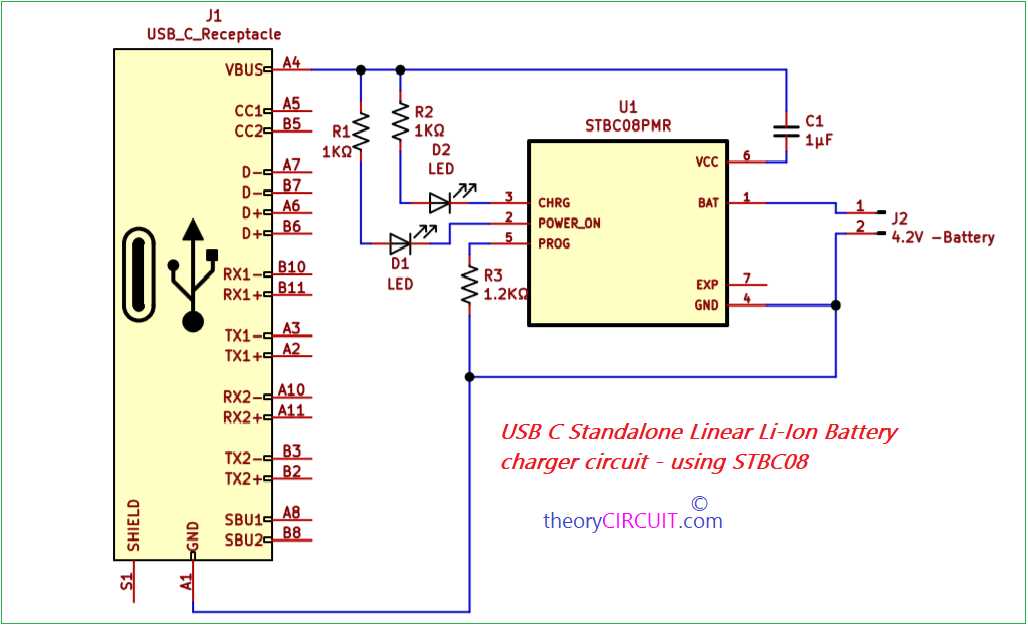
Use a TP4056 module with integrated protection board for charging a single 3.7V lithium-ion cell from a 5V USB input. The module controls the refill process using a constant-current and constant-voltage method. Charging stops automatically at about 4.2V. Current level depends on the resistor connected to the PROG pin; a 1.2 kΩ resistor sets the current close to 1A, which suits most 18650 cells with capacity between 2200–3500 mAh. Input voltage should remain near 5V to prevent overheating of the linear control chip.
Typical Connection Layout
- IN+ / IN- – connect to a 5V USB source
- B+ / B- – connect directly to the lithium-ion cell terminals
- OUT+ / OUT- – connect to the load or to a boost converter module
- Status LEDs indicate activity: red during refill, blue or green after completion
- A protection controller such as DW01A with dual MOSFETs disconnects the cell during abnormal conditions
The protection board prevents several failure modes and extends cell lifespan. Typical parameters include:
- Overcharge cutoff around 4.25V
- Deep discharge cutoff near 2.4–2.7V
- Overcurrent shutdown often between 3A and 5A
- Short-load shutdown within a few milliseconds
Place a 10 µF capacitor close to the cell terminals and keep wiring short to reduce voltage drop. Mount the module where airflow is available; the TP4056 limits current if chip temperature approaches roughly 115°C. A standard 18650 cell usually reaches full capacity in about 3–4 hours with a 1A refill current.